Emirates has signaled one of its boldest North American expansions in years, filing for slots at Calgary and Vancouver in the summer 2027 coordination report assembled by Airports Coordination Limited (ACL), the body that allocates scarce airport capacity. The disclosure lifts the lid on a Canadian strategy that would put the Dubai-based giant directly into the heart of Western Canada, a region it has long served only indirectly, and it arrives while a fierce competition for traffic rights with Abu Dhabi-based Etihad Airways is quietly shaping what the airline can actually fly. Nothing is confirmed, no tickets are on sale, and no schedule exists beyond the paperwork, yet the filing tells a specific story: four weekly flights from Dubai to each city, drawn from a shared pool of Canadian traffic rights, timed for summer 2027 and sized around the Airbus A350-900 rather than the double-decker that made the brand famous. The map of Emirates’ North American network could look materially different within two years, and Calgary in particular would mark a genuinely new civil aviation link between the Middle East and oil-rich Alberta.
Emirates’ ACL Summer 2027 Filing Puts Calgary and Vancouver on the Table
The summer 2027 coordination report is an unlikely place to break airline news, but it is where capacity constraints and commercial ambition collide in public. Carriers submit their desired schedules to the coordinator so that airport capacity can be rationed before the season opens, and those submissions become visible long before marketing departments compose a single launch announcement. Emirates’ entry for Calgary and Vancouver shows a planned frequency of four weekly flights from Dubai to each destination, a measured commitment rather than a dramatic daily service. Filing for slots is not the same as operating them, and veteran airline watchers treat these documents as evidence of intent rather than a timetable, because carriers routinely apply for capacity they later abandon, swap markets to disguise strategic thinking, or hold options that never become routes. Even so, a Gulf carrier with Emirates’ scale does not casually submit long-haul slot requests at two Canadian airports in the same season, and the pairing suggests a deliberate, coordinated plan to open Western Canada rather than a speculative placeholder.
Traffic Rights and the Etihad Squeeze Reshaping Western Canada Flights
The arithmetic behind these routes is governed by a bilateral constraint that puts Emirates and Etihad in an unusual position of interdependence. Both UAE carriers hold seven weekly traffic rights to Western Canada, and unused frequencies allocated to one airline can be taken up by the other. Etihad currently uses four of its entitlements on its new Abu Dhabi to Calgary service, which leaves Emirates room to operate up to ten weekly flights into the region. Emirates’ four-weekly plan for Calgary and Vancouver sits within that headroom only because of Etihad’s unused capacity, and the calculation changes the moment Etihad grows its Calgary operation to daily, a step the same ACL report shows the Abu Dhabi airline has already requested slots to achieve. If that daily increase materializes, Emirates would lose the room to run four flights to both cities and would have to cut one route back to three times weekly, an awkward compromise that would erode the economics of a destination more than eleven thousand kilometers from Dubai. The two airlines are therefore not merely competing for passengers; they are competing for the same regulatory space, and every Etihad expansion into Western Canada directly limits what Emirates can do there.
The 312-Seat A350-900: Emirates’ Likely Aircraft for Calgary and Vancouver
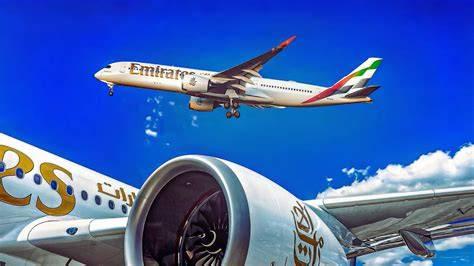
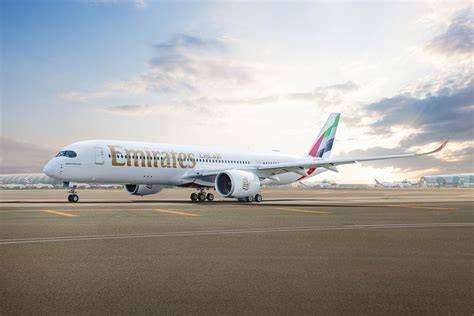
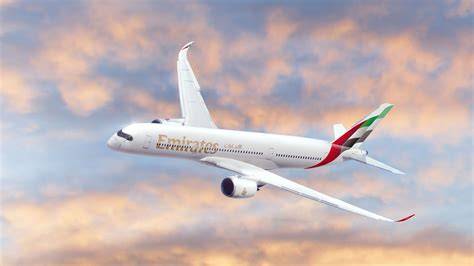
Aircraft planning is where the slot data becomes revealing, because dividing the number of seats by the number of movements points to a specific cabin layout. Emirates holds two A350-900 configurations, and the math suggests the larger 312-seat version is the most likely equipment for these Canadian services. That aircraft carries 32 business class seats in a 1-2-1 arrangement, 21 premium economy seats in 2-3-2 with a 40-inch pitch, and 259 economy seats in 3-3-3 with a 32-inch pitch. It is a higher-capacity, lower-premium proposition than the alternative, and the distinction matters because Emirates’ first North American A350 markets have used the smaller, richer configuration. Flights to Montreal began in January 2026 with the 298-seat layout, and the first US market, Orlando, has just seen the type debut in the same capacity-conscious arrangement. Whether Calgary and Vancouver will follow that premium-heavy pattern is genuinely uncertain, because the airline owns far fewer of the 298-seat aircraft, making it harder to spare one for two long, thin Canadian routes. On a great circle basis, Dubai to Vancouver runs 6,349 nautical miles or roughly 11,758 kilometers each way, though real-world operations stretch that figure with closed airspace, cheaper routing preferences, weather diversions and the politically sensitive corridors that Emirates often depends on.
Why Vancouver Is the Obvious Addition to Emirates’ Network
Vancouver is the softer of the two bets because the city pair already has a track record. Air Canada operated the Dubai route between October 2023 and March 2025 on behalf of Emirates, offering four weekly departures with the 298-seat Boeing 787-9, and it flew the market in both directions. In the final month, AC78 most often departed British Columbia at 9:50 PM and reached the Middle East at 12:30 AM two days later, while AC79 typically left Dubai at 2:05 AM and returned to Western Canada at 7:40 AM the same day. That pattern was engineered around connectivity through Dubai, and it worked: booking data indicates that roughly three-quarters of Air Canada’s Vancouver to Dubai passengers transited in the UAE, whether they began or ended their journey in British Columbia’s most populous city or connected in both Vancouver and Dubai. That data explains why Emirates would lean heavily on its partnership with Air Canada, feeding connecting passengers from across North America through its Dubai hub rather than relying on point-to-point demand from Canadian travelers alone. The unusual arrival time shortly after midnight, matched only loosely by Emirates’ Miami service landing at 11:10 PM, reflects a market that is fed by connections rather than built around a natural arrival bank.
Calgary Could Go From Zero to Two Middle East Operators in a Year
Calgary is the more speculative and more dramatic story. Routes of this length can take years to mature from concept to runway, and it is unknown how long Emirates has been quietly evaluating Dubai to Calgary, or whether the airline accelerated its thinking after Etihad announced its own Abu Dhabi service to oil-rich Alberta in March. Going from no Middle East operators to two within roughly a year would be a remarkable outcome for a city that has waited a long time for direct Gulf access. Emirates would not be the first carrier to disclose interest in Dubai flights from Calgary: in 2022, amid the pandemic’s disruption, WestJet, whose main hub sits in Calgary, secured slots at the Middle East’s busiest airport for a March 2023 launch, and nothing came of it. Emirates is a different proposition, with a vast network behind Dubai, but timing and external conditions matter more than any network map. The ongoing war involving Iran and the price of fuel both weigh directly on whether these long-haul plans survive contact with reality, and both could shift the economics of a route filed today for a season that has not yet opened. For now, Calgary and Vancouver remain exactly what the ACL documents show: serious, specific intentions that have cleared the first administrative hurdle, waiting to see whether the traffic rights, the aircraft and the world’s volatile operating environment allow them to become Emirates’ newest North American gateways.