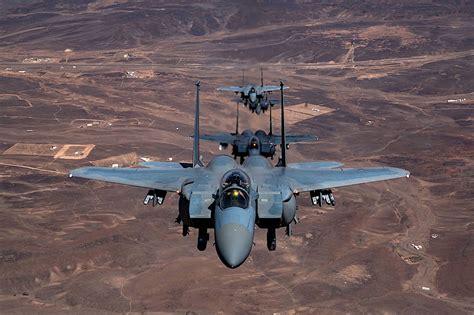
The question of how many F-15 aircraft the United States Air Force operates is deceptively complex. It is not a matter of counting tails on a flight line or reading a single inventory table. It requires understanding how the Air Force defines readiness, how it reports force structure, and how legacy and modernized variants coexist inside a fleet designed for both daily operations and wartime surge. When examined properly, the F-15 inventory offers a clear window into how the USAF balances capacity, capability, and risk in an era of great-power competition.
We address this question using the most current publicly available data from the USAF Annual Report on Tactical Fighter Aircraft Force Structure (October 2025) and place those numbers into operational, historical, and strategic context. Our objective is not simply to provide a number, but to explain what that number actually means for American airpower.
At the start of Fiscal Year 2026, the United States Air Force continues to operate three distinct F-15 variants: the legacy F-15C/D Eagle, the multirole F-15E Strike Eagle, and the newest F-15EX Eagle II. Each plays a different role, is counted differently, and is positioned at a different point in its service life. Understanding their combined total requires understanding how the Air Force measures combat power rather than peacetime availability.

Understanding How the USAF Counts Its F-15 Fleet
The most common source of confusion surrounding the F-15 inventory stems from the difference between Primary Mission Aircraft Inventory (PMAI) and Combat-Coded Total Aircraft Inventory (CCTAI). PMAI represents aircraft that are fully mission-ready on a day-to-day basis, staffed with aircrews, maintainers, and assigned to operational units. CCTAI, by contrast, includes all combat-coded aircraft, including backups, attrition reserves, and aircraft temporarily unavailable due to maintenance or training cycles.
This distinction is not academic. PMAI answers the question of what the Air Force can fly today. CCTAI answers the question of what the Air Force can generate when it matters most. Historically, public reporting focused almost exclusively on PMAI, unintentionally understating wartime capacity. The USAF’s shift to emphasizing CCTAI reflects a recognition that modern conflict demands surge depth, not just peacetime efficiency.
For the F-15 fleet, this distinction is particularly important because older airframes often remain combat-coded even when they are not part of daily sortie generation. In a crisis, these aircraft provide critical mass.
How Many F-15s the USAF Operates in FY26
Entering Fiscal Year 2026, the United States Air Force operates 202 combat-coded F-15 aircraft across all variants when measured by CCTAI. Of these, 164 aircraft are available as PMAI for routine operations.
Broken down by variant, the FY26 inventory consists of 42 F-15C/Ds, 133 F-15Es, and 27 F-15EXs in CCTAI terms. When adjusted to PMAI, those figures become 32 F-15C/Ds, 105 F-15Es, and 27 F-15EXs. The difference reflects how legacy airframes are managed for attrition and surge while newer aircraft are fully missionized upon delivery.
What matters operationally is that the Air Force maintains a larger pool of F-15s than casual observers often assume, particularly in scenarios requiring rapid force expansion. This reality is central to homeland defense, crisis response, and deterrence signaling.
The F-15C/D Eagle: Legacy Air Superiority in a Sunset Role
The F-15C/D Eagle once defined American air superiority. Designed purely to dominate the air-to-air fight, it delivered extraordinary performance through raw thrust, radar power, and pilot-centric design. By FY26, however, its role has narrowed significantly.
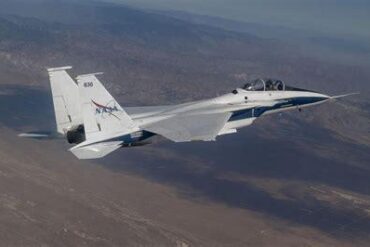
The Air Force retains 42 combat-coded F-15C/Ds, primarily within Air National Guard units assigned to Airspace Control Authority (ACA) missions. These aircraft remain responsible for alert duty, intercepting unidentified aircraft, and defending U.S. airspace. While no longer intended for high-end expeditionary combat, they provide a cost-effective and reliable solution for domestic defense.
In PMAI terms, only 32 F-15C/Ds remain available for routine operations. The remaining airframes serve as backup or attrition assets. Their continued operation reflects a calculated tradeoff: retaining proven capability for homeland defense while freeing resources for modernization elsewhere. The final retirement of the F-15C/D fleet is imminent, but until then, it remains a quiet pillar of national air sovereignty.
The F-15E Strike Eagle: The Long-Range Workhorse
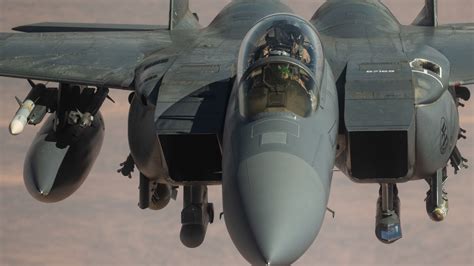
The F-15E Strike Eagle represents one of the most successful multirole adaptations in modern military aviation. By adding terrain-following radar, conformal fuel tanks, and a two-crew cockpit to the Eagle airframe, the Air Force created a platform capable of deep strike, close air support, and air interdiction without sacrificing survivability.
In FY26, the USAF operates 133 F-15Es under CCTAI, with 105 available as PMAI. These aircraft form the backbone of long-range strike capacity outside the stealth fleet. Importantly, the Air Force has begun selectively divesting older F-15Es powered by Pratt & Whitney F100-PW-220 engines, while retaining later-production aircraft equipped with the more powerful and reliable F100-PW-229.
This selective retention strategy reduces sustainment burden while preserving combat effectiveness. The Strike Eagle remains indispensable in scenarios requiring heavy payloads, long endurance, and high sortie rates—characteristics that stealth aircraft, by design, cannot always match.
The F-15EX Eagle II: Modern Mass for a New Era
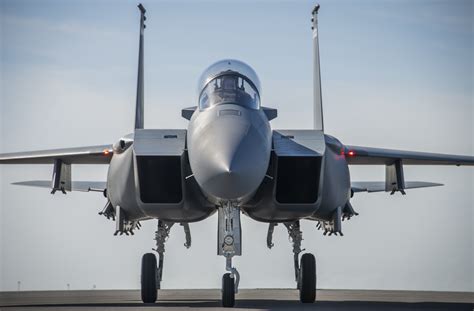
The F-15EX Eagle II is not a legacy holdover. It is a new-build combat aircraft designed to operate alongside fifth-generation fighters while solving problems they cannot. Built around an open-architecture digital backbone, the EX integrates advanced electronic warfare, modern sensors, and unmatched payload capacity.
As of FY26, the Air Force operates 27 F-15EX aircraft, all counted as both CCTAI and PMAI. Unlike older variants, every EX delivered enters service fully mission-capable. Current planning funds 129 total aircraft, with 126 expected by 2030, assuming stable budgets and production rates.
The strategic value of the F-15EX lies in magazine depth. It can carry more air-to-air missiles, larger standoff weapons, and power-hungry systems that stealth aircraft cannot accommodate. In contested but non-penetrating roles, it acts as a force multiplier, extending the reach and lethality of the entire fighter force.
Why Reported Numbers Often Seem to Conflict
Public discussions about the F-15 fleet frequently cite numbers that appear contradictory. This confusion arises from inconsistent use of PMAI versus CCTAI, differences between budget documents and operational reports, and the lag between aircraft retirement decisions and physical drawdown.
The Air Force’s move toward CCTAI reporting reflects an institutional shift toward wartime realism. In a prolonged conflict, aircraft not flown daily still matter. Attrition reserves, backup airframes, and surge capacity are integral to sustaining operations beyond the opening weeks of combat.
Understanding this reporting framework reveals that the F-15 fleet, while smaller than its Cold War peak, is more resilient than raw PMAI figures suggest.
The F-15 Within the Broader USAF Fighter Mix
In FY26, the F-15 family operates alongside F-22 Raptors, F-35A Lightning IIs, and F-16C/D Fighting Falcons. Each platform contributes differently to overall combat power. The F-22 delivers unmatched air dominance but exists in limited numbers. The F-35 offers stealth and sensor fusion but carries smaller payloads. The F-16 provides numerical strength and flexibility.
The F-15 occupies the space between capability and capacity. It delivers reach, persistence, and firepower at scale. In operations from Desert Storm to Allied Force to Iraq in 2003, F-15 variants consistently performed missions that required endurance and volume rather than stealth alone.
The introduction of the F-15EX ensures that this niche remains filled well into the 2030s.
Operational Strengths That Keep the F-15 Relevant
Despite its age, the F-15 airframe continues to offer advantages that modern combat still values. Its range, payload, and sortie generation rate allow it to sustain operations where stealth aircraft would be overextended. Its twin-engine design enhances survivability, particularly in long-range missions over hostile territory.
The EX variant adds electronic warfare sophistication that allows it to operate effectively in complex threat environments when paired with stealth assets. Rather than replacing fifth-generation fighters, the F-15 complements them by absorbing missions that would otherwise dilute stealth availability.
Constraints and Strategic Tradeoffs Ahead
The future size of the F-15 fleet depends on funding stability, industrial capacity, and competing modernization priorities. Each F-15EX costs approximately $90–97 million, placing it between upgraded legacy fighters and stealth aircraft in cost. Expanding the fleet beyond current plans would require tradeoffs with next-generation programs such as NGAD and Collaborative Combat Aircraft development.
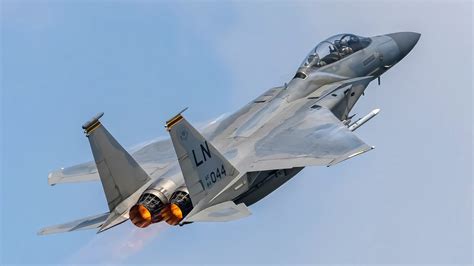
There are also survivability limits. Even with advanced electronic warfare, the F-15 is not a stealth platform. Its strength lies in mass and persistence, not penetration. This reality shapes how and where it will be employed in future conflicts.
The Strategic Meaning of the F-15 Inventory
Ultimately, the answer to how many F-15s the United States Air Force operates is more than a numerical exercise. It reflects a deliberate force-design philosophy that values balance over extremes. The Air Force is neither clinging to legacy platforms nor rushing headlong into an all-stealth future it cannot yet afford or sustain.
In FY26, with 202 combat-coded F-15s and 164 mission-ready aircraft, the Eagle family remains a central pillar of American airpower. It provides capacity where stealth is unnecessary, resilience where attrition is expected, and continuity as the fighter force transitions toward its next generation.
In that sense, the F-15 is no longer merely a symbol of past dominance. It is a practical instrument of present readiness and future stability—proof that in modern air warfare, numbers still matter when they are the right numbers, used the right way.