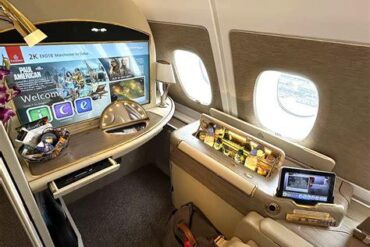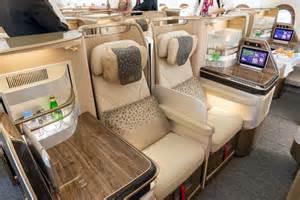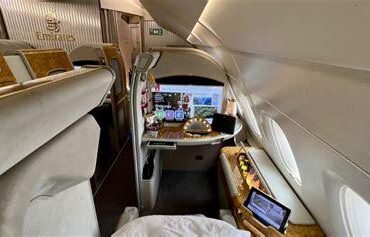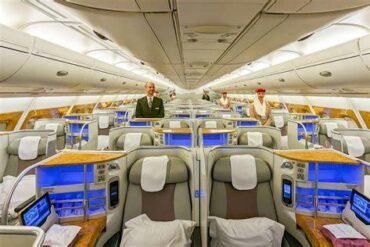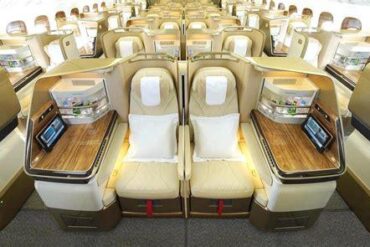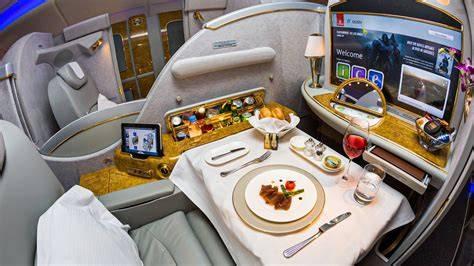
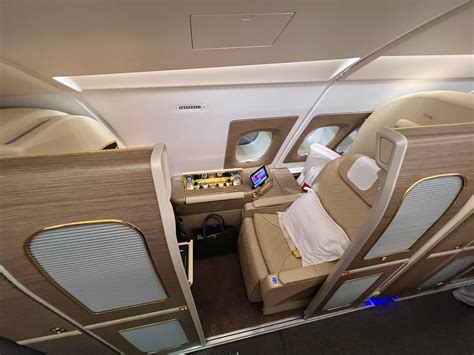
Emirates Airbus A380 First Class is designed to look like an extraordinary exercise in luxury. Passengers enter private suites, settle into wide seats with doors, order unlimited caviar, sip premium Champagne, receive designer amenity kits and pajamas, and, on eligible aircraft, use an onboard shower spa thousands of feet above the ground. With long-haul First Class fares often reaching $10,000 or more one way, it is easy to assume Emirates spends an enormous amount on every passenger.
The reality is much more nuanced. The airline certainly incurs substantial costs operating an A380 First Class cabin, but the direct cost of many individual luxury touches is considerably lower than their retail value suggests. Emirates buys food, beverages, toiletries, clothing, and branded products through large-scale commercial agreements, allowing it to secure prices that individual consumers would never receive.
That distinction between retail value and airline cost is central to understanding the economics of Emirates First Class. A passenger may see a Bulgari amenity kit worth more than $100, expensive Champagne, premium skincare, pajamas, and rare spirits and naturally calculate the experience using consumer prices. Emirates, however, operates on wholesale contracts, bulk procurement, supplier relationships, and economies of scale. The result is an experience that can feel worth thousands of dollars while costing the airline a much smaller amount in direct consumable expenses.
Emirates A380 First Class Fares Can Reach Five Figures
The price of an Emirates A380 First Class ticket provides important context for understanding the cabin’s economics. Long-haul one-way fares can commonly reach $8,000 to $10,000, while particularly long journeys or periods of strong demand can push prices above $15,000 and, in some circumstances, toward $20,000. Routes such as Dubai to Los Angeles or New York to Dubai illustrate how Emirates positions its flagship cabin at the very top of the commercial aviation market.
Those headline fares do not mean Emirates receives the same amount from every First Class passenger. The airline has a substantial loyalty ecosystem through Emirates Skywards, and premium passengers can access First Class through upgrades using miles, cash, or other mechanisms. Upgrade inventory can allow Emirates to monetize seats that might otherwise depart empty while maintaining a high published price for customers purchasing the cabin outright.
This distinction matters because the price of a First Class ticket is not the cost of providing the First Class experience. The fare also contributes toward aircraft ownership and financing, fuel, maintenance, airport charges, labor, catering infrastructure, distribution, corporate overhead, and the enormous network that makes the product possible. Luxury amenities represent only one part of that equation.
Retail Luxury Does Not Equal Emirates’ Actual Spending
One of the easiest mistakes when evaluating airline luxury is to add up consumer retail prices and assume that the airline pays the same amounts. Emirates operates under completely different purchasing economics. It orders products in substantial quantities and can negotiate contracts covering thousands of flights and millions of individual items.
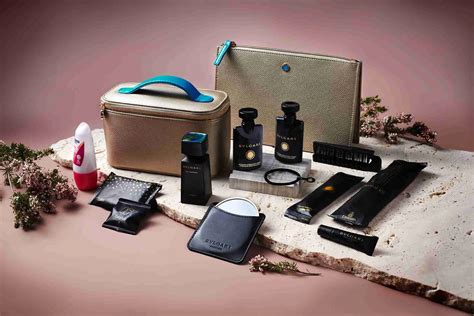
A designer amenity kit illustrates the difference particularly well. A Bulgari-branded kit can have a retail value exceeding $100, depending on its contents and market. A passenger receiving one might reasonably regard the kit as a three-figure gift. Emirates, however, does not walk into a retail store and purchase individual kits at consumer prices. Its commercial agreement with the supplier, production volumes, logistics arrangements, and branding relationship can make the airline’s actual cost only a fraction of the advertised retail value.
The same principle applies to alcohol. A premium bottle that costs a consumer hundreds or even more than $1,000 does not necessarily translate into an equivalent cost for Emirates. The airline purchases beverages through established supply chains and serves them across a global network. Even when the underlying product is genuinely expensive, the per-glass cost to the airline can remain relatively controlled.
The presentation is therefore doing considerable economic work. A polished bottle, crystal-style glassware, attentive service, private suite, and carefully timed dining sequence create an impression of extraordinary expenditure. The passenger experiences the combined effect, rather than the procurement invoice behind each component.
How Much Does Emirates Spend on First Class Catering?
Catering is one of the most visible costs in Emirates First Class because the food and beverage program is deliberately extravagant. On an ultra-long-haul A380 flight lasting around 16 hours, passengers can receive multiple meals, snacks, caviar, Champagne, wine, spirits, and other beverages throughout the journey.
Despite that extensive menu, industry estimates put the direct First Class catering cost at roughly $30 or more per passenger. That figure is an estimate rather than an Emirates-published figure, and actual spending will vary by route, menu, provisioning location, passenger consumption, and supplier contracts. Nevertheless, it illustrates the enormous gap between the perceived value of the service and its direct consumable cost.
For an A380 carrying 14 First Class passengers, a $30-per-passenger estimate would translate to only about $420 in direct First Class catering expense. That is striking when the passenger experience can include products whose retail value appears dramatically higher.
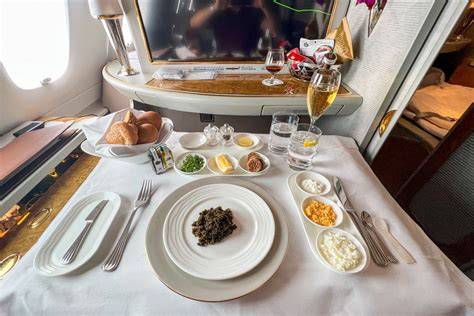
The caviar is perhaps the most obvious example. Unlimited service can create the impression that hundreds of dollars are being consumed by a single traveler, particularly because premium caviar has a substantial retail price. Yet an airline buying quantities through commercial suppliers can achieve materially different economics from a consumer purchasing a small tin from a luxury food retailer.
The same applies to Champagne. Emirates has famously associated its premium cabins with prestige Champagne, but the airline’s cost per serving is determined by its procurement contracts rather than the price charged by a restaurant or retail wine merchant. A $100 retail glass does not mean Emirates spends $100 every time a First Class passenger asks for another pour.
The Cost of Emirates First Class Amenity Kits and Pajamas
The physical amenities provided to First Class passengers add another layer to the equation. Emirates has used luxury-branded amenity kits, premium pajamas, skincare products, notebooks, pens, and other items to reinforce the identity of its flagship cabin.
A typical retail-value calculation might assign approximately $130 to a Bulgari amenity kit, around $110 to the hydra-active pajamas, roughly $80 to spa products, and about $20 to a notebook and pen. Taken together, those items can appear to represent several hundred dollars before a passenger has even ordered a meal.
But again, retail valuation is not the appropriate measure of Emirates’ expense. Airline procurement is fundamentally different from consumer shopping. Emirates can purchase products in bulk, establish recurring supply agreements, standardize packaging, and integrate distribution into its existing logistics network.
That means a product with a $100-plus consumer value could cost the airline considerably less. The precise contract prices are generally not public, so any estimate of Emirates’ exact per-passenger amenity expenditure should be treated as an approximation rather than an audited figure.
The distinction is important because there is no reliable public evidence showing that Emirates spends the full retail value of these amenities on each passenger. The visible product is real, but the retail price printed on an equivalent item elsewhere is not the airline’s invoice.
Chauffeur Service and Shower Spas Add Value Without Scaling Like Luxury Retail
Some of the most memorable Emirates First Class benefits are services rather than products. Depending on the itinerary and eligibility, passengers can receive chauffeur-driven airport transfers and enjoy premium ground services. The A380 also provides the famous First Class shower spas on equipped aircraft, allowing passengers to freshen up during a long flight.
These services are more difficult to assign a simple per-passenger retail price because their costs are embedded in larger operational systems. A chauffeur vehicle, for example, can serve multiple passengers over a period of time, while airport infrastructure and dedicated facilities spread fixed costs across numerous travelers and flights.
The shower spa presents a similar economic principle. Its installation and maintenance represent genuine costs, but those expenses are not incurred anew every time one passenger turns on the shower. The aircraft carries the facility whether a particular suite occupant uses it or not.
This is one reason premium airline products can create very high perceived value without equally high marginal costs. Once the aircraft, facilities, equipment, and service infrastructure are in place, accommodating another passenger in an available First Class suite does not require the airline to recreate the entire luxury environment from scratch.
What Emirates May Actually Spend Per First Class Passenger
Putting the publicly discussed estimates together produces a useful picture, although not a definitive Emirates accounting figure. Direct catering may begin around $30 per passenger, while amenities such as pajamas, skincare products, branded kits, and stationery could add additional tens of dollars after wholesale pricing is considered.
Alcohol and premium beverages increase the figure, particularly for passengers who consume large quantities of Champagne, wine, and spirits. Ground transportation, catering logistics, cleaning, laundry, provisioning, and other service expenses also have to be considered.
As a result, a reasonable interpretation is that Emirates’ direct passenger-facing First Class amenity and catering spending is likely measured in tens or perhaps low hundreds of dollars rather than thousands of dollars. The exact number cannot be established from publicly available information because Emirates does not publish a detailed per-passenger cost breakdown for its A380 First Class product.
That uncertainty should not be confused with evidence that the cabin is inexpensive to operate. The aircraft itself is extraordinarily costly, and First Class requires highly trained crews, premium catering infrastructure, specialized maintenance, airport facilities, cleaning, and significant capital investment.
The key point is narrower: the luxury items themselves are much cheaper for Emirates than their combined consumer retail value suggests.
The Economics Behind a $10,000 Emirates First Class Ticket
The difference becomes even clearer when looking at an entire Emirates A380 operation. A long-haul flight such as Dubai to Los Angeles can generate enormous operating costs, particularly because of fuel, crew, maintenance, airport charges, aircraft ownership, and other expenses.
Estimates for such a flight have placed total operating costs at around $322,000, with fuel representing a particularly large share. At the same time, potential passenger revenue can be substantially higher when premium cabins generate strong yields and the aircraft is well utilized. Cargo revenue can provide another source of income.
This is why Emirates does not need every passenger to spend thousands of dollars on physical luxury products for the First Class cabin to make commercial sense. First Class occupies only a small number of seats, but those seats can generate a disproportionate amount of passenger revenue.
On the A380, Emirates has historically configured only 14 First Class suites on its flagship aircraft. Limiting the number of suites creates scarcity while leaving most of the aircraft’s capacity for Business and Economy passengers. The airline can therefore combine premium yields with high-volume cabins and cargo capacity.
Why Emirates First Class Feels More Expensive Than It Costs
The genius of the product is not simply that Emirates provides expensive things. It is that the airline combines relatively controlled costs into an experience that feels coherent and exceptionally valuable.
The private suite creates physical separation. Caviar creates a recognizable luxury ritual. Premium Champagne signals prestige. Bulgari products connect the cabin with the world of high-end fashion and fragrance. Pajamas make the experience feel more like a luxury hotel, while the shower spa provides something passengers cannot replicate on most commercial flights.
Each individual component reinforces the others. A $20 notebook would not create a luxury experience by itself. Neither would a pair of premium pajamas. But when those products appear inside a private suite alongside fine dining, personal service, premium drinks, and an onboard shower, their combined psychological effect is considerably larger than their individual cost.
That is the fundamental economics of Emirates A380 First Class. The airline does not need to spend $1,000 on amenities to create $1,000 worth of perceived luxury. It needs to select recognizable products, negotiate favorable procurement terms, deliver them consistently, and surround them with service and scarcity.
For passengers, the resulting experience can genuinely feel extraordinary. For Emirates, however, the underlying calculation is much more disciplined. The airline is selling an integrated premium product whose perceived value can be many times greater than the direct cost of the physical items handed to each traveler. That gap between what luxury looks like and what luxury actually costs an airline is one of the most revealing features of modern premium aviation.