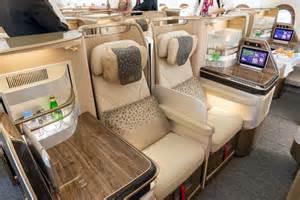
If there is one aircraft that has come to symbolize the glamour of long-haul premium travel, it is the Airbus A380. And if there is one airline that has made the A380 part of its identity, it is Emirates. The Dubai-based carrier has built an enormous reputation around its double-decker flagship, particularly for passengers traveling in business class. The combination of a spacious upper deck, lie-flat seating, premium dining, lounge access, and the famous onboard bar creates an experience that feels considerably different from simply paying for a wider airline seat.
But that experience comes at a price. In 2026, an Emirates A380 business class ticket can cost anywhere from roughly $2,500 to more than $8,000 one way, depending on the route, travel date, booking window, fare conditions, and demand. Round-trip fares can move from approximately $5,000 to $10,000 or more on important long-haul routes. There is no single Emirates A380 business class price because the airline uses dynamic pricing, meaning the same seat can have dramatically different prices on different dates.
For travelers trying to decide whether the premium is worthwhile, understanding how Emirates prices its business class cabin is almost as important as understanding what the cabin itself offers. A discounted fare can represent relatively strong value, while a last-minute ticket purchased during a peak period can cost several thousand dollars more.
Emirates A380 Business Class: Where It Sits in the Premium Cabin Hierarchy
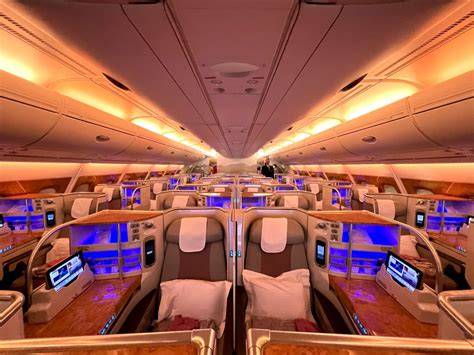
Emirates currently operates a four-cabin hierarchy consisting of Economy, Premium Economy, Business Class, and First Class. On the Airbus A380, the differences between these cabins are especially noticeable because the aircraft’s enormous size gives Emirates room to create distinctly different environments rather than simply adding more space to the same basic cabin.
Business class occupies the second-highest position, directly below first class. It is arguably Emirates’ most strategically important premium product because it appeals to a broad mixture of passengers. Corporate travelers value the ability to work and sleep comfortably, while leisure travelers may be willing to spend substantially more for a special long-haul experience.
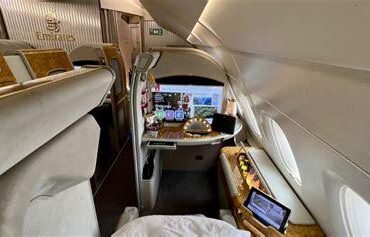
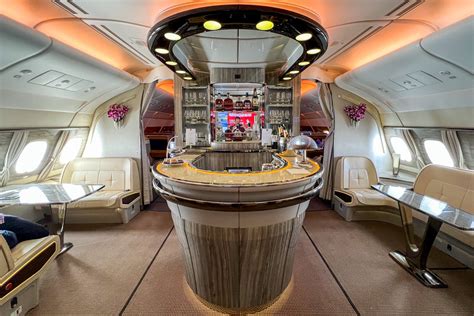
The A380 version is particularly desirable because the business class cabin is positioned on the upper deck. Passengers are separated from the much larger economy cabin below, creating a more exclusive atmosphere. The upper-deck location also connects business class passengers with one of the aircraft’s most famous features: the Emirates onboard lounge and bar.
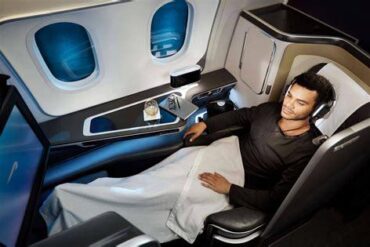
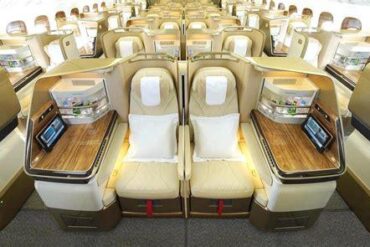
The seats transform into fully flat beds of approximately 78 inches, or 198 centimeters, giving passengers the ability to sleep properly during overnight flights. Storage areas, large entertainment screens, premium meals, drinks, and attentive service complete the package.
This is where the Emirates A380 business class product becomes more than a transportation upgrade. For many passengers, the aircraft itself becomes part of the experience.
How Much Does Emirates A380 Business Class Cost in 2026?
The simplest answer is that travelers should expect a wide price range rather than a fixed fare. Promotional business class tickets can sometimes be found for around $2,500 to $3,500 one way, particularly when passengers book early and travel during periods of weaker demand.
Those lower fares are not necessarily available every day. Emirates manages business class inventory through different fare buckets, and cheaper seats can disappear quickly when demand increases. Once the lower-priced inventory has been sold, passengers may only see significantly more expensive options.
For major intercontinental routes, a more typical one-way business class fare can fall around $4,000 to $6,000. On especially important routes, fully flexible fares and last-minute bookings can rise toward $7,000 or $8,000 one way.
Round-trip pricing presents a somewhat different picture. Travelers finding a sale or favorable booking window might encounter fares around $5,000 or less, while more conventional pricing on major routes can reach $6,000 to $10,000. During peak periods, particularly when flights are filling with high-paying business travelers, the final price can move even higher.
The important point is that these figures should be treated as realistic 2026 ranges rather than guaranteed prices. Emirates can change fares frequently, and two passengers sitting next to each other on the same A380 could theoretically have paid thousands of dollars different for their tickets.
Why Dubai–London and Dubai–New York Can Be So Expensive
Route economics have a major influence on Emirates business class fares. Connections between Dubai and major global financial or commercial centers are particularly important because they attract travelers who place a high value on nonstop service, schedule flexibility, and onboard comfort.
Dubai–London is a classic example. London is one of Emirates’ most important international markets, and premium demand can be substantial. When corporate travel, tourism, and seasonal demand converge, business class inventory becomes significantly more valuable.
The same principle applies to Dubai–New York, where passengers may be traveling for business, visiting family, or connecting through Emirates’ extensive Dubai network. The nonstop nature of the service makes the premium product especially attractive to travelers who do not want an additional connection.
Other long-haul destinations, including Paris and Sydney, can also command substantial fares. Sydney is particularly interesting because of the enormous distance involved. When passengers are spending many hours onboard, the ability to convert a business class seat into a fully flat bed becomes much more valuable than it might on a shorter flight.
This helps explain why the price of an Emirates A380 business class ticket cannot be judged solely by mileage. Demand, competition, timing, and passenger willingness to pay all influence the final fare.
What Makes Emirates A380 Business Class Different?
Price matters, but passengers are not paying several thousand dollars simply for a larger seat. The A380 business class experience includes a collection of features designed to make long-haul travel substantially more comfortable.
The most important is the fully flat bed. On overnight flights, this can fundamentally change the journey. Instead of spending eight or more hours trying to sleep in a reclined seat, passengers can lie horizontally and create a much more conventional sleeping environment.
The upper-deck location also gives Emirates A380 business class a distinctive character. At the rear of the cabin is the onboard bar and lounge, where passengers can leave their seats, have a drink, and socialize during the flight. It is one of the most recognizable features of Emirates’ A380 operation and remains a major reason aviation enthusiasts specifically seek out the aircraft.
Dining is another important component. Business class passengers receive an elevated meal service and a selection of premium beverages, while Emirates’ long-haul service is designed around a more personalized experience than economy.
Airport benefits also contribute to the overall value. Depending on the market and ticket conditions, business class passengers can receive access to Emirates lounges and, in selected markets, chauffeur-driven airport transfers.
The result is an experience that begins before the aircraft even leaves the gate and continues until the passenger reaches the destination.
Emirates A380 Versus Boeing 777 Business Class
One of the biggest reasons travelers specifically search for an Emirates A380 business class ticket is that not every Emirates business class flight offers the same cabin.
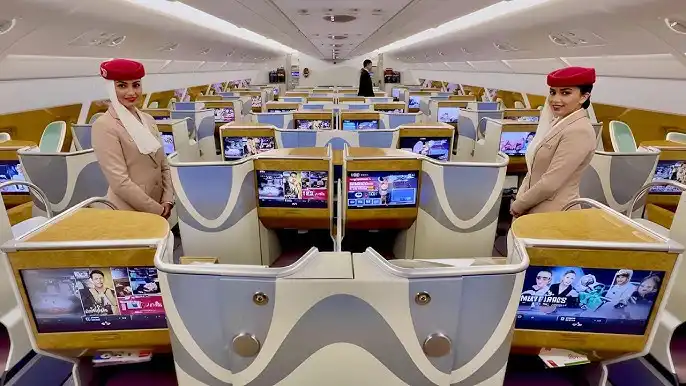
Emirates operates business class across both the Airbus A380 and Boeing 777 fleets, but the products can differ substantially. The A380 is generally the more distinctive choice because its business class cabin has the upper-deck environment, direct aisle access, lie-flat seats, and access to the famous onboard lounge.
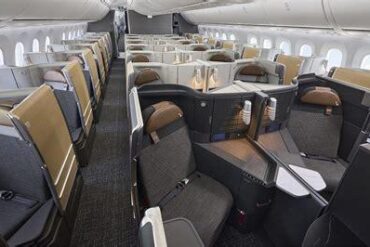
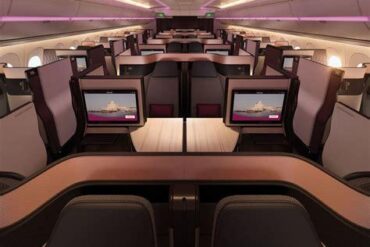
The Boeing 777 experience is less consistent because Emirates has operated different business class configurations across its fleet. Some older aircraft have featured a 2-3-2 business class layout, which can leave passengers without direct aisle access. That configuration feels considerably less private than a modern 1-2-1 cabin.
Emirates has also introduced refreshed 777 interiors with newer business class seating and improved privacy. Those aircraft can provide a much more competitive premium experience, but passengers cannot simply assume that every Emirates 777 offers the same product.
This makes aircraft selection an important part of booking. A traveler paying $5,000 or $6,000 for business class should pay attention not only to the airline and route but also to the aircraft scheduled to operate the flight.
For passengers specifically chasing the Emirates A380 experience, the aircraft type can be almost as important as the fare.
How Emirates Dynamically Prices Business Class Tickets
Emirates does not use one fixed business class price for every departure. Instead, the airline relies on sophisticated revenue management and dynamic pricing.
Demand is one of the biggest factors. When Emirates expects a flight to sell strongly, it has less incentive to offer large numbers of discounted premium seats. As cheaper fare buckets disappear, the remaining tickets become progressively more expensive.
Booking timing matters for the same reason. Travelers who book well in advance may have access to lower-priced business class inventory, although there is no guarantee that booking early will always produce the lowest possible fare. A promotional sale can sometimes appear later.
Last-minute travelers face a different problem. Business passengers often have less flexibility and may need to travel regardless of price. Airlines understand this behavior, which is why a seat that looked relatively affordable weeks earlier can become extremely expensive shortly before departure.
Seasonality is equally important. School holidays, major festivals, Christmas and New Year travel, summer vacations, and major international events can all put upward pressure on premium cabin fares.
Competition also plays a role. Emirates competes with carriers such as Qatar Airways, Etihad Airways, Turkish Airlines, Singapore Airlines, and British Airways on various international markets. When competitors offer aggressive business class fares, Emirates may need to respond to remain attractive.
When Is the Best Time to Buy Emirates A380 Business Class?
There is no magic booking day that guarantees the cheapest Emirates business class fare, but travelers can improve their odds by being flexible.
The first opportunity is to monitor fares well before departure. Lower business class inventory is limited, so waiting until the last moment is generally risky. Travelers with flexible dates should check several departures around their preferred travel date rather than searching only one specific flight.
It can also help to avoid peak travel periods. A slightly different departure date can sometimes produce a dramatic difference in price because airlines manage inventory independently for each flight.
Route flexibility matters too. If a traveler is willing to depart from or arrive at an alternative airport, the available fares may change substantially. Even when the aircraft and cabin are similar, different city pairs can produce very different business class pricing.
For passengers paying cash, the objective is simple: find a fare that provides the A380 experience without paying the maximum premium created by peak demand or last-minute booking.
Can You Use Miles for Emirates A380 Business Class?
Cash is not the only way to access Emirates business class. Emirates Skywards remains the airline’s primary loyalty program, and members can redeem miles for Emirates-operated flights when award availability exists.
Other frequent-flyer programs can also provide access to Emirates flights through partnerships. Programs such as Japan Airlines Mileage Bank and Air Canada Aeroplan have offered options for redeeming miles for Emirates-operated services, although availability and pricing can vary.
The challenge is not simply having enough miles. It is finding business class award availability at a reasonable redemption rate.
Emirates controls the number of premium seats it releases for award bookings, meaning a flight with plenty of paid business class seats may not necessarily have corresponding award space. Travelers therefore need flexibility and patience when attempting to use miles.
For passengers who collect transferable points or airline miles, however, an award ticket can dramatically reduce the cash cost of experiencing the A380 business class cabin.
Is Emirates A380 Business Class Worth the Price in 2026?
Whether Emirates A380 business class is worth $3,000, $5,000, or $8,000 depends heavily on the individual traveler.
For a short daytime flight, paying thousands of dollars for business class may be difficult to justify. On an overnight journey of 10, 12, or even 14 hours, however, the equation changes. A fully flat bed, direct aisle access, premium meals, lounge access, and the ability to spend part of the flight at the onboard bar can make a meaningful difference.
The A380 itself also provides something that many newer aircraft cannot easily reproduce: a sense of space and occasion. The double-decker cabin, staircase, upper-deck lounge, and distinctive Emirates interior create an experience that is recognizable even before the aircraft reaches cruising altitude.
For aviation enthusiasts, that novelty has genuine value. For business travelers, the productivity and sleep benefits may be more important. For leisure passengers celebrating a special trip, the experience can become part of the destination itself.
Still, not every fare represents good value. Paying $7,000 or $8,000 one way for a ticket that could have been purchased for $3,000 with more flexible planning requires a very different justification.
The Bottom Line on Emirates A380 Business Class Prices
In 2026, Emirates A380 business class remains an expensive but highly recognizable premium travel product. A realistic one-way range starts at roughly $2,500 to $3,500 for attractive discounted fares, while more typical long-haul pricing can reach $4,000 to $6,000. During peak periods or for flexible and last-minute fares, prices can approach or exceed $7,000 to $8,000 one way.
Round-trip travelers should generally expect somewhere around $5,000 to $10,000, although sales, route differences, and travel dates can push that figure lower or significantly higher.
The biggest lesson is that the price printed on one search does not define the value of the product. Emirates’ dynamic pricing means timing can be worth thousands of dollars, while aircraft selection can determine whether passengers receive the full A380 experience they expected.
For travelers who specifically want the upper-deck cabin, fully flat business class seat, onboard lounge, premium service, and unmistakable Emirates A380 atmosphere, the fare can be justified on a long overnight journey. The smartest approach is to watch prices early, remain flexible with dates, check the aircraft type carefully, and consider miles when cash fares become excessive.
The Emirates A380 may no longer be the newest aircraft in the sky, but in business class it continues to offer something few aircraft can match: a premium travel experience that feels like an event rather than simply a flight.