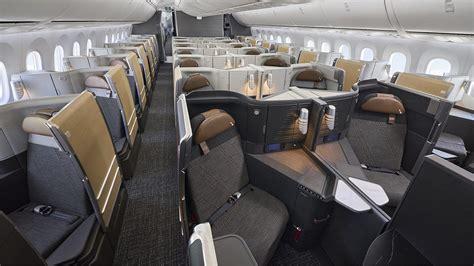
For travelers considering a long-haul premium cabin, the price of American Airlines Boeing 787 business class in 2026 can be surprisingly difficult to pin down. A Flagship Business ticket does not have one fixed price, and the same seat can cost dramatically different amounts depending on the route, travel date, direction of travel, season, and level of demand. A one-way ticket can cost around $2,200 on some European routes, while particularly expensive itineraries can climb beyond $15,000.
American Airlines calls its premium business class cabin Flagship Business, and the product appears across the airline’s widebody fleet as well as selected Airbus narrowbodies. On the Boeing 787, however, passengers encounter several generations of seats rather than one standardized configuration. That distinction matters because American has been introducing its newest Flagship Suites on the 787-9, giving some passengers a substantially more private experience than those flying on older Dreamliners.
The Boeing 787 has become one of the most important aircraft in American’s international network. The airline currently has 70 Dreamliners, comprising 37 Boeing 787-8s and 33 Boeing 787-9s, with another 19 787-9s expected to join the fleet. The aircraft operates from most of American’s major hubs, although Washington, Charlotte, and Phoenix are exceptions. Its relatively efficient long-haul performance allows American to serve a wide range of international markets with different levels of premium-cabin demand.
American Airlines 787 Business Class Prices To Europe
Europe is one of the most important markets for American’s Boeing 787 fleet, particularly from Philadelphia and Chicago O’Hare. Those hubs do not have Boeing 777 bases, making the 787 especially important for transatlantic flying. American also deploys the Dreamliner selectively from New York-JFK, Miami, Los Angeles, and Dallas/Fort Worth, creating a broad range of opportunities to book Flagship Business.
A one-way American Airlines business class ticket to Europe can begin at approximately $2,200, although fares can rise above $11,000 when demand is strong or travel dates are less flexible. The difference between US-originating and Europe-originating tickets can also be significant. In general, fares originating in the United States tend to be higher, meaning that travelers willing to construct an itinerary beginning in Europe may sometimes encounter a substantially different price for essentially the same transatlantic experience.
Philadelphia is particularly important because American uses the 787-8 for numerous European destinations. These include Athens, Dublin, Milan, Prague, Copenhagen, Nice, Budapest, Naples, Amsterdam, Zurich, Barcelona, and Madrid. The larger 787-9 operates to destinations including Paris, Rome, Venice, Lisbon, London-Heathrow, and Edinburgh. This creates considerable variation in the aircraft and cabin experience even when the itinerary is sold under the same Flagship Business branding.
From Chicago O’Hare, the Boeing 787-9 operates to London-Heathrow and Rome, while the 787-8 serves Barcelona, Madrid, Naples, Dublin, Amsterdam, Paris, and Athens. Dallas/Fort Worth has a different mix, with the 787-8 serving Frankfurt and the 787-9 flying to London-Heathrow. New York-JFK also sees the 787-9 on services to Rome and London-Heathrow, while the 787-8 connects JFK with Barcelona.
What American 787 Business Class Costs To Asia
For American Airlines Boeing 787 business class to Asia, typical one-way fares are approximately $3,100 to more than $8,500. Despite the much longer distances involved on many Asian routes, these prices can remain below American’s highest European fares. One important factor is American’s comparatively smaller presence in Asia, where United Airlines and Delta Air Lines have larger networks and stronger positions in several major markets.
Dallas/Fort Worth is the center of American’s 787 operation to Asia. The 787-9 operates from New York-JFK to Delhi and Tokyo Haneda, while Dallas/Fort Worth is connected with Tokyo Haneda and Shanghai. From Los Angeles, the 787-9 serves Tokyo Haneda. These flights are supplemented by Boeing 777 services, giving American additional capacity in markets where demand can support larger aircraft.
The aircraft itself is an important part of the equation when buying a premium ticket. American’s 787-9 fleet is divided between older 285-seat aircraft and newer premium-heavy aircraft with only 244 seats. The newer configuration contains 51 Flagship Business suites, compared with 30 business class seats on the earlier 787-9 configuration. That difference represents a major shift toward premium seating and gives the newest aircraft a much greater business-class footprint.
Why Oceania Business Class Can Cost More Than $15,000
American’s Boeing 787 also plays an important seasonal role in the South Pacific. The airline has a relatively small independent network in Oceania, although its relationship with Qantas expands the destinations available to customers through the joint venture. American serves Sydney year-round with the Boeing 777-300ER, while the 787-9 is used seasonally to Auckland from Dallas/Fort Worth and Los Angeles.
The airline also operates the 787-9 between Dallas/Fort Worth and Brisbane during the winter season. These markets can produce some of American’s highest Flagship Business fares, with prices exceeding $15,000 in some cases. The combination of very long distances, limited nonstop competition from American, seasonal capacity, and premium demand can push fares well above those seen on many European and Asian services.
That does not mean every South Pacific ticket costs five figures. Dynamic pricing means fares can move considerably depending on the travel date and remaining inventory. A traveler searching several dates can therefore encounter a wide spread between the lowest available fare and the price displayed for a popular departure.
American Airlines 787 Business Class Prices To South America
South America presents another interesting pricing pattern. American has a particularly strong network in the region because of its Miami hub, yet its Boeing 787 business-class fares can be lower than those seen on many European and Asian routes. One-way Flagship Business prices generally range from approximately $2,300 to more than $5,400.
From Dallas/Fort Worth, American uses the 787 for Buenos Aires and São Paulo. From New York-JFK, the 787-9 operates to São Paulo, while Buenos Aires is served with the 777-300ER. Miami has an even broader role. The 787-8 serves Buenos Aires and Rio de Janeiro year-round, while Santiago receives the 787-8 during the summer. During winter, the Santiago service uses the 777-200ER, while the 787-9 serves São Paulo from Miami during the summer.
Although these routes can be comparable in length to some transatlantic flights, they often command lower fares. One factor is the nature of demand. Many North America-South America flights are overnight services, and aircraft can spend extended periods on the ground between flights because there are fewer time-zone changes. American’s extensive Miami network helps offset those operational challenges by generating substantial connecting and local traffic.
The Business Class Seats On American’s Boeing 787
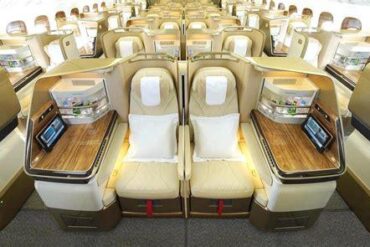
Price is only part of the story. American Airlines 787 business class seats vary according to the individual aircraft, and travelers should check the seat map before booking if the onboard product is important.
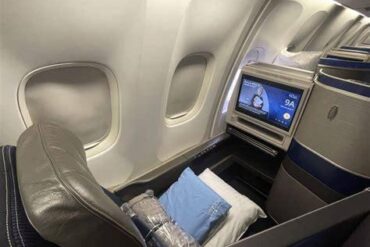
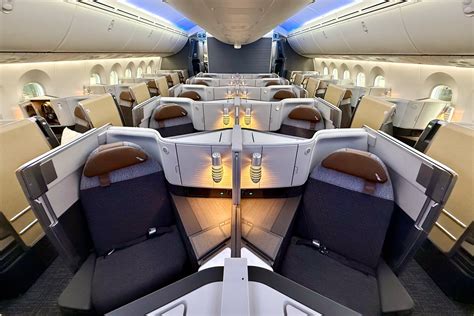
The oldest 787-8 aircraft use the Safran Concept D, a customized reverse-herringbone arrangement. These seats alternate between forward-facing and rear-facing positions and are installed in pairs. The design has attracted criticism because movement in one seat can sometimes be felt by the neighboring passenger.
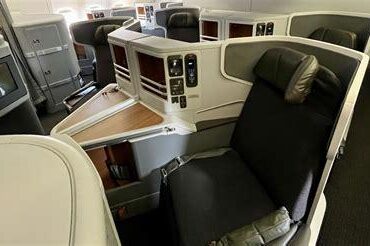
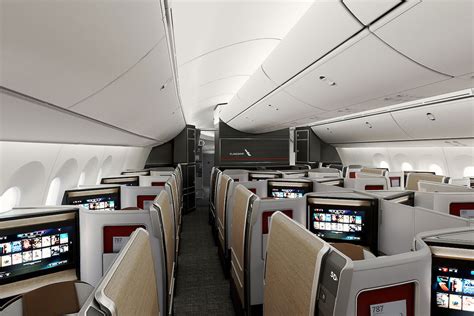
American subsequently moved to the Collins Aerospace Super Diamond seat. Seventeen 787-8 aircraft received this product, while the first 22 Boeing 787-9s were also delivered with Super Diamond. It is a reverse-herringbone design with a more conventional layout and fixed individual entertainment screens.
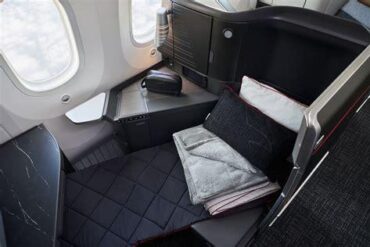
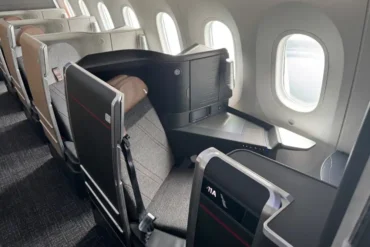
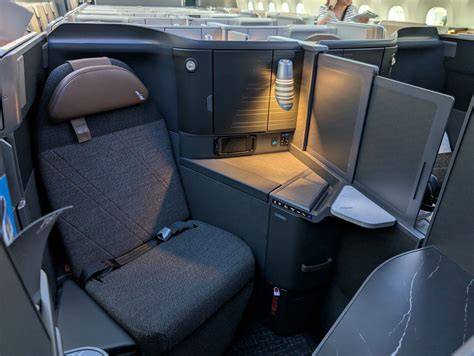
The newest 787-9s are considerably different. American began receiving aircraft in 2025 with its premium-heavy 789P configuration, which contains 51 Flagship Business seats and only 244 seats overall. These aircraft use the Elevate Ascent reverse-herringbone seat, which includes privacy doors. The new cabin also introduces Flagship Preferred suites in the first row, offering additional space without a separate surcharge at present.
Can You Use AAdvantage Miles For American 787 Business Class?
For travelers who find five-figure cash fares difficult to justify, AAdvantage miles provide another way to access American’s premium cabins. American publishes starting award levels, but its award pricing is dynamic and can rise substantially depending on demand.
American advertises Flagship Business awards to Europe from 75,000 AAdvantage miles one way. Long-haul South American awards start at 90,000 miles, while Asian and South Pacific routes start at 95,000 miles. These figures should be viewed as starting prices rather than guarantees of availability at those levels.
AAdvantage miles can also be used for eligible flights operated by American’s oneworld partners and several other partner airlines. This gives travelers additional opportunities to use miles when American’s own 787 inventory is expensive or unavailable. The program’s flexibility can therefore be particularly useful for passengers willing to consider connecting itineraries instead of insisting on a nonstop American flight.
AAdvantage also has relationships with Citi, Marriott Bonvoy, and World of Hyatt. However, hotel-point transfers do not convert at the same ratio as Citi transfers, with Marriott Bonvoy points transferring at 3:1 and World of Hyatt points at 5:2.
What A 2026 American 787 Business Class Ticket Really Costs
There is no single answer to the question of how much an American Airlines Boeing 787 business class ticket costs in 2026. The reference ranges show just how broad the market can be. Europe can range from about $2,200 to more than $11,000 one way, Asia from roughly $3,100 to above $8,500, and South America from around $2,300 to more than $5,400. Oceania stands apart, with some fares exceeding $15,000.
The aircraft configuration also deserves attention because a business-class ticket does not necessarily guarantee the newest Flagship Suites. American’s 787 fleet contains Concept D, Super Diamond, and the newer Elevate Ascent products, meaning two passengers paying similar fares could receive noticeably different seating experiences.
For travelers paying cash, flexibility is therefore crucial. For travelers using miles, the difference between the advertised starting award price and the actual dynamically priced award can be substantial. Ultimately, the American Airlines 787 Flagship Business fare is shaped by route, demand, season, aircraft configuration, and inventory rather than a fixed premium-cabin price. In 2026, the Dreamliner offers everything from comparatively attainable transatlantic business-class fares to some of the airline’s most expensive long-haul premium tickets.