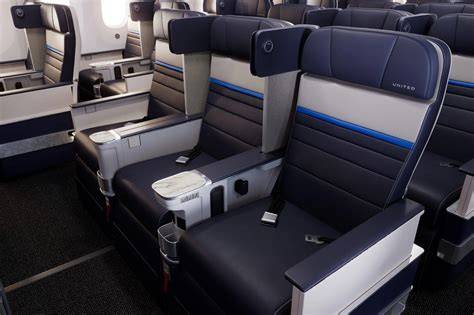
For cash-paying travelers, premium economy often looks like the smartest cabin on a long-haul aircraft. It offers a wider seat, more legroom, improved meals, priority services and, on many airlines, a noticeably calmer experience without the enormous price of business class. That makes it an appealing compromise for passengers who want to escape the limitations of economy without spending several thousand dollars on a lie-flat seat. The problem begins when the same cabin is evaluated through the lens of airline miles and points.
Loyalty currencies rarely follow the same logic as cash fares. A passenger might find that premium economy costs only moderately more than economy in cash, yet requires a disproportionately large number of miles. At the same time, the additional miles needed to move from premium economy into business class can be surprisingly small. This creates an unusual situation in which the cabin that looks like the best value when purchased with money can become one of the worst award redemptions when purchased with points.
The reason is not that premium economy is a bad product. In fact, premium economy can be an excellent product when the fare is right. The problem is the way airlines construct their award charts, upgrade rules and revenue-management systems. Premium economy frequently occupies an awkward middle position: too expensive in miles to be an attractive economy alternative, but close enough to business class that spending a little more can unlock dramatically greater comfort and additional benefits.
Why Premium Economy Creates an Awkward Miles Sweet Spot
Consider a simplified long-haul example. Suppose an economy ticket costs $900 or 40,000 miles, while premium economy costs $1,600 or 95,000 miles. A business-class ticket might cost $4,500 in cash but 130,000 miles. The cash differences are enormous, but the mileage differences tell a very different story.
Moving from economy to premium economy in this example requires 55,000 additional miles. Moving from premium economy to business requires only another 35,000 miles. The passenger therefore spends considerably more miles for the intermediate cabin while receiving a much smaller improvement in product than the additional mileage might suggest. From a value perspective, that is where premium economy begins to look unattractive.
Using the cash prices as a rough benchmark, the economy redemption produces about 2.25 cents per mile, while business class produces about 3.46 cents per mile. Premium economy produces only about 1.68 cents per mile. The exact figures will vary dramatically by airline, route and fare, but the underlying principle remains important: award pricing does not necessarily preserve the same value relationship as cash pricing.
That distinction is easy to overlook because premium economy feels like a logical midpoint. Travelers naturally assume that if the cabin sits halfway between economy and business in terms of comfort and price, it should also occupy a similar position in the loyalty program. Airlines, however, have no obligation to maintain that symmetry. Their mileage pricing is designed around inventory, demand, revenue management and the strategic value of each cabin rather than a simple percentage of the cash fare.
Airline Upgrade Rules Can Make the Difference Even Bigger
There is another complication: airlines do not use one universal formula for upgrades. British Airways, for example, structures Avios requirements around distance zones, cabin differences and peak or off-peak pricing. Virgin Atlantic uses distance bands and has introduced Saver reward pricing, while Lufthansa structures upgrades around regional combinations and fare conditions. Air France and KLM use dynamic pricing mechanisms, while major US carriers have increasingly moved toward dynamic award and upgrade systems.
This matters because an attractive premium economy redemption can disappear once the passenger examines the next cabin. British Airways provides a useful illustration. A passenger traveling from London to New York can require 60,000 Avios for premium economy and 90,000 Avios for business class on a relevant peak-date example. The difference is only 30,000 Avios.
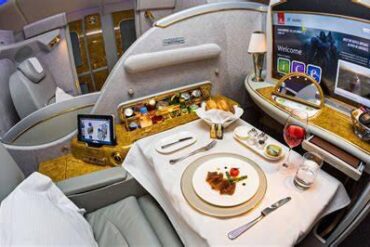
That makes the premium economy redemption difficult to justify if business-class availability exists and the traveler can purchase an eligible fare. The passenger is not merely paying for a better seat. Business class can bring a lie-flat bed, lounge access, priority services, better dining, greater privacy and a fundamentally different long-haul experience.
Fare eligibility is crucial, however. Not every discounted ticket can necessarily be upgraded. Some airlines tie upgrade costs to the original fare bucket, while others restrict upgrades to certain classes or require a particular type of paid ticket. A cheap premium economy fare can therefore be attractive in one situation and completely useless for an upgrade strategy in another.
Virgin Atlantic Shows Why Award Pricing Can Be Misleading
Virgin Atlantic provides another useful example of the strange mathematics surrounding premium economy. The airline introduced Saver reward seats that allowed Flying Club members to use points for seats across its cabins. On several popular routes, the gap between economy and premium economy is relatively modest, but the jump from premium economy to business can reveal a very different value proposition.
On London-New York, for example, Saver pricing has started at 6,000 points for economy, 10,500 for premium economy and 28,500 for business class. London-Miami and London-Orlando have started at 7,500 points for economy, 13,500 for premium economy and 28,500 for business. On the longer London-Los Angeles route, economy has started at 9,000 points, premium economy at 16,500 and business at 40,500.
Those numbers do not automatically make business class the correct choice. Availability is critical, and the lowest Saver prices can be extremely difficult to find on desirable dates. Nevertheless, the figures demonstrate why passengers should never evaluate a premium economy redemption in isolation.
The important question is not simply, “How many points does premium economy cost?” It is, “How many additional points does business class cost on the same flight or route?” That second calculation can completely change the answer.
Premium Economy to Business Is Often the Better Upgrade
For many legacy airlines, the strongest use of points is therefore not economy-to-premium but premium-economy-to-business. The reason is straightforward: the physical and service improvement between those cabins can be enormous, while the additional mileage requirement may remain relatively manageable.
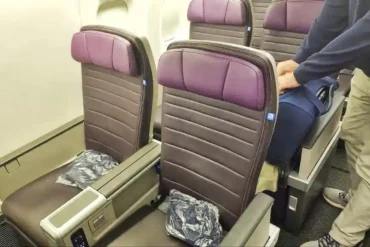
A premium economy passenger normally receives a larger recliner, additional legroom and improved service. That can make a long flight considerably easier, but it does not fundamentally change the way the passenger uses the aircraft. Business class, by contrast, can transform the journey. A lie-flat seat allows genuine sleep, while direct aisle access, lounge facilities, priority handling and enhanced dining can make a long overnight flight feel substantially less exhausting.
This is particularly important on flights lasting 10, 12 or even 16 hours. On a short daytime flight, premium economy may provide nearly everything a traveler needs. On an ultra-long-haul overnight sector, the value of a lie-flat bed becomes much more significant. Spending another 20,000 or 30,000 points can therefore make far more sense than spending tens of thousands of points simply to move from economy to premium economy.
The strategy becomes even more compelling when a passenger can buy an upgradeable premium economy fare with cash and then wait for a business-class upgrade opportunity. Depending on the airline, the upgrade may be offered for cash, miles, points or a combination. There is no guarantee that an offer will appear, but when it does, the total cost can be substantially lower than purchasing business class outright.
The Best Strategy Often Starts With Cash
For travelers who want to maximize loyalty currencies, premium economy can make sense as a paid fare rather than an award fare. This distinction is fundamental. Paying cash for a premium economy ticket can produce a relatively reasonable price while also generating miles, elite-qualifying credit or other benefits. The same seat purchased entirely with points may represent poor value.
Corporate travelers sometimes enjoy the strongest version of this strategy because an employer may pay for premium economy while the traveler uses personal points to upgrade to business. That effectively converts an ordinary business trip into a premium experience without requiring the traveler to personally finance the entire business-class fare.
Leisure travelers can reproduce part of the strategy by searching aggressively for lower premium economy fares. Return tickets can sometimes be significantly cheaper than two one-way fares, particularly on international routes. Connecting itineraries can also produce unexpected savings because airlines price complete journeys according to market demand rather than simply adding the cost of each individual flight.
A traveler flying from Los Angeles to Auckland, for instance, might discover that an itinerary connecting through San Francisco is priced very differently from a nonstop or independently purchased combination. Even when the flights appear similar, the fare construction can produce large differences. Searching multiple combinations is therefore often more valuable than simply accepting the first premium economy fare displayed.
Airlines Have a Reason to Keep Premium Economy in the Middle
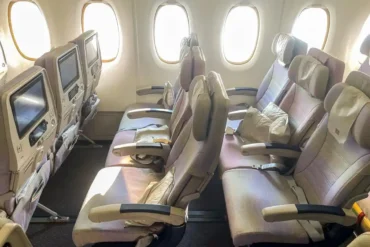
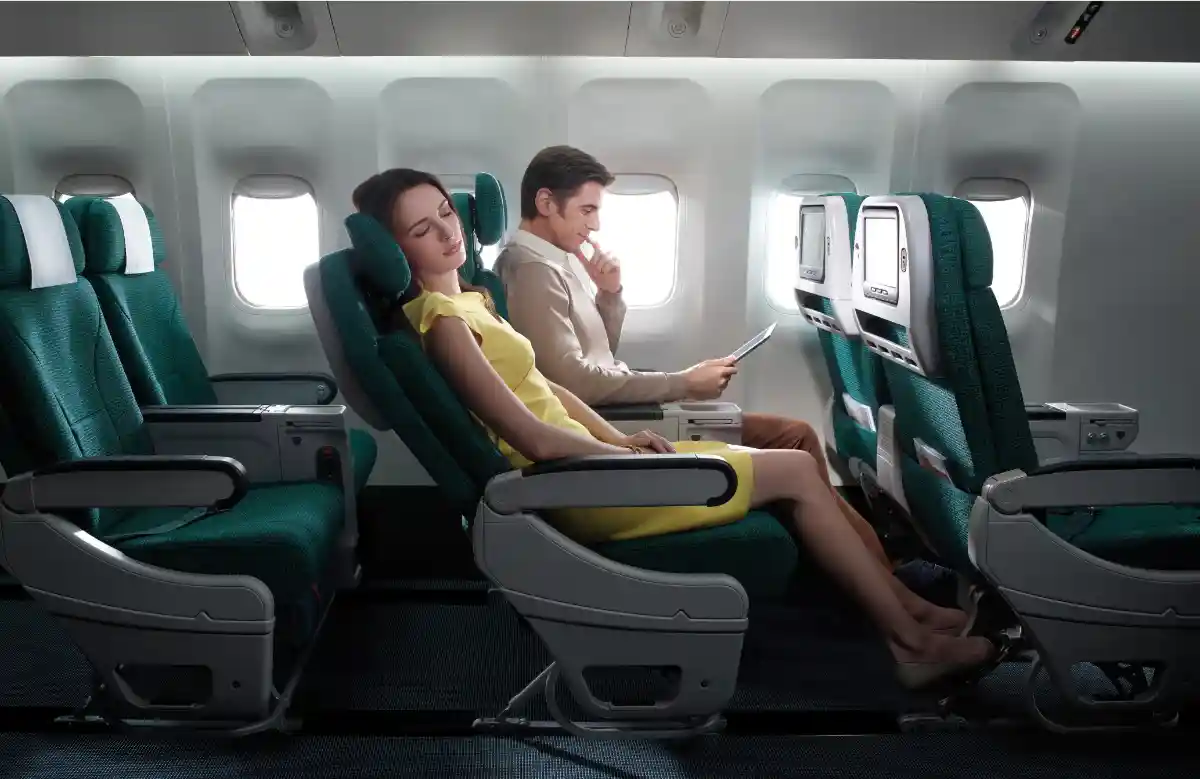
The strange award economics of premium economy also make more sense when viewed from the airline’s perspective. Premium economy is not simply economy with extra legroom. At major network airlines, it is increasingly a deliberate pricing tier designed to capture passengers who are willing to spend more but unwilling to pay business-class prices.
That makes the cabin commercially valuable. Airlines want to attract comfort-seeking leisure travelers and price-sensitive business travelers without undermining the much higher revenue generated by business class. If premium economy became too similar to business class or too inexpensive, it could encourage customers who would otherwise purchase business class to trade down.
The cabin is therefore carefully positioned between the two. Airlines can make it substantially better than economy while keeping meaningful differences in privacy, seating, service and sleeping capability. The result is a product that works extremely well as a cash proposition but does not necessarily translate into equally attractive award pricing.
This also explains why premium economy cabins are expanding across many long-haul fleets. Airlines are increasingly taking seats away from economy rather than business class when adding premium capacity. British Airways’ A380 retrofit plans illustrate the trend. Its existing configuration has 14 first-class suites, 97 business-class seats, 55 premium economy seats and 303 economy seats, while the newer arrangement is planned around 12 first-class suites, 110 business-class seats, 84 premium economy seats and 215 economy seats.
The change dramatically reduces economy capacity while adding both premium economy and business-class seats. That is a strong indication that airlines believe passengers are increasingly willing to pay for a better experience, but it does not mean premium economy should automatically receive the best mileage pricing.
The Real Test Is the Cost of the Next Cabin
The most important lesson for points collectors is simple: never evaluate a premium economy award by itself. Always price economy, premium economy and business class on the same route and date. Then examine the additional cost of moving upward rather than looking only at the total mileage requirement.
If premium economy costs 80,000 points and business costs 105,000, the premium redemption may be difficult to defend. If business costs 160,000 and premium costs 85,000, however, premium economy may become much more compelling. The value changes again if the premium economy cash fare is exceptionally low or if the traveler values extra space but has no need for a lie-flat bed.
There is no universal rule that premium economy is always a bad redemption. Route length, aircraft configuration, award availability, elite status, taxes, carrier surcharges and personal travel priorities all matter. A 10,000-point premium economy award on a long-haul route can be excellent, while a 90,000-point redemption for a similar seat can be dreadful.
The real problem is that premium economy frequently occupies the worst mathematical position in the cabin lineup. Economy can deliver strong value because its award price is low, while business can deliver strong value because the product is dramatically better for a relatively manageable mileage premium. Premium economy sits between them, often demanding a large number of points without delivering a proportional improvement.
For that reason, the smartest strategy is often to pay cash for premium economy when the fare is attractive, then preserve valuable miles for a business-class upgrade. When the numbers work, the traveler gets the comfort of premium economy, the possibility of a much better business-class experience and a far stronger return on loyalty currency. The key is not to assume that the middle cabin is automatically the middle ground for value. With airline miles, premium economy can be precisely where the value proposition breaks down.