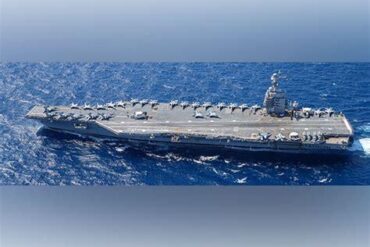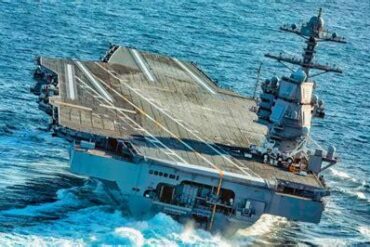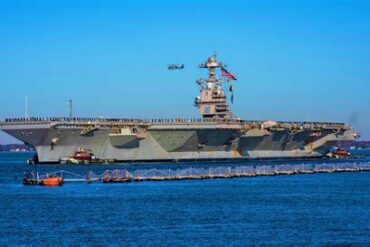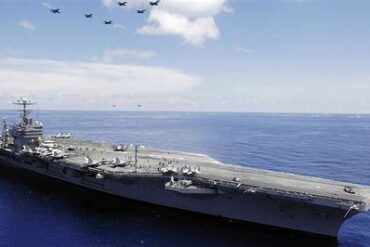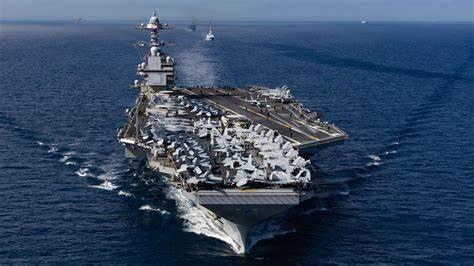
Keeping a US Navy supercarrier deployed for 300 days is far more expensive than simply adding up fuel, food, ammunition, and sailor salaries. A nuclear-powered carrier may not need conventional fuel to propel itself across an ocean, but the Carrier Strike Group (CSG) surrounding it consumes enormous resources every day. When the aircraft carrier, air wing, escort ships, submarine, aircraft, weapons, maintenance requirements, and thousands of sailors are considered together, the financial commitment becomes extraordinary.
A widely cited estimate places the cost of operating a carrier strike group at roughly $6.5 million per day. Applied across a 300-day deployment, that produces a basic operating bill of approximately $1.95 billion. But that figure is better understood as a starting point than a final invoice. Inflation-adjusted calculations have pushed the estimated daily cost considerably higher, while combat operations, emergency repairs, unexpected diversions, and delayed maintenance can create additional expenses that are difficult to capture in a single daily number.
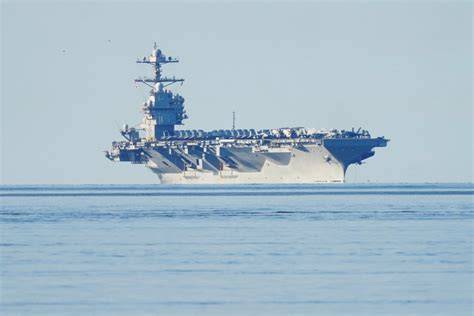
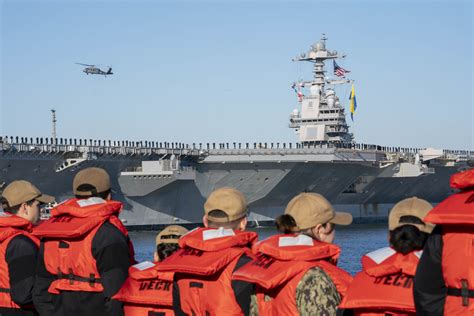
The financial scale becomes even clearer when considering the USS Gerald R. Ford (CVN-78) and its extraordinary deployment history. The Ford eventually spent 326 days away from Norfolk, turning what might have been a conventional overseas cruise into a prolonged global commitment. Using the older $6.5 million daily estimate, such a deployment would already approach $2.12 billion. Using a more recent inflation-adjusted estimate of $9.05 million per day, the theoretical cost rises to approximately $2.95 billion.
What the $6.5 Million Daily Carrier Cost Really Includes
The frequently cited $6.5 million-a-day figure originated with a 2013 study by Captain Henry Hendrix titled At What Cost a Carrier. The calculation was designed to examine the full life-cycle cost of maintaining a carrier-centered naval force rather than treating the aircraft carrier as an isolated warship.
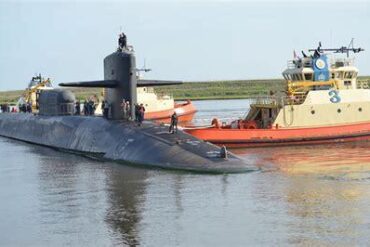
That distinction matters. A supercarrier does not operate alone. A typical strike group includes the carrier itself, a carrier air wing containing roughly 60 to 80 aircraft, several surface combatants, a fast-attack submarine, and thousands of sailors and officers. The combined force represents a mobile military ecosystem rather than a single ship.
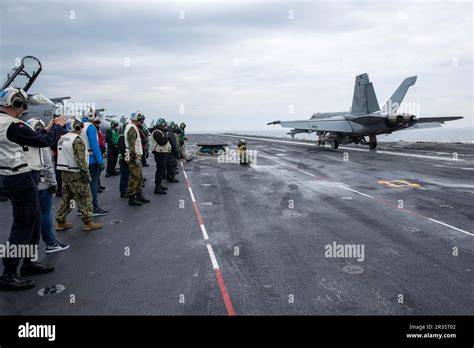
The air wing adds another enormous layer of expense. Fighters, electronic warfare aircraft, airborne early-warning aircraft, helicopters, spare engines, weapons, aviation fuel, maintenance equipment, and replacement parts all have to remain available. Every sortie consumes resources, and a high operational tempo accelerates wear on aircraft engines, landing gear, tires, brakes, avionics, and other components.
The escorts also contribute substantially to the bill. Destroyers must operate their own propulsion systems, radars, communications networks, combat systems, and missile inventories while protecting the carrier. A submarine operating beneath the surface adds another highly specialized and expensive component. The result is a fleet whose daily cost is measured in millions of dollars even before combat begins.
Inflation Has Changed the 300-Day Calculation
The original estimate becomes considerably more striking when adjusted for modern costs. Brown University’s Costs of War project revisited the Hendrix calculation in 2025 and estimated that the equivalent daily cost had increased to approximately $9.05 million.
That produces a theoretical cost of about $2.72 billion for 300 days.
The difference between $1.95 billion and $2.72 billion demonstrates why the phrase “daily operating cost” can be misleading. The same deployment can appear to have dramatically different price tags depending on the methodology, inflation adjustment, force composition, and expenses included.
The Ford’s 326-day deployment illustrates the difference even more dramatically. At $6.5 million per day, the calculation reaches approximately $2.12 billion. At $9.05 million per day, it approaches $2.95 billion.
Neither number should be treated as an official Pentagon invoice. The US Navy does not publish a simple public accounting showing exactly how much one individual carrier strike group costs for every day at sea. Instead, these estimates provide a framework for understanding the scale of the commitment.
The USS Gerald R. Ford Makes the Numbers Even Bigger
The Ford-class carriers were designed to deliver greater sortie generation and operational efficiency than the preceding Nimitz class. The USS Gerald R. Ford itself reportedly carries a procurement price of around $13.3 billion, compared with roughly $8 billion for the final Nimitz-class carrier, USS George H.W. Bush.
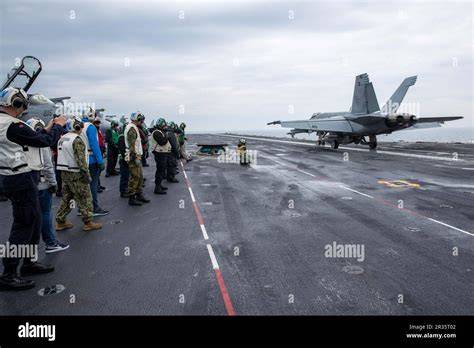
The higher price reflects an entirely different generation of naval technology. The Ford incorporates electromagnetic aircraft launch systems, advanced arresting technology, more automated systems, and redesigned shipboard operations intended to reduce manpower requirements while increasing aircraft throughput.
The Navy projected that the Ford could eventually generate around 160 aircraft sorties per day, compared with approximately 120 for a Nimitz-class carrier under comparable assumptions. That additional capacity is strategically valuable, but it also means that the ship is an enormous concentration of technology and human expertise operating continuously in a harsh environment.
A carrier can therefore become more expensive to keep deployed precisely because it is doing what it was designed to do: generating and supporting sustained aviation operations. Every additional day at sea increases the cumulative demand on machinery, aircraft, crews, spare parts, and maintenance teams.
A 300-Day Deployment Is Not Just 300 Days of Normal Operations
The biggest weakness in a simple daily estimate is that not every day costs the same. A carrier spending a quiet day conducting routine operations is financially different from one launching combat sorties, firing defensive missiles, responding to emergencies, or being diverted thousands of miles from its planned deployment route.
The Ford’s extended deployment demonstrates how quickly circumstances can change. What began as a conventional overseas cruise developed into a sequence of missions spanning multiple regions. The carrier was diverted from its original plans and eventually operated in increasingly demanding environments.
Such changes have consequences throughout the strike group. Aircraft accumulate flight hours. Engines require more frequent inspection. Weapons stocks decline. Maintenance teams work longer hours. Escort ships consume missile inventories and accelerate their own maintenance requirements.
The strategic bill can therefore grow even when the direct operating cost appears relatively stable. A destroyer that fires expensive interceptors during a combat engagement does not simply spend another ordinary day at sea. It creates a requirement for replenishment, transportation, maintenance, testing, and eventually industrial replacement.
The Hidden Cost of Carrier Repairs at Sea
Perhaps the most revealing expenses are the ones that never appear in a headline budget number. A supercarrier is effectively a floating industrial city containing thousands of people, hundreds of compartments, extensive electrical systems, aircraft maintenance facilities, kitchens, medical spaces, machinery rooms, and sanitation systems.
Something is always breaking.
The Ford experienced repeated difficulties with its complex vacuum wastewater system, which serves hundreds of toilets across the ship. Independent estimates cited in the reference material suggested that dealing with the problem could consume hundreds of thousands of dollars per day in specialized chemicals and associated work.
The episode illustrates an important point: even a relatively mundane system can become strategically significant aboard a nuclear carrier. A plumbing failure cannot simply be ignored until the ship returns home. If a critical system stops functioning, sailors must improvise repairs using available materials, while specialized personnel may have to work around the clock.
The cost is therefore not limited to replacement parts. It includes labor, supplies, lost operating efficiency, additional logistics flights, and potentially diverted missions.
Fire Damage Can Become a Fleet-Wide Financial Problem
The same principle applies to major accidents. A fire aboard a deployed carrier can create costs far beyond the immediate physical damage.
The Ford experienced a serious fire in its industrial laundry area during its extended deployment. Hundreds of sailors were displaced from their berthing areas, smoke affected parts of the ship, and the carrier required emergency attention. Events like this can force a ship away from its assigned operating area and disrupt the schedules of the entire strike group.
The most important financial consequence may come later.
A carrier that returns late can miss its scheduled maintenance window. That delay affects the shipyard, which already has other vessels waiting for work. Those vessels may then remain unavailable longer, forcing operational planners to adjust deployment schedules elsewhere in the fleet.
This creates a maintenance domino effect. One delayed carrier can influence another carrier’s schedule, which can affect a third ship’s deployment. The resulting cost is difficult to calculate because it involves opportunity cost and fleet availability rather than a single repair invoice.
America’s 11-Carrier Fleet Leaves Little Room for Error
The United States currently maintains 11 nuclear-powered aircraft carriers, a fleet dramatically smaller than the carrier force available during the Cold War. That makes each individual hull more important.
The Navy’s operational model depends on rotating carriers through deployment, training, maintenance, and preparation periods. The objective is to keep enough ships available without exhausting crews or allowing maintenance requirements to accumulate faster than shipyards can handle them.
A deployment that stretches from approximately seven months to nearly a year disrupts that balance.
The problem becomes particularly serious when the ship returning from an extended mission requires substantial maintenance. Instead of simply returning to its normal rotation, the carrier may need an extended period in a shipyard. The next carrier may then be asked to remain deployed longer, creating another delay further down the chain.
That is where the true cost of a 300-day deployment becomes much larger than the estimated $2 billion to $3 billion operating bill. The deployment can consume future availability that was never included in the original calculation.
Crew Fatigue Is Another Hidden Cost
There is also a human dimension to prolonged deployments that cannot be reduced to a spreadsheet.
A carrier requires thousands of sailors to operate continuously. Aircraft must be launched and recovered, reactors monitored, weapons maintained, aircraft repaired, meals prepared, medical services provided, and thousands of routine tasks completed every day.
Extending a deployment means extending that workload.
Long periods away from home can affect morale, retention, training schedules, family life, and the Navy’s ability to move sailors into their next assignments. The financial consequences can emerge years later through recruitment and retention challenges.
For a specialized nuclear carrier crew or experienced naval aviator, replacement is not instantaneous. Training a qualified sailor or pilot represents another investment of time and money, while losing experienced personnel can reduce the effectiveness of the force even after the ship finally returns to port.
Why the $3 Billion Figure Still May Not Be the Full Cost
A $2.7 billion to $3 billion estimate for a 300-day deployment should therefore be viewed as an analytical range rather than a precise bill.
It captures the enormous cost of maintaining a carrier strike group but cannot perfectly measure every consequence of prolonged deployment. Combat ammunition, emergency repairs, aircraft losses or accelerated component wear, shipyard delays, additional logistics, and future maintenance requirements can all push the ultimate economic impact higher.
There is also a strategic cost that cannot easily be expressed in dollars. If one carrier remains deployed for an unusually long period, another carrier may be unavailable for training or maintenance while waiting to assume the next operational role. The Navy can temporarily stretch its forces, but it cannot eliminate the physical limits of ships, aircraft, sailors, and shipyards.
The Ford’s 326-day deployment therefore represents more than a record of endurance. It is an unusually clear demonstration of the financial and operational price of keeping a modern supercarrier at sea for an extraordinary length of time.
The Real Price of Keeping a Supercarrier at Sea
A 300-day deployment can begin with a deceptively simple calculation: $6.5 million per day multiplied by 300 days equals $1.95 billion. Adjust the underlying estimate for inflation and the figure rises to approximately $2.72 billion. Apply the same modern estimate to 326 days and the theoretical total approaches $2.95 billion.
But the real cost extends beyond those numbers.
A supercarrier is not merely a $13 billion warship sailing through the ocean. It is the center of a vast network of aircraft, escorts, submarines, sailors, weapons, maintenance teams, logistics infrastructure, and industrial capacity. Keeping that system deployed for 300 days places continuous pressure on every part of the network.
That is why the most important cost of an exceptionally long deployment may not appear until the carrier returns home. Shipyard congestion, deferred maintenance, exhausted crews, reduced fleet availability, and accelerated equipment wear can continue affecting the Navy long after the carrier leaves the operational theater.
The arithmetic is impressive: roughly $2 billion to nearly $3 billion for a single prolonged deployment under commonly cited estimates. The deeper lesson is even more significant. For a fleet with only 11 nuclear carriers, every additional month at sea is not simply another month of military presence. It is an increasingly expensive decision that shifts costs into the future, where they can eventually appear as maintenance delays, manpower pressure, and fewer carriers available for the next crisis.