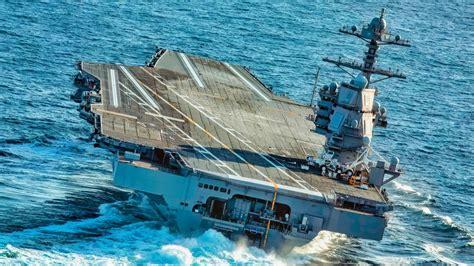
The question of how quickly a U.S. Navy supercarrier can travel from American shores to the Middle East is more than a matter of curiosity—it reveals the raw logistical power behind modern naval dominance. These floating airbases are not only symbols of military strength but also instruments of rapid global response, capable of repositioning thousands of personnel and dozens of aircraft across oceans with remarkable efficiency.
At the center of this capability is nuclear propulsion, a technological advantage that allows supercarriers to operate for years without refueling. Unlike conventional ships, their range is effectively limited only by food supplies and mission parameters. This endurance makes them uniquely suited for long-distance deployments, especially when geopolitical tensions demand swift presence in regions like the Persian Gulf.
To understand the timeline, consider a typical departure point: Naval Station Norfolk, the largest naval base in the world. From there, the most direct route to the Middle East spans the Atlantic Ocean, cuts through the Mediterranean Sea, passes the Suez Canal, and continues into the Gulf region. This journey covers approximately 8,560 nautical miles (9,850 miles) under ideal conditions.
Maximum Speed vs Operational Reality
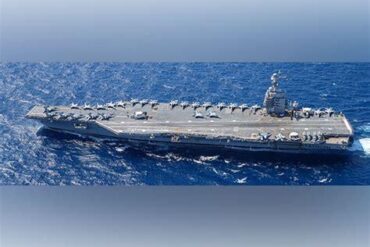
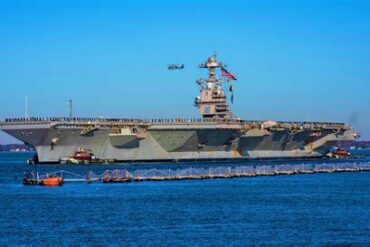
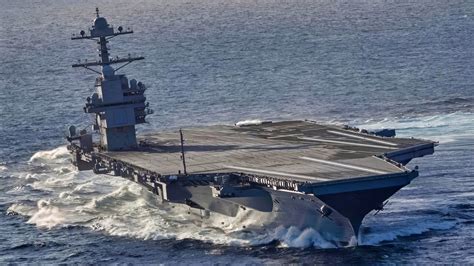
The USS Gerald R. Ford, the most advanced aircraft carrier ever built, is widely believed to exceed 30 knots (around 35 mph). On paper, this suggests an incredibly fast transit time. If a carrier could maintain that speed continuously across the entire journey, it would reach the Middle East in just under 12 days.
However, real-world naval operations rarely align with theoretical maximums. Supercarriers do not travel alone—they are the centerpiece of a carrier strike group, which includes destroyers, cruisers, and supply ships. These vessels must move together, and their collective speed dictates the pace. In practice, this reduces the average speed to approximately 25–29 mph.
Even at this moderated pace, the distance can be covered efficiently. Rear Admiral Paul Lanzilotta once noted that a strike group can move over 700 miles in a single day, a figure that underscores both speed and coordination. Still, sustaining this pace continuously across thousands of miles introduces operational complexities.
The Suez Canal Bottleneck
One of the most significant constraints on transit time is the Suez Canal, a narrow but vital passage linking the Mediterranean to the Red Sea. While a supercarrier may dominate open waters, the canal imposes strict limitations. Large vessels like the Gerald R. Ford are restricted to speeds of approximately 8.5 mph through its 120-mile length.
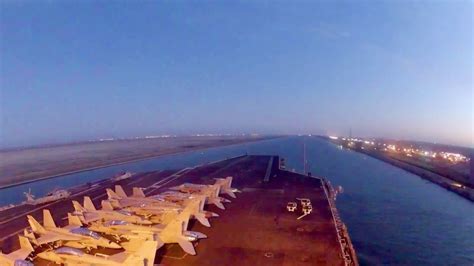
This forced slowdown adds many hours to the journey and requires precise navigation, coordination with canal authorities, and often waiting periods before entry. The canal is not just a passage—it’s a logistical choke point where even the most powerful warships must yield to infrastructure constraints.
Environmental and Strategic Variables
Beyond speed limits and escort coordination, numerous factors can influence travel time. Sea state, for example, can significantly affect speed and fuel efficiency for accompanying ships. Rough waters may force a reduction in speed to maintain formation integrity and ensure safety.
Operational considerations also play a role. A carrier strike group may alter its course for strategic positioning, intelligence gathering, or to avoid potential threats. Additionally, the need for replenishment at sea, even for non-nuclear escort vessels, can introduce pauses or deviations.
Weather systems across the Atlantic and Mediterranean can further complicate planning. Storms, high winds, and visibility issues are not merely inconveniences—they are variables that can reshape an entire deployment timeline.
Realistic Transit Time: Just Over Two Weeks
When all factors are accounted for—reduced group speed, canal restrictions, and operational realities—the journey from the U.S. East Coast to the Middle East typically takes around 14 to 15 days. This estimate assumes relatively smooth conditions and minimal delays, making it a practical benchmark for planning purposes.
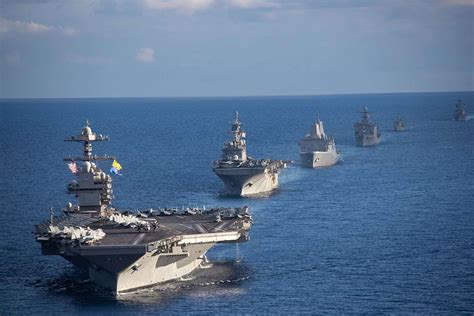
This timeframe highlights a critical truth: even the most advanced naval assets operate within a framework of coordination, geography, and physics. Yet, the ability to project such overwhelming force across nearly 10,000 miles in just over two weeks remains a staggering demonstration of capability.
In strategic terms, that speed translates into deterrence, flexibility, and global reach. It means that when a crisis emerges, a fully equipped air wing—complete with fighters, surveillance aircraft, and support systems—can be on station in a matter of days, not months. That is the true power of a U.S. Navy supercarrier: not just how fast it moves, but how decisively it arrives.