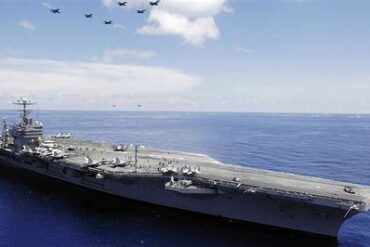
When Washington orders a carrier strike group to surge toward the Middle East, the clock starts ticking immediately. A U.S. Navy supercarrier is not simply a floating runway; it is a mobile airbase, a sovereign projection of power wrapped in 100,000 tons of steel and nuclear engineering. The key question is brutally practical: how fast can it get there?
The answer begins with geography. A carrier departing Naval Station Norfolk, Virginia, must cross more than 5,900 nautical miles to reach the Suez Canal. After transiting the 120-mile canal, it continues down the Red Sea for roughly 1,200 miles, then through the Gulf of Aden for another 920 miles before entering the Arabian Sea, the operational gateway to the Middle East. In total, the journey stretches approximately 8,140 miles.
At its publicly stated maximum speed of around 30 knots — roughly 35 miles per hour — a Ford-class carrier could theoretically cover that distance in under ten days if it maintained flanking speed continuously and faced no operational delays. In reality, naval movements are shaped by tactical discretion, sea state, and strategic signaling. Even so, a timeline of about 8 to 10 days is entirely plausible for an unobstructed transit.
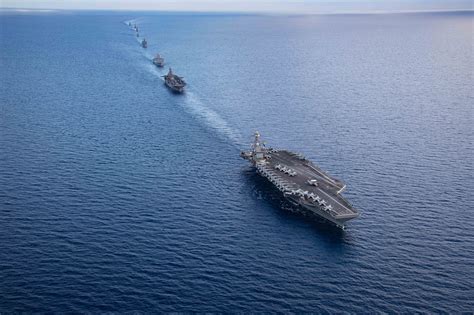
The Speed of a Nuclear-Powered Supercarrier
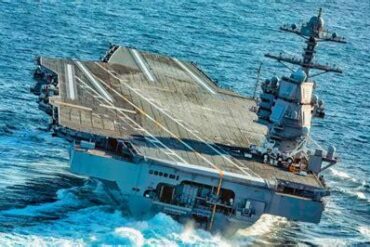
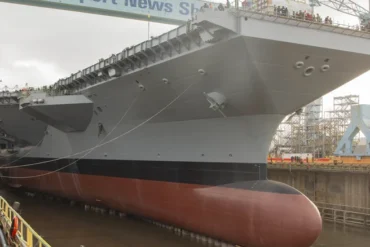
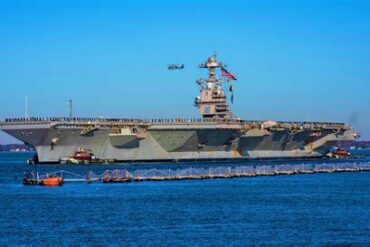
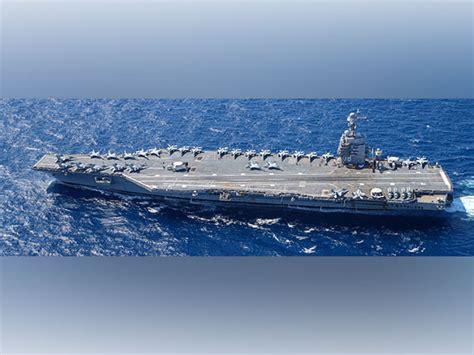
The crown jewel of the fleet, the USS Gerald R. Ford, stretches 1,106 feet in length with a waterline beam of 134 feet. Despite its immense size, this vessel moves with surprising agility. Power comes from two nuclear reactors that generate steam to drive turbines producing approximately 280,000 shaft horsepower across four shafts. To put that into perspective, even the most powerful commercial tugboats rarely exceed 22,000 horsepower.
Officially, the Navy lists 30 knots as the top speed. The actual maximum is classified. Naval architecture suggests that emergency speeds could exceed published figures, though sustained operation at extreme velocity would stress mechanical systems and consume enormous logistical bandwidth. Persistent rumors claim 40 knots is possible, but physics and hull design constraints make that unlikely for sustained travel. The credible benchmark remains around 30 knots.
What makes this speed remarkable is endurance. Unlike conventional warships, a nuclear-powered aircraft carrier does not require fuel stops for propulsion. Its reactors can operate for decades before refueling. That means the carrier can cross oceans without pausing for bunker fuel, eliminating a major bottleneck that slows conventional fleets.
Why Transit Speed Matters in Middle East Deployments
Speed is not merely about arriving first; it shapes deterrence. When tensions escalate in the Middle East, the visible movement of a carrier strike group sends a calibrated message. An 8,000-mile voyage completed in under ten days demonstrates logistical depth and operational reach. It reassures allies and complicates adversary planning.
A carrier rarely sails alone. It travels with destroyers, cruisers, and supply ships forming a carrier strike group. While the carrier itself can maintain high speeds, escorts and replenishment schedules may influence the overall pace. Still, U.S. naval doctrine emphasizes rapid forward presence. The ability to reposition overwhelming air power across hemispheres within days remains central to American maritime strategy.
Transit through chokepoints like the Suez Canal introduces variables. Canal scheduling, regional security conditions, and diplomatic clearance can affect timing. Alternatively, a carrier could reroute around the Cape of Good Hope, adding thousands of miles and extending transit by weeks. Strategic urgency determines the chosen path.
Engineering Power and Strategic Cost
The speed and endurance of a supercarrier come at staggering expense. Nuclear propulsion systems are extraordinarily complex and costly to build and maintain. The United States operates 11 nuclear-powered aircraft carriers, each representing tens of billions of dollars in lifetime investment.
Yet that cost buys strategic flexibility. Emerging technologies, including the integration of 3D-printed components aboard carriers, aim to streamline maintenance and reduce downtime. The faster repairs can be made at sea, the less operational tempo is disrupted during deployments.
Ultimately, a U.S. Navy supercarrier can reach the Middle East from the American East Coast in roughly a week and a half under optimal conditions. That capability reflects more than raw speed; it embodies industrial scale, engineering mastery, and decades of maritime doctrine refined for global reach. In an era defined by rapid crises and shifting alliances, the ability to move a floating airbase across oceans in days remains one of the most formidable demonstrations of naval power ever devised.