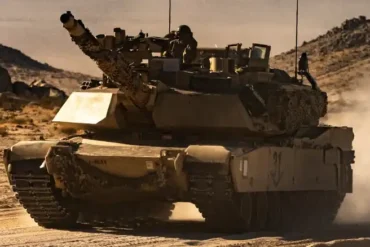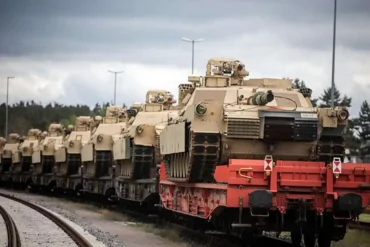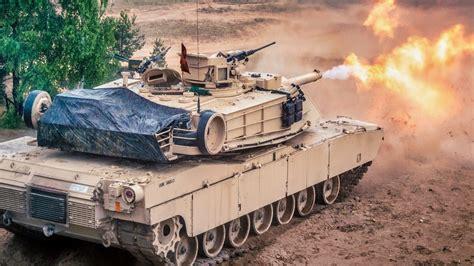
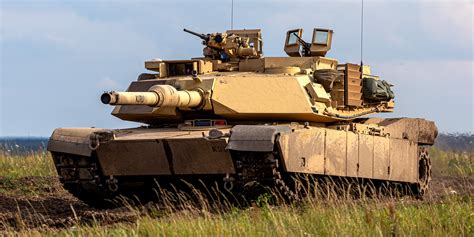
The M1 Abrams main battle tank has remained an enduring symbol of American land power for over four decades, blending overwhelming firepower with rugged protection and impressive mobility. While much is made of its formidable armament and heavy armor, one of the most overlooked yet critical aspects of the M1 Abrams’ battlefield prowess is its top speed and ability to maneuver despite its massive frame.
Introduced in 1980, the M1 Abrams was engineered not only to dominate in firepower but also to move with agility unheard of in tanks of its class. Weighing anywhere between 62 to 73.6 tons, depending on the variant and combat configuration, the Abrams is undeniably one of the heaviest military vehicles in active service. Yet, remarkably, it stands among the fastest tracked battle tanks ever constructed.
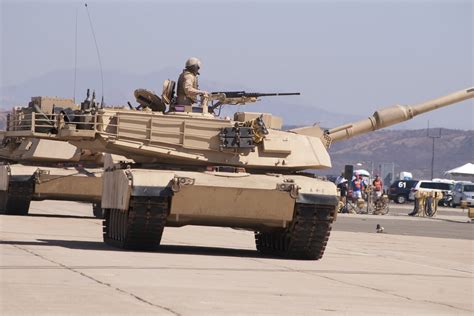
The M1 Abrams Top Speed: Breaking the Mold for Heavy Armor
Despite tipping the scales at over 60 tons — more than six fully loaded Type C school buses — the M1 Abrams can achieve a top speed of 45 mph (72 km/h) on level ground. This performance is astonishing, especially when considering the inherent mobility limitations of traditional tracked vehicles. It shatters the stereotype of tanks being sluggish steel beasts, replacing it with a new image of fast, lethal, and mobile armored warfare.
At the heart of this impressive speed lies the AGT1500 turbine engine, a powerplant supplied by Honeywell Aerospace Technologies. Unlike conventional diesel engines found in many tanks, the AGT1500 is a gas turbine design, similar in concept to jet engines but optimized for armored vehicles. It produces 1,500 shaft horsepower and generates a formidable 2,750 lb-ft of torque at just 3,000 RPM, propelling the Abrams across harsh terrain with relative ease.
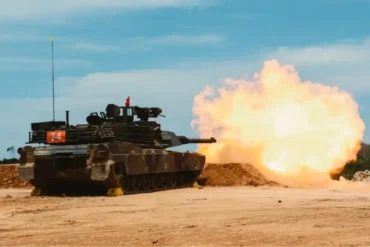
Crucially, the M1 Abrams doesn’t sacrifice combat capability for speed. Thanks to advanced stabilization systems, it can engage targets while on the move, delivering precise fire from its 120mm smoothbore main gun without halting — a decisive tactical advantage in dynamic combat scenarios.
Can the Abrams Go Faster? The Push for a Lighter, Swifter Tank
Though the Abrams’ current speed is exceptional for a vehicle of its weight class, there’s recognition within military circles that its increasing mass poses long-term mobility challenges. Each successive upgrade, focusing on enhanced protection and integrated technology, has steadily added pounds to the platform.
The most recent variant, the M1A2 SEPv3, now weighs 73.6 tons, a significant leap from earlier models. While these additions have improved survivability, they also restrict tactical transportability and operational flexibility. Moving such heavy armor, especially across bridges, rugged terrain, or via transport aircraft, becomes a logistical hurdle.
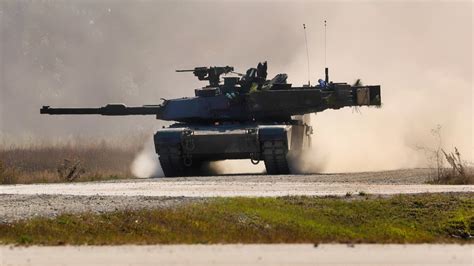
Acknowledging these limitations, the U.S. Army awarded General Dynamics Land Systems (GDLS) a pivotal contract in 2024 to design a next-generation Abrams variant, the M1E3. Central to this initiative is an ambitious goal: slash the tank’s weight to under 60 tons while incorporating cutting-edge battlefield technologies.
Achieving this reduction isn’t merely about shedding armor but reimagining the tank’s architecture. Some proposed changes include:
- Remote turret systems, reducing the size and weight of crew compartments.
- Enhanced composite armor, providing similar protection with lighter materials.
- Advanced situational awareness and digital integration, reducing reliance on bulky hardware.
A leaner Abrams could translate into greater speed, improved transportability, and superior battlefield responsiveness. While official estimates of the potential top speed for the M1E3 remain under wraps, military analysts speculate that reducing weight by over 10 tons could allow the new variant to surpass the 45 mph mark under optimal conditions.
Why Speed Matters in Modern Tank Warfare
In modern conflicts, raw speed isn’t just a matter of numbers on a spec sheet — it’s a game-changing tactical asset. The ability for a tank to rapidly reposition, exploit gaps, or evade incoming threats often determines battlefield success. Unlike static warfare of the past, today’s mechanized engagements demand agility alongside firepower.
For the M1 Abrams, speed enhances:
- Flanking capabilities, allowing armored units to outmaneuver slower adversaries.
- Urban operations, where quick repositioning minimizes exposure in dense environments.
- Survivability, by reducing the tank’s time in vulnerable positions.
- Combined arms operations, keeping pace with mechanized infantry and air support.
Moreover, being able to fire while moving, a signature feature of the Abrams, means speed translates directly to offensive pressure, denying adversaries the opportunity to engage static targets.
Looking Ahead: The M1 Abrams’ Future on the Battlefield
The M1 Abrams has evolved significantly from its 1980 origins, adapting to shifting combat environments, from the deserts of the Middle East to NATO exercises in Eastern Europe. Yet, as battlefield threats grow more sophisticated, so too must the platforms that face them.
The anticipated M1E3 variant is not merely an incremental upgrade but a foundational redesign to ensure relevance in coming decades. Weight reduction, enhanced speed, and integrated digital warfare systems will likely define its evolution.
In parallel, defense planners continue to explore powerplant innovations. While the AGT1500 has proven reliable, emerging technologies such as hybrid-electric drives could offer improved fuel efficiency, lower thermal signatures, and potentially even greater torque — all while preserving or exceeding current speed benchmarks.
Conclusion: The Abrams Remains a Force to Reckon With
For over 40 years, the M1 Abrams has exemplified the intersection of firepower, protection, and mobility. Its 45 mph top speed, remarkable for such a heavy armored vehicle, embodies the U.S. Army’s emphasis on maneuver warfare and rapid dominance.
As efforts to modernize and lighten the Abrams platform accelerate, future variants promise to push the envelope further, ensuring that American armored forces retain their edge in both speed and survivability. Whether crossing open deserts or contested urban environments, the Abrams remains poised to strike swiftly and decisively — a testament to the enduring power of battlefield mobility.
The next chapter of the Abrams story, spearheaded by the lighter, faster M1E3, could redefine expectations for what a modern battle tank can achieve — both in terms of raw speed and operational versatility.