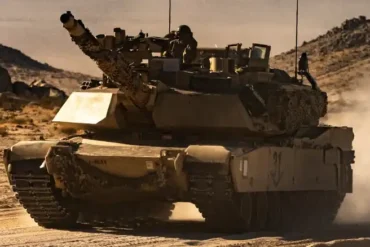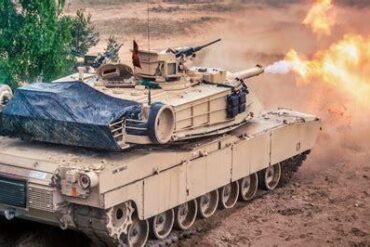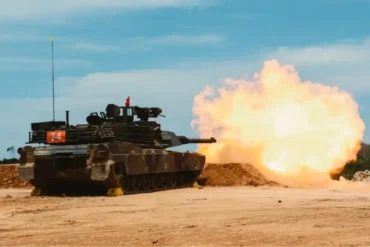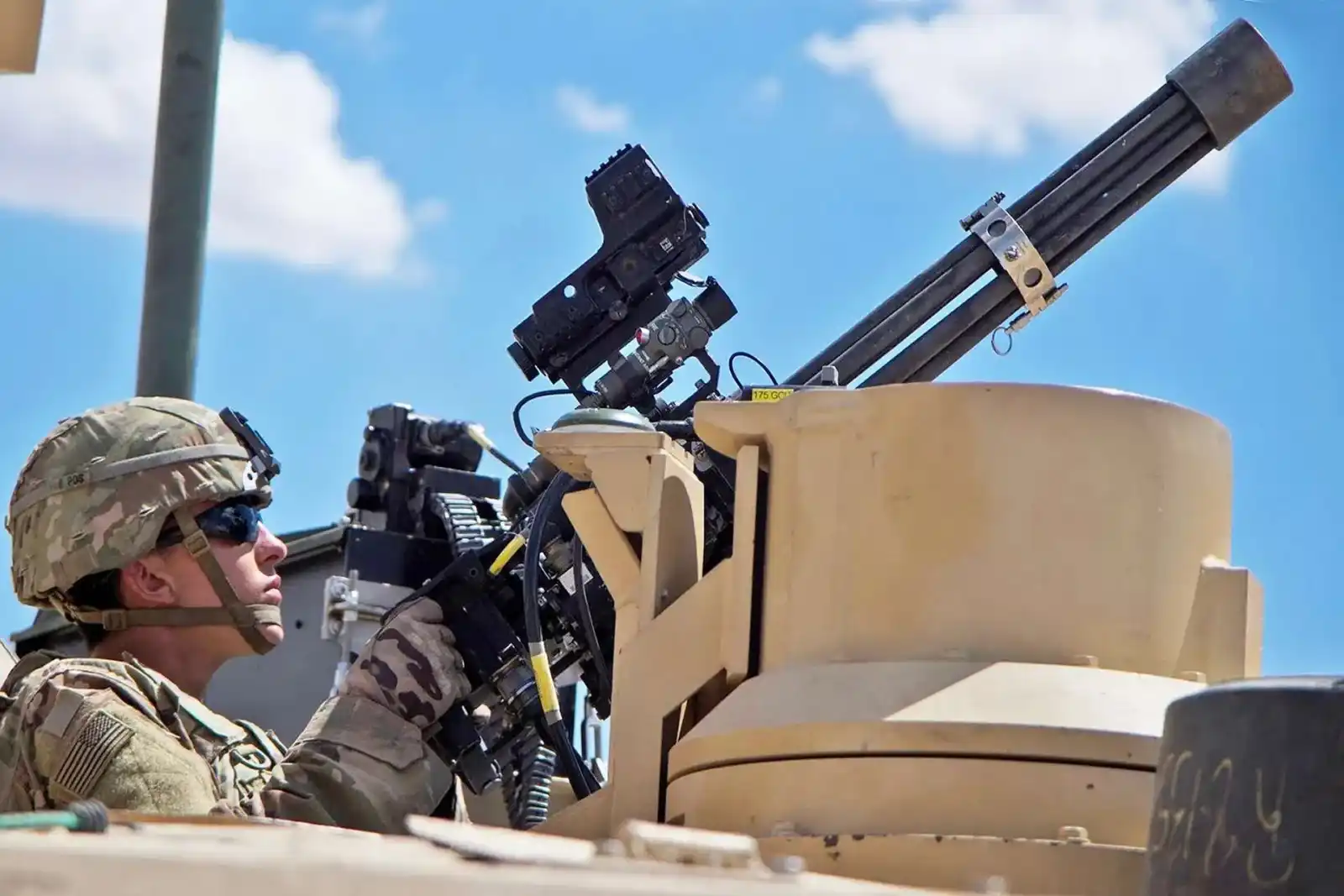
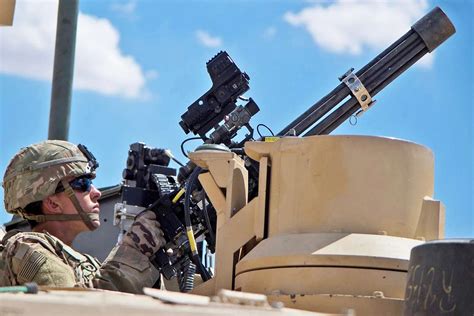
On July 26, 2025, the U.S. Army’s 1st Armored Division initiated a field test that may redefine the future of armored warfare. For the first time, an M134 Minigun—a six-barrel, electrically powered rotary machine gun typically mounted on helicopters—was integrated onto an M1 Abrams Main Battle Tank. The test, showcased via the Army’s official Instagram channel, underscores a critical pivot in U.S. military doctrine: adapting traditional armored forces to confront the rising menace of drones and loitering munitions on modern battlefields.
The modification replaces the standard M240 coaxial machine gun above the tank loader’s hatch with the M134, drastically enhancing the Abrams’ short-range air defense capabilities. This dramatic increase in firepower, capable of discharging up to 6,000 rounds per minute, is aimed squarely at addressing a glaring vulnerability that has become all too apparent in recent conflicts, particularly in Ukraine, where consumer-grade UAVs and cheap FPV drones have frequently threatened multimillion-dollar armored platforms.
Tactical Innovation Driven by Battlefield Realities
The rationale behind this unconventional pairing of rotary firepower and tank armor is straightforward yet transformative. As swarms of drones become increasingly available to both state and non-state actors, the traditional role of tanks is under threat. Active protection systems (APS) such as Trophy or Iron Fist offer some defense against projectiles, but their effectiveness against small, fast, low-signature drones is limited. The Minigun offers a different proposition: volume of fire.
Fitted with a Trijicon MGRS sight for manual aiming and supplied via a 3,000-round fixed ammunition magazine, the M134 on the Abrams functions as a last-resort shield against fast-moving aerial intrusions. The high rate of fire can saturate a sky sector within seconds, creating a lethal zone that no small drone is likely to survive. While manually operated in its current iteration, the configuration hints at the potential for automated fire control systems, such as those seen in Phalanx Close-In Weapon Systems (CIWS) used by the U.S. Navy.
A Global Trend in Ground-Based Rotary Anti-Drone Systems
While the U.S. Army’s use of the M134 on the Abrams is experimental, it mirrors similar moves across the globe as militaries scramble to find practical and mobile counter-UAV platforms. Recent examples include:
- Iran, which deployed M61A1 Vulcan clones mounted on 6×6 trucks for local air defense between 2022 and 2023.
- Poland’s Tarnów, which developed a system built around the WLKM 12.7mm Gatling gun, offering autonomous targeting and 3600 rounds per minute capabilities.
- China’s LD2000, a land-based CIWS equipped with a 30mm AO-18 clone Gatling cannon.
- Türkiye’s TOLGA Defense Shield System, a hybrid platform revealed at IDEF 2025, fusing soft-kill jamming technologies with hard-kill rotary firepower on a maneuverable 4×4 base.
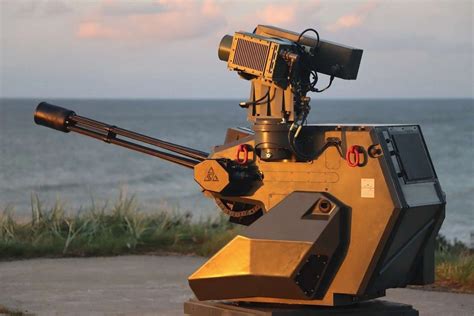
In contrast, the Abrams-based Minigun configuration is rudimentary by comparison—lacking radar guidance, auto-tracking, and soft-kill components. But where it lacks finesse, it compensates in brute force and platform survivability. The Abrams’ armor, power supply, and mobility grant it a unique edge as a highly protected, fast-responding drone killer, suitable for both offensive thrusts and defensive perimeter security.
Learning From Ukraine: The Catalyst for Evolution
One of the clearest lessons from the war in Ukraine is that armor without drone defense is a liability. Inexpensive drones have repeatedly crippled or destroyed high-value armored assets by bypassing their frontal armor and attacking from above or behind. Commercial drones adapted to carry improvised explosives or RPG warheads have proven devastating in ambush scenarios. With the front lines increasingly saturated by these threats, NATO forces are recalibrating for full-spectrum drone defense, and the M134-equipped Abrams may be the first public signal of how the U.S. Army intends to approach this problem.
The significance of this development lies not in its current form but in its trajectory. While today’s M134 is manually operated, tomorrow’s version may include radar-cued fire control, 360-degree optical tracking, and AI-assisted threat prioritization. These components are already in use in naval warfare and fixed-site CIWS applications; the challenge is downsizing and hardening them for battlefield mobility.
Toward a Layered Counter-UAV Doctrine
By placing a Minigun on the Abrams, the U.S. Army appears to be exploring a layered defense architecture for ground formations. This approach might involve:
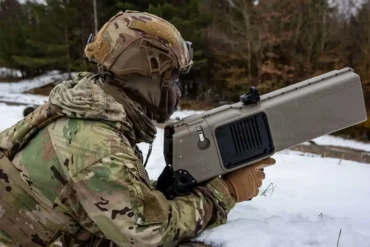
- Electronic warfare systems at brigade and battalion level to jam drone signals.
- Short-range kinetic systems like Miniguns, 20mm cannons, and even shotguns at vehicle level.
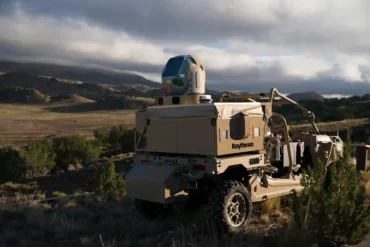
- Laser weapons and RF interceptors in development for silent, low-cost takedowns.
If successfully integrated, such systems will drastically enhance the survivability of mechanized units in drone-dense environments, where constant airborne surveillance and attack is expected. A hybrid M1 Abrams that can defend itself not only against anti-tank weapons but also airborne swarm attacks would be far more viable in peer or near-peer conflict zones.
Operational Implications and Future Deployment
The M134 Minigun’s inclusion on the Abrams is not yet part of an official program of record, indicating the U.S. Army is still in the experimental phase. However, the public nature of the trial suggests serious institutional interest. If future iterations prove successful, we may see:
- Retrofits of existing Abrams fleets with modular drone defense kits.
- New procurement guidelines demanding built-in short-range anti-drone capabilities.
- Cross-service applications, with the Minigun defense module potentially transferable to Bradley IFVs, Strykers, and JLTVs.
The trial also sends a strategic message to near-peer adversaries. It signals that the U.S. military is adapting faster, learning from global conflict zones, and willing to break from doctrinal orthodoxy. A tank that can provide high-volume suppression against drones, in addition to dominating ground threats, is a game-changer in environments where airspace dominance is contested or nonexistent.
Challenges and Trade-offs
While promising, the Minigun-on-Abrams approach does raise logistical and operational questions. These include:
- Ammunition logistics: At 6,000 RPM, even a 3,000-round magazine provides only 30 seconds of sustained fire.
- Thermal signature: Prolonged use of the Minigun may increase the vehicle’s heat profile, making it more visible to thermal-seeking munitions.
- Targeting accuracy: Without radar and auto-tracking, the system relies on crew reflexes and visibility, reducing effectiveness against small, fast-moving drones.
Nonetheless, the test is a credible step in addressing a rapidly growing threat vector. With continuous refinements, including multi-sensor integration, auto-cueing, and networked battlefield awareness, the M134-equipped Abrams could evolve into a multi-domain warfare platform that defines the future of armored combat.
Conclusion: A Glimpse into Tomorrow’s Tank Warfare
The U.S. Army’s decision to field test an M134 Minigun on an M1 Abrams tank marks a paradigm shift in how ground forces may respond to the drone threat of tomorrow. It reflects a willingness to integrate unorthodox solutions in order to build resilience against a decentralized, airborne enemy that grows more capable with each passing year.
As warfare moves into an era defined by ubiquitous sensors, AI-driven threats, and autonomous aerial platforms, legacy hardware like the Abrams must adapt—or risk obsolescence. The Minigun trial is not just an experiment in firepower. It’s a statement: in the battles to come, volume, velocity, and versatility will matter as much as armor and caliber.