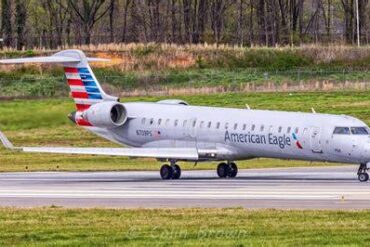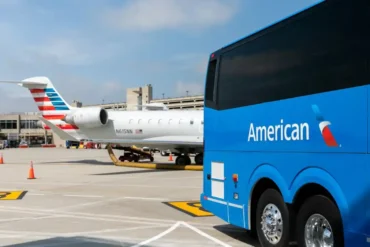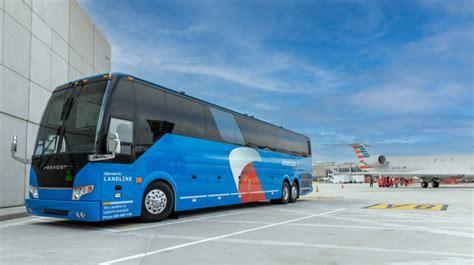
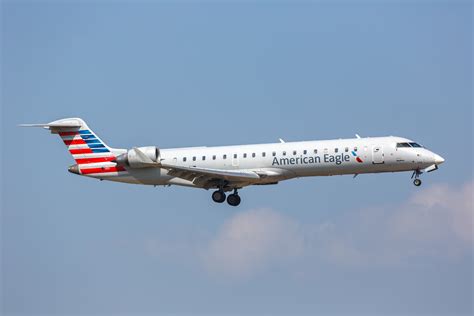
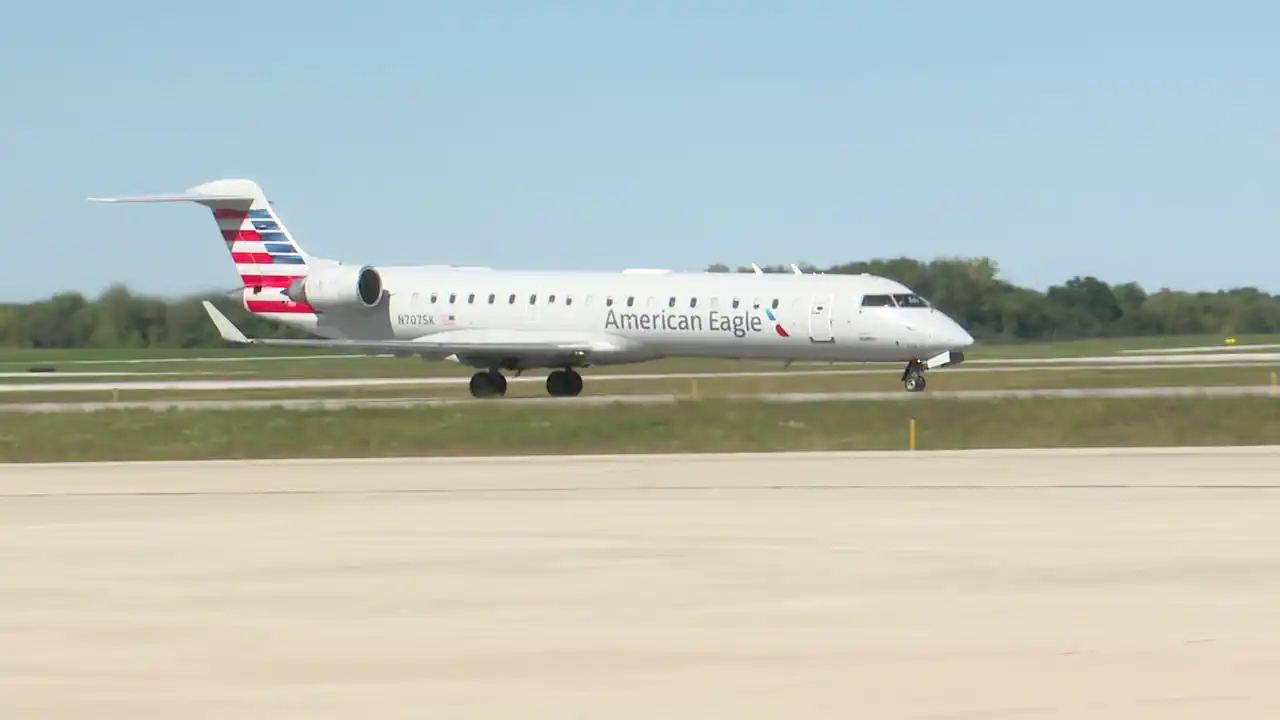
American Airlines has replaced its unusual 84-mile connection between South Bend Regional Airport (SBN) and Chicago O’Hare International Airport (ORD) with scheduled regional jet service, ending a year-long experiment in which passengers traveled between the two airports by motorcoach. Beginning October 5, 2026, American Eagle is operating three daily round trips on the route using 65-seat Bombardier CRJ-700 aircraft, replacing the 35-seat Landline buses that previously connected South Bend with its Chicago hub.
The change represents more than a simple equipment upgrade. The SBN–ORD service began on October 6, 2025, as one of the first two American Landline routes serving O’Hare, alongside Chicago Rockford International Airport (RFD). Just one year later, South Bend has moved from a ground feeder to a genuine air service, suggesting that passenger demand was strong enough for American to commit aircraft and regional crews to the market.
At only 84 miles (135 kilometers), the route becomes one of the shortest scheduled jet services in American Airlines’ domestic network. It ranks behind the 67-mile (109-kilometer) connection between Chicago O’Hare and Milwaukee Mitchell International Airport (MKE), but its length makes the use of a regional jet particularly notable. The aircraft will spend relatively little time in the air, yet the service can provide South Bend passengers with a more conventional airline experience and access to American’s extensive O’Hare network.
American Airlines Turns an 84-Mile Bus Connection Into a Flight
The original Landline service was designed to function much like a flight despite using buses. Passengers checked in through American, handled their baggage before departure and completed the required security process before boarding a 35-seat motorcoach. Once aboard, travelers were transported directly to the secure side of O’Hare, avoiding the need to repeat the airport process when they reached Chicago.
The buses were configured in a premium 2-1 seating arrangement and offered features including complimentary Wi-Fi. Passengers could also earn AAdvantage miles, allowing the ground connection to fit relatively smoothly into American itineraries. The concept gave the airline a way to connect a regional market to a major hub without immediately committing aircraft, flight crews and airport resources to the route.
The CRJ-700 changes that equation. American will operate three departures in each direction every day, compared with four daily bus departures under Landline. Despite the reduction in frequency, daily seat capacity rises substantially. Four 35-seat buses previously supplied 140 seats in each direction, while three 65-seat regional jets provide 195 seats. That represents a 39% increase in daily one-way capacity.
The aircraft also introduces a dual-class cabin to the South Bend–Chicago market. That gives passengers the opportunity to book a premium cabin on the connection, something the Landline operation could not provide in the same way as a conventional regional aircraft.
SkyWest CRJ-700s Increase Capacity at South Bend
The new services are operated by SkyWest Airlines, one of the largest regional airline operators in the United States. Its CRJ-700 is well suited to markets where demand is meaningful but does not necessarily justify a larger mainline aircraft.
For South Bend, the change is particularly significant because the airport is gaining more than an airplane. It is gaining additional capacity and a more traditional connection to a major airline hub. Travelers can use O’Hare to connect onward to American destinations throughout the United States and internationally.
South Bend Regional Airport CEO Mike Daigle said the decision reflects the performance of the route. According to the airport, the connection has been in high demand, with passengers gaining one-stop access to more than 350 destinations through American’s network.
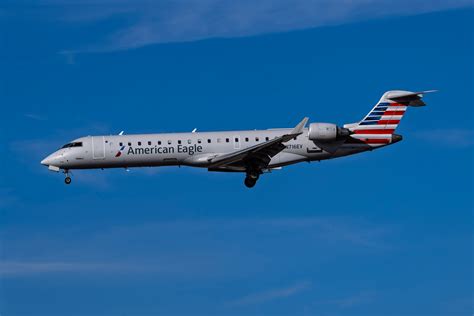
The timing also gives the change a clear significance. American introduced the SBN–ORD connection only one year earlier, meaning the airline has moved from testing a low-cost ground connection to operating regional aircraft in a remarkably short period.
South Bend and Rockford Take Different Paths
The contrast with Rockford is striking. American and Landline launched South Bend and Rockford as O’Hare feeder markets at approximately the same time, but their results have diverged sharply. South Bend has graduated to three daily regional jet flights, while American ended the Rockford Landline service on October 4.
The original strategy allowed American to test both markets without taking on the full cost and operational complexity of conventional air service. Landline effectively provided a low-risk way to establish connections between smaller airports and O’Hare while allowing American to observe passenger demand.
South Bend’s transition indicates that the experiment produced enough evidence to justify a larger commitment. Rather than treating the bus as the permanent solution, American has demonstrated that a motorcoach can act as an intermediate step before an airport receives actual scheduled flights.
United Already Has a Strong South Bend Presence
American is entering a market where it already faces established competition. United Airlines operates eight daily flights between South Bend and Chicago O’Hare, giving United a significantly larger schedule than American’s three daily departures.
That competitive environment makes American’s capacity increase more meaningful. United had previously expanded its own South Bend schedule from six to eight daily flights, indicating that the route has attracted enough traffic to support substantial hub connectivity.
American’s new CRJ-700 operation therefore gives travelers another choice while allowing the airline to compete directly for passengers seeking connections through O’Hare. The three daily flights are not enough to match United’s frequency, but the move gives American a larger physical presence in a market that it initially approached through buses.
Landline Remains Important to American Airlines
The end of the South Bend bus operation does not mean American is abandoning Landline. The airline continues to use the model extensively around Philadelphia International Airport (PHL), where Landline connects Philadelphia with Allentown/Bethlehem, Atlantic City, Wilkes-Barre/Scranton, Wilmington and Trenton.
Those five markets collectively account for 22 daily round trips, or 44 individual bus journeys, with more than 1,500 seats available each day. American says more than 200,000 passengers have used its Landline services since the program began connecting regional airports located within 100 miles of its hubs.
The attraction remains straightforward: passengers can start their journey at a smaller airport with easier parking and less congestion, then connect into a major airline network. For some markets, that arrangement may be more practical than operating a dedicated aircraft.
However, the South Bend transition shows that Landline can also serve another purpose. It can provide airlines with a relatively inexpensive way to establish a market before committing to scheduled air service.
What the South Bend Upgrade Means for O’Hare
The SBN–ORD change fits into American Airlines’ broader expansion at Chicago O’Hare. The airline added 29 destinations from O’Hare during 2025 and pushed its peak operation beyond 500 daily departures in 2026 while continuing to expand domestic and international connectivity.
South Bend is a small but revealing part of that strategy. American did not initially need to dedicate aircraft to the market. Instead, it used Landline to establish the connection, build awareness and measure demand. Once the route demonstrated sufficient potential, the airline could replace the buses with CRJ-700s.
The result is a rare example of a short-distance ground feeder evolving into scheduled regional aviation. At just 84 miles, the route is hardly a conventional long-distance airline market, but its importance lies in what it feeds: Chicago O’Hare and American’s wider global network.
For South Bend travelers, the practical result is more seats, a premium cabin option and a conventional regional aircraft connection to Chicago. For American, the change offers a stronger presence against United while showing that the Landline model can do more than replace short flights. In this case, the bus appears to have served as a stepping stone to the airplane.