Etihad Airways is preparing to expand its North American network, with nonstop flights between Abu Dhabi International Airport and Calgary International Airport weeks away. The service, scheduled to begin on October 25, 2026, will establish the first scheduled passenger connection between the Middle East and Alberta, giving travelers in western Canada a gateway to destinations across Etihad’s network in Asia, the Middle East, and beyond.
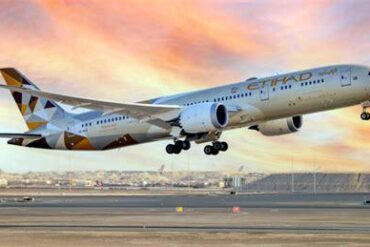
The new route will operate four times per week on Tuesdays, Thursdays, Saturdays, and Sundays. Etihad will deploy its Boeing 787-9 on the 6,243-nautical-mile (11,562-kilometer) journey, creating a long-haul link of almost fifteen hours westbound. Calgary becomes Etihad’s second Canadian destination after Toronto Pearson and its eighth destination in North America.

Etihad Abu Dhabi Calgary Route Begins October 25
Etihad’s new EY29 service will depart Abu Dhabi at 2:25 a.m. and arrive in Calgary at 7:00 a.m. local time after a scheduled flight of 14 hours and 35 minutes. The return EY30 will leave Calgary at 1:00 p.m. and reach Abu Dhabi at 12:55 p.m. the following day, with a scheduled duration of 13 hours and 55 minutes.
Those timings have been designed around Etihad’s broader connecting network rather than simply the nonstop market between the two cities. The early-morning departure from Abu Dhabi fits into one of the airline’s largest North American departure banks, allowing passengers arriving from major Asian markets, particularly India, to connect onward to Calgary. On the Canadian side, the long turnaround is intended to position the return flight for a major wave of inbound services from Canada and the United States.
The schedule shows that Etihad is using Calgary as a network destination rather than an isolated city pair. Passengers from Asia, the Middle East, and parts of Africa gain another path into Alberta without connecting through Toronto, Vancouver, or a U.S. hub.
Boeing 787-9 Brings High-Density Long-Haul Capacity
Etihad plans to operate the Calgary route with a 303-seat Boeing 787-9, one of the airline’s most important widebody aircraft. The carrier has 35 examples of the type, making the 787-9 its most numerous widebody aircraft. The particular configuration planned for Calgary is relatively economy-heavy, with 32 Business Class seats in a 1-2-1 layout and 271 Economy Class seats arranged 3-3-3 with approximately 31 inches of pitch.
The choice gives Etihad substantial capacity without requiring the larger Airbus A350-1000 or A380 used on some busy North American services. Calgary is demanding for long-haul operations because its high elevation reduces takeoff performance, particularly in warm conditions. Payload restrictions could therefore affect some flights returning to Abu Dhabi, depending on operating conditions.
On great-circle calculations, the route is Etihad’s fourth-longest connection to North America. However, when measured by scheduled flying time, it ranks sixth because winds and other operational factors influence the actual duration.
Calgary Expands Etihad’s North American Network
The Calgary launch comes as Etihad continues to expand its presence across North America. The airline introduced Atlanta service in July 2025 and added Charlotte in March 2026. Charlotte was particularly notable because it made Etihad the only Middle Eastern airline serving North Carolina with nonstop flights from the region.
With Calgary joining the schedule, Etihad will serve eight North American destinations: New York JFK, Atlanta, Boston, Chicago O’Hare, Washington Dulles, Toronto Pearson, Charlotte, and Calgary. The airline previously served Dallas, Los Angeles, and San Francisco, although those routes ended in earlier years.
Etihad Targets Connecting Demand From Asia
The strategic value of Calgary extends beyond Alberta’s local population. Etihad’s schedule is heavily influenced by connecting traffic, and the carrier has a particularly strong network across India and other Asian markets. By timing the Abu Dhabi departure within its North American bank, Etihad can feed passengers from those origins into Calgary while also connecting Calgary travelers into its wider network.
Calgary already has strong international competition and established connections through major hubs. Etihad therefore needs to offer more than a new city pair. Its advantage is the combination of single-stop itineraries from numerous markets and access to its expanding Middle Eastern network.
Etihad Will Become a Larger North American Operator
According to OAG data for November 2026, Etihad plans 57 weekly departures to North America, equivalent to roughly seven to nine flights per day. That places it behind Emirates and Qatar Airways among Middle Eastern operators, with Emirates scheduled for 119 weekly services and Qatar Airways for 98.
Etihad’s North American capacity has nevertheless grown strongly. Its planned November schedule represents a 17% increase from a year earlier, even as regional geopolitical disruption creates operating uncertainty. The expansion suggests the airline is positioning for long-term growth as conditions stabilize.
Calgary Gives Etihad A New Canadian Opportunity
The Calgary route will give Etihad two Canadian destinations for the first time, with Toronto continuing to serve as its other Canadian gateway. Toronto is also unique within the airline’s North American network because Etihad operates the Airbus A380 there, giving the route a different capacity profile from the new Calgary service.
For Calgary, the arrival of Etihad adds a new long-haul option to the Middle East and a direct connection to Abu Dhabi. Starting October 25, the route will combine a nearly 15-hour nonstop flight with Etihad’s connecting network, making it a strategically important North American addition in 2026.