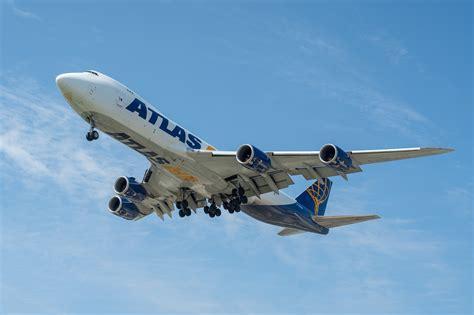
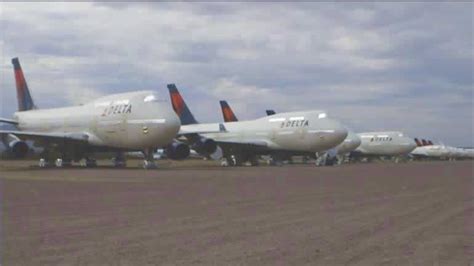
Delta Air Lines’ retired Boeing 747-400s may look like relics of a vanished era, but their value did not disappear when they left passenger service. Instead, the aircraft parked at Pinal Airpark in Arizona became an unexpected source of critical components for the shrinking global fleet of 747 freighters. As UPS Airlines, Atlas Air, and other cargo operators continue flying aging four-engine jumbos, parts recovered from retired passenger aircraft can make the difference between a short maintenance stop and a prolonged grounding.
The story began with Delta’s decision to retire its 747 fleet after decades of transpacific service. The aircraft had become increasingly difficult to justify economically as newer twin-engine widebodies offered better fuel efficiency and lower maintenance costs. Yet the retirement of these aircraft coincided with another problem: the enormous installed base of 747 freighters still working at cargo airlines around the world needed replacement components.
That created an unusual second life for Delta’s former passenger fleet. Instead of carrying passengers, the aircraft became donor airframes, supplying engines, avionics, landing gear components, hydraulic equipment, actuators, and other hardware to operators that still depend on the 747’s distinctive capabilities.
Delta’s Final Boeing 747 Flight Ended Passenger Service, Not the Aircraft’s Commercial Value
Delta’s Boeing 747 story reached its final chapter as a passenger operation in late 2017. The airline had inherited 16 747-400s through its merger with Northwest Airlines in 2008, giving Delta one of the last significant American passenger fleets of the iconic four-engine aircraft.
But the economics had changed dramatically.
The 747-400 required four engines, while newer aircraft such as the Boeing 787-9 and Airbus A350-900 could operate long international routes with only two. That difference mattered enormously on fuel-intensive transpacific flights. Four engines meant four sets of maintenance requirements, more components exposed to wear, and substantially greater fuel consumption compared with newer twin-engine aircraft.
Delta therefore completed its scheduled 747 passenger operation in December 2017, with the final service arriving at Detroit Metropolitan Wayne County Airport from Seoul Incheon. The aircraft that had once represented the peak of long-haul passenger aviation was suddenly facing a very different future.
On January 3, 2018, Boeing 747-400 N674US departed Atlanta for its final ferry flight to Pinal Airpark in Marana, Arizona. The approximately three-hour-and-33-minute journey was effectively the end of its passenger career.
Yet the aircraft had one more commercial contribution to make.
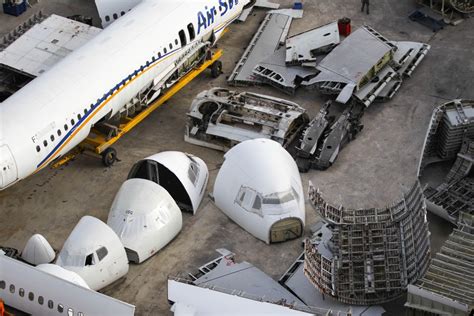
Pinal Airpark, commonly identified by its airport code MZJ, sits across roughly 2,080 acres of dry Arizona terrain. The desert environment is particularly suitable for aircraft storage because its low humidity reduces corrosion. Hundreds of aircraft can remain parked there while operators, maintenance companies, and teardown specialists determine whether individual airframes will eventually return to service, be preserved, or be dismantled.
Delta’s 747s were ultimately destined for dismantling. But that did not make them worthless. In fact, the opposite was true.
Why Retired Delta 747s Became Valuable Donor Aircraft
A retired commercial aircraft contains thousands of components, and many remain valuable long after the aircraft itself is no longer economically viable to operate.
For an airline operating an older 747 freighter, the most valuable item in the desert is not necessarily the aluminum fuselage. It can be a relatively small component that is difficult or impossible to purchase new.
This is where aircraft teardown becomes strategically important. Maintenance organizations can remove serviceable or overhaulable components from retired aircraft, inspect and certify them, and return them to the commercial parts market. Cargo operators can then use those components to repair aircraft that are still generating revenue.
For a company operating a high-utilization freighter fleet, that matters enormously. A grounded 747 is not simply an aircraft sitting on an apron. It represents lost cargo capacity, disrupted schedules, crew-planning complications, and potentially significant knock-on costs across a network.
Buying a replacement component from a retired aircraft can therefore make economic sense even when the component itself is decades old.
The alternative can involve ordering a newly manufactured part from an original equipment manufacturer or specialist supplier. For legacy aircraft, however, production volumes are tiny compared with those of modern aircraft. Some components may no longer be manufactured at all, while others can involve long production lead times.
The desert boneyard effectively provides a secondary supply chain for legacy aviation hardware.
Engines, Avionics and Landing Gear Can Keep Cargo 747s Operating
The Boeing 747-400 was built around highly complex systems, and many of those systems remain relevant to freighters derived from the same basic aircraft architecture.
The former Delta aircraft carried equipment associated with the 747-400 platform, including engines and numerous mechanical, hydraulic, electrical, and avionics components. Depending on configuration and condition, teardown specialists can recover flight control actuators, landing gear assemblies, computers, radar equipment, hydraulic components, doors, panels, and other valuable hardware.
Engines represent one of the most obvious examples.
A Pratt & Whitney PW4000-family engine or General Electric CF6-80C2 associated with a 747-400 can represent a substantial asset, particularly when a cargo operator needs a replacement or an engine undergoing maintenance requires additional parts. The value does not come simply from avoiding the purchase of an entirely new engine. It also comes from shortening the path toward returning an aircraft to service.
Avionics can be even more difficult.
An older aircraft may depend on computers, circuit cards, display equipment, control units, and other systems that are no longer being manufactured in large quantities. A component that appears obsolete from a modern aircraft perspective can still be essential to a 30-year-old freighter.
That creates an unusual aviation economy in which one retired aircraft can keep another aircraft alive.
A 747 that no longer makes economic sense as an operating aircraft can therefore remain economically useful as a collection of thousands of components.
Why UPS and Atlas Air Still Need the Boeing 747
The biggest reason the 747 remains important to cargo airlines is not nostalgia. It is capability.
Modern twin-engine freighters such as the Boeing 777F provide outstanding efficiency and have become increasingly important to global cargo networks. Nevertheless, the 747 possesses a feature that fundamentally changes what cargo can be loaded: the main-deck nose cargo door.
The 747’s hinged nose can swing upward, exposing the forward end of the main deck. This allows exceptionally long cargo to be loaded directly into the aircraft without making the sharp turn required by a conventional side-loading cargo door.
That capability is valuable for industrial equipment, machinery, aerospace components, oversized manufacturing equipment, and other freight that is awkward or impossible to load through a conventional side door.
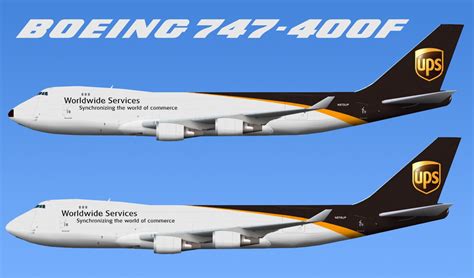
For operators such as UPS Airlines and Atlas Air, the 747 therefore provides something beyond simple payload capacity. It provides cargo flexibility.
A 747-400F can carry a substantial combination of main-deck and lower-deck freight, while its large fuselage volume makes it particularly useful for high-volume cargo. Its ability to accommodate approximately 30 standard cargo pallets on the main deck gives cargo planners a large working envelope.
On major international cargo corridors, that flexibility can be more important than the aircraft’s relatively poor fuel economy.
The 747’s Unique Nose Door Is Difficult to Replace
The retirement of the passenger 747 does not mean the aircraft’s basic cargo advantages have disappeared.
Quite the opposite.
As long as industries continue to move oversized freight by air, there remains a niche for an aircraft capable of accepting cargo through its nose. A modern twin-engine freighter can replace much of the 747’s work, but it cannot simply reproduce every aspect of its loading architecture.
This distinction is important when considering why cargo operators continue investing in maintenance for aircraft that are otherwise technologically outdated.
The decision is not necessarily between an old 747 and a new aircraft with identical capabilities. It can instead be between an aging 747 with unique cargo-loading characteristics and a modern aircraft that is cheaper to operate but unable to accept certain types of freight as efficiently.
That is why the 747 can remain commercially relevant even as its passenger career has completely disappeared.
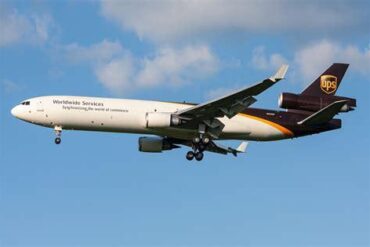
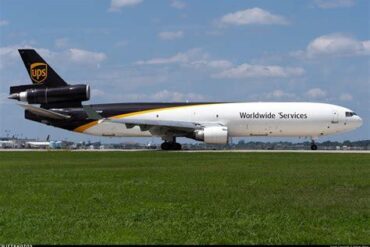
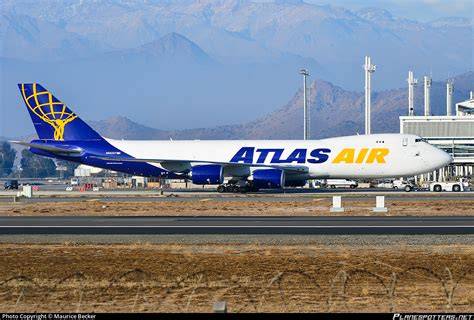
For Atlas Air, whose business includes specialized cargo and charter operations, the aircraft’s flexibility can be especially useful. UPS has also maintained a substantial 747 presence because its global express network requires enormous cargo capacity and schedule reliability.
The challenge is keeping those aircraft operational.
Boeing’s 747 Production Shutdown Changed the Spare-Parts Equation
The situation became more complicated when Boeing ended 747 production.
The final 747-8F was delivered to Atlas Air in 2023, bringing the production era of the legendary aircraft to a close. Once the production line ended, the industry lost more than an assembly line. It also lost the manufacturing ecosystem surrounding a major aircraft program.
Suppliers gradually have less economic incentive to maintain production capacity for components used only by a shrinking fleet. Tooling, engineering resources, production lines, and inventories can all become increasingly difficult to justify.
For a modern aircraft family with hundreds or thousands of active examples, suppliers can spread development and manufacturing costs across a large customer base. For an aging 747 variant, that equation is very different.
This makes retired aircraft increasingly important.
A passenger 747 sitting at Pinal Airpark may contain exactly the component required by a freighter operating thousands of miles away. The component may be old, but if it is inspected, certified, and compatible with the aircraft requiring it, its age becomes less important than its availability.
That is why the 747 boneyard has effectively become part of the freighter industry’s supply chain.
Every Teardown Removes Another Piece of the 747 Safety Net
There is an irony at the center of the entire process.
The more successfully retired aircraft support the surviving fleet, the faster the supply of donor components disappears.
Every aircraft dismantled at Pinal Airpark can provide engines, avionics, landing gear, actuators, structural components, and other equipment. But once those parts are removed and consumed, they cannot be harvested again.
That means the boneyard is not an infinite resource.
The remaining population of 747-400 passenger aircraft is shrinking, while the surviving cargo aircraft continue to accumulate flight hours and cycles. Eventually, the number of economically recoverable donor aircraft will become too small to support the remaining fleet.
At that point, cargo operators will face increasingly difficult choices.
They can spend more money maintaining older aircraft, invest in expensive component repairs, stockpile increasingly scarce parts, or accelerate fleet replacement with modern freighters.
The transition will not happen overnight. Aircraft can remain useful for decades when maintenance support is available. But the economics become progressively less attractive as parts become scarce.
The Boeing 747 Is Entering Its Final Commercial Chapter
The Delta Air Lines 747s therefore represent something much more significant than abandoned passenger aircraft in an Arizona desert.
They are physical remnants of an aviation generation that is gradually disappearing. Their components can still have direct operational value to aircraft flying international cargo routes today.
For UPS and Atlas Air, the desert donor fleet provides an important buffer against the realities of supporting aging four-engine freighters. Engines, avionics, landing gear components, hydraulic equipment, and flight-control hardware recovered from retired aircraft can help reduce downtime and extend the useful life of surviving 747s.
But the process also reveals the industry’s ultimate limitation.
There are no new 747-400s being built. Boeing’s 747 production line is gone. Many specialized components are becoming increasingly difficult to source. And every donor aircraft dismantled in Arizona reduces the remaining inventory of usable legacy hardware.
The Boeing 747’s final passenger flight may have happened years ago, but its commercial afterlife is still unfolding.
Delta’s N674US and its former Northwest siblings did not simply disappear when they entered the Arizona desert. Their components were absorbed into a global ecosystem supporting aircraft that continue carrying the world’s freight.
Eventually, however, the desert will run out of donors.
When that happens, the final 747-400 freighters will no longer have the same safety net of retired aircraft waiting to supply their parts. Their retirement will then become less about whether the aircraft can still fly and more about whether the industry can still afford to keep them flying.
That is the quiet significance of Delta’s 747 boneyard fleet: the aircraft may be grounded, but their parts are still helping keep the Queen of the Skies in commercial service.