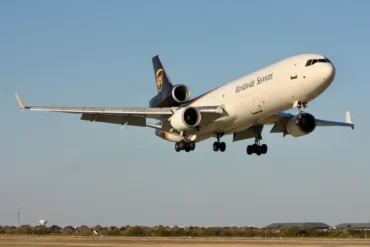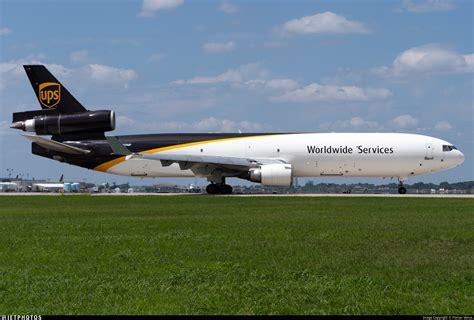
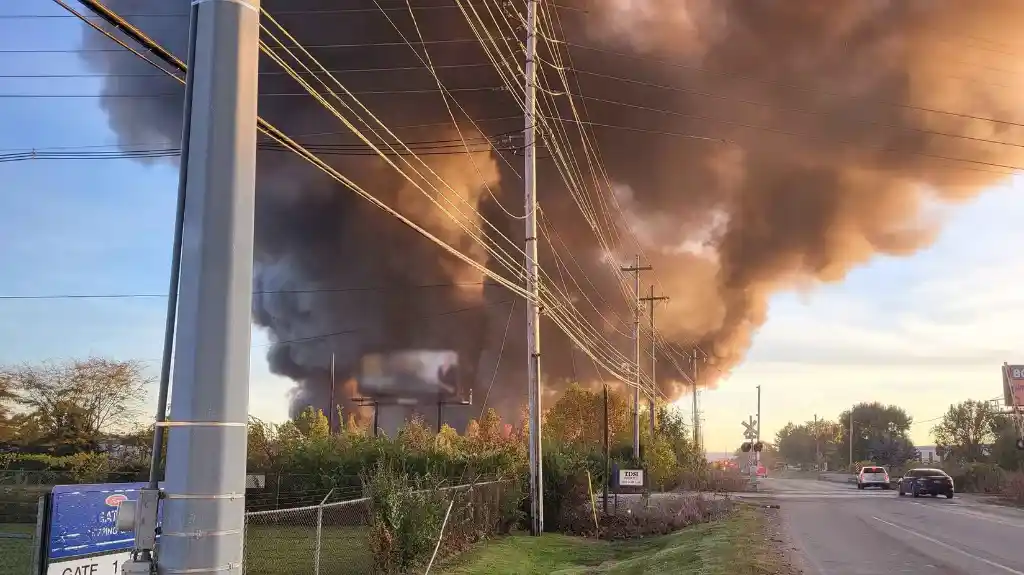
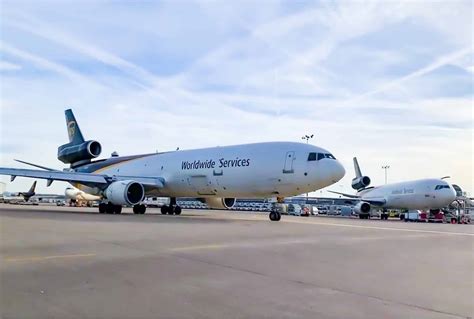
The coming legal battle surrounding the fatal UPS Airlines MD-11 freighter crash is growing into one of the most consequential aviation lawsuits in recent cargo history. The families of those killed in the accident are moving ahead with wrongful death claims, naming UPS, GE Aerospace, and Boeing as responsible parties. The allegations point to a chain of failures—mechanical, operational, and systemic—that culminated in the catastrophic engine separation that sent the aircraft spiraling into an industrial district last month. Fourteen lives were lost in seconds, including the entire three-member flight crew and eleven civilians on the ground, leaving families fractured and entire communities struggling to process the enormity of the disaster.
The National Transportation Safety Board (NTSB) disclosed early structural indications that support these legal claims. Preliminary investigations identified fatigue cracking within critical components of the airframe—a finding that raises complex questions about maintenance oversight, airworthiness decision-making, and the long-term viability of aging cargo fleets operating at high daily load cycles. Against this backdrop, legal counsels representing two victim families have confirmed lawsuit filings set to begin this week. Their focus is clear: assign responsibility, demand accountability, and pursue justice for lives that ended without warning.
Legal Teams Target Major Aviation Stakeholders For Negligence
Among the first plaintiffs are the families of Angela Anderson, age 45, and Trina Chavez, age 37—two women with no connection to aviation except that they were simply at work when a disintegrating aircraft fell from the sky. They are represented by Clifford Law Offices of Chicago and Sam Aguiar of Louisville, both known for high-profile aviation litigation. Their filings accuse UPS and its aviation subsidiary of negligence in fleet management and operational safety. The suit further extends liability to GE Aerospace, manufacturer of the aircraft’s powerplant, Boeing, successor to McDonnell Douglas and inheritor of the MD-11 design legacy, and VT San Antonio Aerospace, which handled maintenance and inspection responsibilities prior to the crash.
Attorneys argue the freighter was “old, tired, and well beyond its useful life,” suggesting profit margins superseded safety considerations. The case hinges on whether critical wear indicators were missed, ignored, or inadequately addressed—a determination that will shape industry standards for years. As lead attorney Bradley Cosgrove noted, when a fully loaded cargo tri-jet erupts into a fireball moments after rotation, its effect ripples far beyond the crash zone. Families face irreversible loss, survivors carry long-term trauma, and cities absorb environmental and economic damage that lingers long after news cameras leave.
Class Action Litigation Deepens Pressure On UPS, Boeing, And GE
The wrongful death filings follow an already-active class action lawsuit, initiated within forty-eight hours of the crash. That suit—led by Morgan & Morgan, one of the largest injury law firms in the United States—seeks restitution for residents and business owners facing permanent displacement, toxic exposure, and total loss of property. Plaintiffs describe a blast so violent it was likened to “a bomb detonating next door,” with debris raining across blocks and thick black smoke choking entire neighborhoods.
Legal arguments reference a troubling historical pattern: the MD-11 has experienced multiple high-profile incidents, including the infamous FedEx MD-11 crash in Tokyo in 2009 and documented anomalies involving the CFM56 engine series. With eleven hull losses over the fleet’s lifetime, the aircraft ranks among the least forgiving commercial jetliners ever operated—more than five percent of all MD-11s built have been destroyed in accidents. For communities living beneath cargo corridors, statistics like these are more than numbers—they represent risk embodied in metal and fuel.
FAA Grounding May Signal End Of The MD-11 Era
In response to the November disaster, the Federal Aviation Administration (FAA) issued an emergency grounding order across the remaining global MD-11 fleet. Before grounding, roughly sixty aircraft remained in commercial cargo service across FedEx Express, UPS Airlines, and Western Global Airlines. There is growing concern that the MD-11 may never return to active duty at scale. The cost of structural life-extension, engine inspection protocol, and potential redesigns could outweigh operational value in an industry increasingly adopting twin-engine widebodies for freight efficiency.
The tri-engine design, once celebrated for range and heavy-lift capability, now sits under a spotlight brighter than any in its 34-year service lifespan. The lawsuits will test legacy accountability across corporate lines—manufacturer, maintainer, operator—and the results could redefine liability expectations for aging fleets worldwide.
The Road Ahead: Justice, Compensation, And Industry Reckoning
Families affected by the crash are beginning a legal marathon that will draw expert testimony, forensic engineering analysis, and aviation safety scrutiny at the highest level. Wrongful death compensation claims may surpass typical precedents, especially if plaintiffs prove long-term systemic negligence rather than isolated mechanical failure. For UPS, Boeing, GE, and affiliated maintenance entities, the coming months may become a crucible—one that determines whether the crash was preventable and whether warnings were missed along the way.
The tragedy that ignited over an industrial park is now sparking a legal and ethical evaluation of how aviation companies balance cost, fleet age, and risk. Eleven civilians were never meant to be part of an aviation accident. Fourteen families should not need legal action to find answers. Yet the courtroom may become the only place where truth, responsibility, and closure can intersect.
Accountability now moves from the runway to litigation chambers, and the outcome is set to shape aviation safety conversations for years.