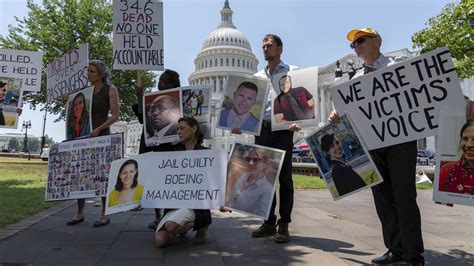
The controversial agreement between Boeing and the U.S. Department of Justice (DOJ) over two catastrophic 737 Max crashes has triggered fierce backlash from the families of the victims. On Wednesday, Boeing revealed it would pay $1.1 billion to settle potential prosecution stemming from the tragedies that claimed 346 lives, a move that is drawing sharp condemnation from legal advocates representing those who lost loved ones.
Spearheading the opposition is Sanjiv Singh, a lawyer representing 16 families affected by the 2018 Lion Air disaster. Singh has labeled the deal as “morally repugnant”, arguing that it allows Boeing to evade true criminal accountability for engineering flaws that led to the devastating loss of life.
The crashes in question — Lion Air Flight 610 in October 2018 and Ethiopian Airlines Flight 302 in March 2019 — exposed critical deficiencies in Boeing’s Maneuvering Characteristics Augmentation System (MCAS), which was later tied directly to both incidents. Despite the parallels and the mechanical culpability, Boeing’s deal with the DOJ, if approved by a federal judge, will shield the aerospace giant from further criminal fraud prosecution.
DOJ Settlement Shields Boeing From Trial
According to Boeing’s Securities and Exchange Commission (SEC) filing, the DOJ “agreed that it will not further criminally prosecute the company.” This commitment, bound within the legal framework of a deferred prosecution agreement, is being viewed by critics as an act of leniency that prioritizes corporate interests over justice for grieving families.
Under the terms of the agreement:
- Boeing will pay $444.5 million directly to the victims’ families.
- An additional $455 million will be directed toward enhancing compliance, safety, and quality control programs.
- The company is also on the hook for a criminal penalty of $487.2 million, although half of this was already paid in 2021.
Despite the substantial dollar figures, legal experts and victims’ advocates argue the financial penalties do not equate to accountability. Singh, voicing the concerns of many, asserted, “If you look at that $1.1 billion, it’s actually like Boeing paying $10 to escape criminal liability. It’s as if they got a misdemeanour ticket or a parking ticket.”
Lives Lost and the Pattern of Tragedy
The two crashes bore strikingly similar patterns that underscored systemic failures within Boeing’s design and oversight processes. On October 29, 2018, Lion Air Flight 610 plunged into the Java Sea just 13 minutes after takeoff from Jakarta, Indonesia, killing all 189 people on board. Merely five months later, on March 10, 2019, Ethiopian Airlines Flight 302 crashed six minutes after departing from Addis Ababa, Ethiopia, resulting in 157 additional fatalities.

Investigations revealed that both crashes were linked to the MCAS software, which automatically pushed the aircraft’s nose down based on faulty sensor readings. Pilots in both cases were unaware of the system’s behavior and lacked the training or override capability to counteract it effectively. These tragic events ignited global outrage and grounded the entire 737 Max fleet for nearly two years.
Boeing’s Track Record of Concealment
The backlash is further fueled by Boeing’s history of deception, especially its conduct in 2021 when it admitted to defrauding the FAA by deliberately withholding information about MCAS from regulators. That admission formed the basis for a deferred prosecution agreement under which Boeing agreed to pay a $2.5 billion settlement — a sum that included a then-criminal penalty, compensation for airlines, and support for crash victims.
The latest DOJ agreement, which layers onto the 2021 deal, has compounded public skepticism. Critics argue that Boeing has been allowed to strategically avoid a jury trial, which would have brought internal decisions and actions under open legal scrutiny.
Families Demand Transparency and Accountability
The response from victims’ families has been overwhelmingly visceral. “There’s no accountability here,” one family member of a Lion Air victim said. “You cannot put a price on the life of a child, a spouse, or a parent. And yet, that’s exactly what this deal attempts to do — with numbers that mean more to shareholders than to us.”
Legal representatives have indicated they will appeal the deal before a federal judge, hoping to compel the court to reject the proposed resolution and reopen the possibility of a full criminal trial. Singh said, “This agreement provokes visceral outrage. It’s offensive to the core of justice. It sends a signal that you can kill hundreds of people and write a check to avoid jail time.”
Boeing’s Public Response and Strategic Damage Control
In response to the criticism, Boeing released a statement reiterating its commitment to safety reforms, stating: “We are deeply sorry for their losses, and remain committed to honouring their loved ones’ memories by pressing forward with the broad and deep changes to our company.”
Boeing also emphasized its investment in transforming its internal culture, especially in areas of engineering ethics, oversight protocols, and employee whistleblower protection. However, such efforts, no matter how extensive, are viewed by many as reactive — prompted by public fallout rather than internal conviction.
A Legal Precedent With Dangerous Implications
Industry analysts and legal scholars warn that this agreement sets a troubling precedent. Allowing a multinational corporation to resolve mass-casualty criminal allegations through financial negotiation rather than trial could embolden similar behavior across sectors. “This isn’t just about aviation,” said a Georgetown Law professor. “It’s about what kind of justice we allow corporations to purchase.”
If approved, this deal could be cited as precedent for future corporate prosecutions, effectively lowering the legal consequences for gross negligence or willful misconduct that results in large-scale human loss.
Justice Deferred or Justice Denied?
As the world watches the U.S. federal court’s response to the proposed agreement, a profound question lingers: is deferred prosecution a tool for reform or a convenient path to impunity?
For the families of the 346 victims who perished aboard two defective Boeing jets, the answer is already painfully clear. Their hope lies in a courtroom that recognizes not just the economic calculus of settlements, but the moral gravity of life lost due to corporate failure. Until then, the scars of Jakarta and Addis Ababa remain fresh, and the battle for justice continues.