Modern tanks generally use automatic transmissions, although this was not always the case. The earliest tanks and many older armored vehicles used manual or semi-manual systems because transmission technology was less sophisticated and crews were expected to manage more of the vehicle’s mechanical operation themselves. As tanks became heavier, faster, and more technologically advanced, automatic transmissions became increasingly valuable because they reduce driver workload while allowing the engine’s power to be delivered efficiently to the tracks.
The reason a tank needs a transmission is fundamentally similar to that of a car. The engine produces power, but that power must be controlled and transferred to the vehicle’s drive system. In a tank, however, the transmission has a much more demanding job because it must work with enormous weight, tracked propulsion, high torque requirements, and a steering system that can be integrated directly into the drivetrain.
Older tanks such as the M4 Sherman used during World War II commonly relied on manual transmissions. Soviet-designed vehicles such as the T-54 also employed manual or semi-manual arrangements during the early Cold War period. These systems required considerably more involvement from the driver, including gear selection and clutch operation. For a vehicle already demanding significant concentration in combat, that mechanical workload could make driving considerably more complicated.
Why Modern Tanks Use Automatic Transmissions
The shift toward automatic transmissions was driven by more than convenience. A modern main battle tank can weigh dozens of tons, yet it must accelerate, maneuver, reverse, and turn across terrain ranging from paved roads to mud, sand, rubble, and steep ground. An automatic transmission can select appropriate gear ranges while allowing the driver to concentrate more heavily on controlling the vehicle and responding to battlefield conditions.
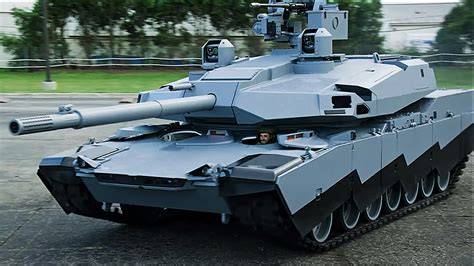
The M1A2 Abrams is a particularly clear example. Its driver does not operate the tank like someone driving a conventional manual automobile. Instead, the Abrams uses a steering yoke and throttle controls, while its transmission manages power delivery to the tracked drivetrain. The result is a driving system designed around rapid maneuvering rather than the familiar clutch-and-gearstick arrangement found in older civilian vehicles.
The Abrams X1100-3B Cross-Drive Transmission
The Abrams uses the Allison X1100-3B, an automatic cross-drive transmission specifically designed for heavy tracked vehicles. Unlike a normal automotive transmission that primarily changes gear ratios, a tank’s cross-drive system also plays an important role in steering and braking.
The X1100 family is designed for armored vehicles weighing up to roughly 75 tons and can handle engines producing up to 1,500 horsepower. It provides four forward ranges and two reverse ranges, giving the Abrams the flexibility required for both road movement and tactical maneuvering.
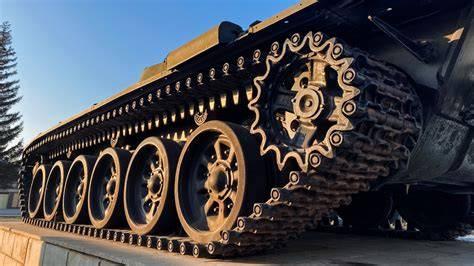
This arrangement is particularly important because steering a tracked vehicle differs fundamentally from steering a wheeled car. The transmission and final-drive system must help control the relative movement of the tracks, allowing the tank to change direction while maintaining traction and delivering enormous amounts of torque.
Will Tanks Ever Return to Manual Transmissions?
For modern main battle tanks, a return to conventional manual transmissions makes little practical sense. Automatic systems reduce the mechanical workload placed on drivers and simplify training without eliminating the skills needed to operate a heavily armored combat vehicle.
That advantage becomes even more significant as military vehicles become increasingly computerized. Modern tank crews already have to manage communications, navigation, sensors, weapons systems, and battlefield information. Requiring drivers to manually coordinate clutch operation and gear changes would add another demanding task without providing an obvious operational advantage.
The evolution from manual transmissions in older tanks to sophisticated automatic cross-drive transmissions reflects a broader change in armored warfare. Today’s tanks are enormously more powerful and complex than their predecessors, but their transmissions have evolved in the same direction as the rest of the vehicle: greater automation, better control, and less unnecessary workload for the crew.