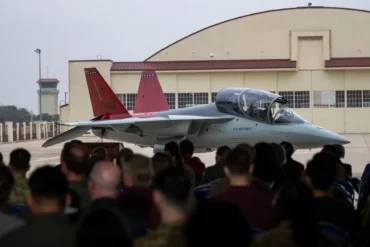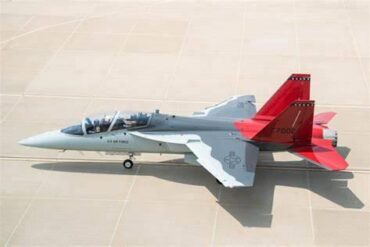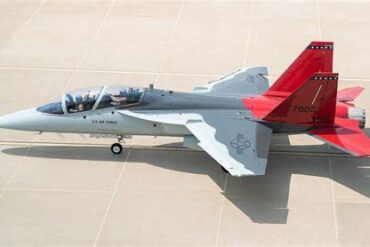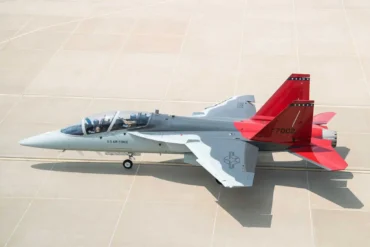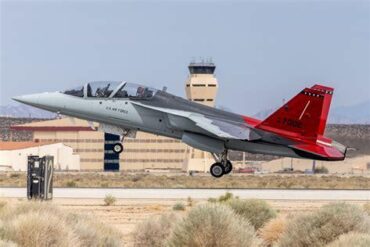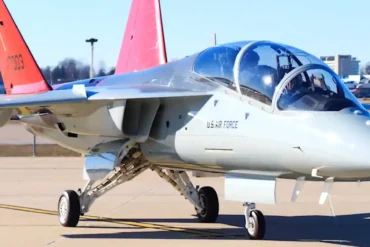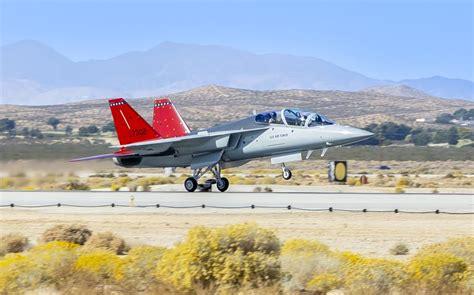
Boeing’s T-7A Red Hawk has become one of the clearest examples of how digital engineering is changing military aircraft development. The aircraft went from an initial concept to its first flight in roughly 36 months, an extraordinary pace for a clean-sheet military aircraft. That achievement has fueled a tempting narrative: if Boeing can design an aircraft this quickly, perhaps the era of enormous, decades-long fighter programs represented by the F-35 Lightning II is finally coming to an end.
That conclusion, however, goes much further than the evidence supports. The T-7A is not a technological replacement for the F-35, nor is it designed to perform the same missions. Instead, its importance lies somewhere more fundamental. The Red Hawk demonstrates how digital engineering, model-based systems engineering, digital twins, high-fidelity simulation, and integrated digital threads can change the way aircraft are designed, assembled, tested, and modified.
The distinction matters because the T-7A’s headline development speed tells only part of the story. Its digital design process was remarkably fast, but the aircraft subsequently encountered substantial delays after moving from computer screens into the physical world. The program has slipped years beyond its original schedule, suffered technical and software problems, and accumulated approximately $1.8 billion in fixed-price losses for Boeing. Its experience therefore provides a much more interesting lesson than the simple claim that the F-35 is obsolete.
The T-7A Red Hawk and the Digital Engineering Revolution
The F-35 program began in an era when digital engineering was already important but had not reached the maturity available to aerospace companies today. Engineers possessed sophisticated computer-aided design and simulation capabilities, yet physical prototypes remained central to discovering how an aircraft would actually behave.
That traditional process could create a lengthy feedback loop. Engineers would design an aircraft digitally, construct physical components or prototypes, test them, discover unexpected problems, modify the design, manufacture replacement components, and test again. Every cycle consumed time and money. On a highly complicated aircraft, even a relatively small design change could propagate through numerous systems and structures.
The T-7A was developed in a fundamentally different environment. Modern Model-Based Systems Engineering allows engineers to maintain a connected digital representation of the aircraft and its systems. Digital twins and high-fidelity simulations can then be used to evaluate interactions before expensive hardware exists. A three-dimensional model is no longer simply a drawing; it can become a central source of information connecting engineering, manufacturing, assembly, testing, and maintenance.
This approach helped Boeing compress the early development process dramatically. The T-7A moved from concept to first flight in approximately three years, demonstrating that a military aircraft does not necessarily need to spend most of its development life moving between drawings, prototypes, tooling, and physical test articles.
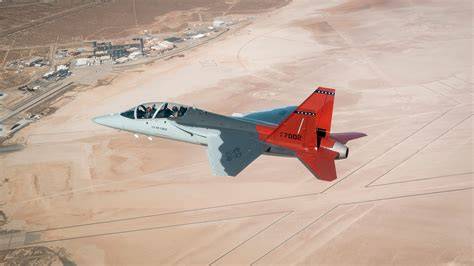
One particularly striking example involves assembly. Boeing reported that technicians could join the aircraft’s forward and rear fuselage sections in less than 30 minutes. On older aircraft, fitting major structures together could require days or even weeks because of physical tolerances, alignment problems, and the need to correct discrepancies during assembly.
Digital engineering helped reduce traditional assembly errors by roughly 50 percent. The significance goes beyond faster production. When engineers, manufacturing teams, and suppliers work from a shared digital definition, the aircraft can theoretically arrive at the factory with fewer surprises waiting to be discovered.
Why the T-7A Cannot Simply Replace the F-35
The excitement surrounding the Red Hawk sometimes obscures a critical fact: the T-7A and F-35 were built for entirely different purposes.
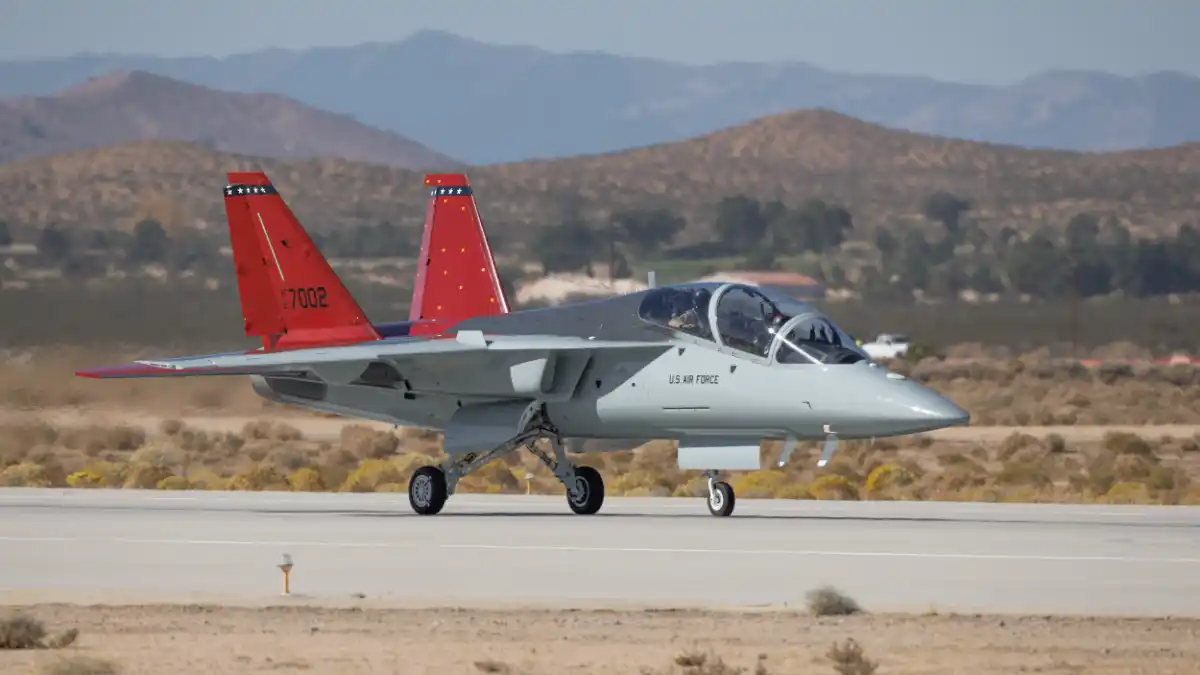
The T-7A is an advanced jet trainer designed primarily to prepare pilots for modern fighter aircraft. It is comparatively small, subsonic, and structurally less complicated than a stealth multirole fighter. The F-35, by contrast, was designed as a family of highly capable combat aircraft intended to replace or supplement multiple generations of tactical aircraft.
The F-35 program attempted to combine stealth, advanced sensors, electronic warfare, networking, precision weapons, supersonic performance, and commonality across three variants. The aircraft was expected to serve the US Air Force, Navy, and Marine Corps while also becoming a major export fighter for allied nations.
That ambition created an engineering challenge of an entirely different magnitude. The aircraft’s low-observable characteristics alone impose demanding requirements on shaping, materials, manufacturing tolerances, thermal management, maintenance, and weapons integration. Its sensor fusion architecture and software are similarly complex.
The F-35 also adopted significant concurrency. Production began while testing and software development were still underway. This approach allowed the program to deliver aircraft sooner but created expensive consequences when testing revealed problems that affected aircraft already manufactured.
The T-7A therefore does not prove that the F-35’s development philosophy was simply incompetent. Instead, it demonstrates how much aerospace engineering has changed since the F-35 was conceived.
The T-7A’s Three-Year Development Was Not the Whole Program
The most important caveat is that 36 months from concept to first flight is not the same as 36 months from concept to operational capability.
The T-7A first flew in 2016, while the Air Force now expects initial operational capability in August 2027. That creates a gap of approximately 11 years between first flight and planned operational service, considerably longer than the aircraft’s spectacular initial development sprint.
The program has faced aerodynamic anomalies, safety-system concerns, and software integration problems. Perhaps most ironically, some of its difficulties exposed a weakness in the digital-first approach itself. Physical flight systems and ground-based simulation software were found to be insufficiently synchronized, requiring additional coding and testing.
This is an important lesson for the wider aerospace industry. Digital engineering does not eliminate engineering complexity. It changes where and when that complexity appears.
A highly accurate digital model can prevent enormous numbers of physical mistakes, but only if the underlying models are correct and the interfaces between different digital systems remain synchronized. If the digital environment contains inconsistent assumptions, the speed of development can actually allow errors to propagate faster.
Other Aircraft Are Following the T-7A Development Model
The Red Hawk is nevertheless part of a much larger transformation. Boeing is not the only aerospace company using digital engineering to accelerate military aircraft development.
Northrop Grumman’s Scaled Composites demonstrated the potential of this approach with the Model 437. The clean-sheet aircraft made its first flight in August 2024, with the company stating that detailed design to first flight took approximately 21 months.
The development process included digitally designing its wing before physical production. According to the company, the digitally developed wing sections were shipped between facilities and fitted successfully when they arrived, demonstrating how a common digital environment can reduce manufacturing and integration risk.
The same philosophy is increasingly visible in America’s emerging Collaborative Combat Aircraft programs. Platforms associated with Anduril, General Atomics, and Northrop Grumman are being designed around relatively rapid development cycles, digital modeling, autonomous systems, and software-driven capabilities.
These aircraft are much closer to the concept of disposable or rapidly replaceable combat assets than traditional fighters. Instead of expecting one exquisite aircraft design to remain dominant for decades, the emerging model places greater emphasis on rapidly producing, testing, upgrading, and replacing systems.
Digital Engineering Is Also Changing Large Stealth Aircraft
The transformation is not limited to small autonomous aircraft. One of the strongest examples is the B-21 Raider, which shows that digital engineering can also be applied to extremely complicated stealth platforms.
The B-2 Spirit first flew in 1989 and entered service in 1997, an approximately eight-year gap. The B-21 first flew in 2023 and is expected to enter service around 2027, suggesting a development-to-service interval of roughly four years.
The B-21 is obviously not a simple aircraft. It incorporates stealth, long-range strike capability, advanced sensors, communications systems, and highly classified technologies. Its comparatively rapid progress therefore provides evidence that digital engineering can influence even the development of exceptionally complicated military aircraft.
The emerging F-47 program represents another important test. The US Air Force has indicated an ambitious schedule for its next-generation fighter, with a representative prototype expected to fly around 2028 and operational service potentially arriving in the early 2030s.
If those targets are achieved, the interval between prototype flight and service could be dramatically shorter than that experienced by many previous fighter programs.
Why the F-35 Era Is Not Actually Ending
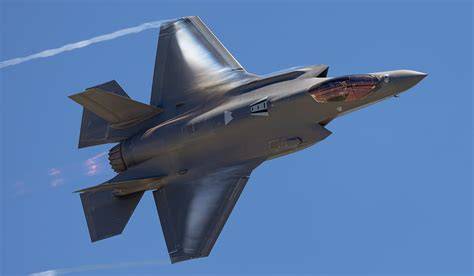
Despite the changes taking place around it, the F-35 is not disappearing. In fact, its importance is likely to increase for years.
The aircraft is already deeply embedded in the force structures of the United States and numerous allied nations. The United Kingdom, Australia, Norway, the Netherlands, and other operators have invested heavily in the platform, infrastructure, training systems, weapons, maintenance networks, and operational doctrine surrounding it.
Replacing such an ecosystem would be far more difficult than simply designing a faster aircraft.
The F-35 is also not a frozen design from the 2000s. Its software, sensors, weapons, electronic warfare capabilities, and computing architecture are being continuously upgraded. The ongoing Block 4 modernization is intended to introduce additional capabilities and keep the aircraft relevant against increasingly sophisticated threats.
The irony is that the F-35 itself is now becoming part of the digital transformation. Future upgrades can be developed and integrated using technologies that were less mature when the original aircraft was designed.
In that sense, the T-7A is not the aircraft that ends the F-35 era. It is a demonstration of the development philosophy that will shape what comes after the F-35.
The Real Legacy of Boeing’s T-7A
The greatest significance of the T-7A is therefore not its speed alone. Its real contribution is proving that digital engineering can compress the most expensive early stages of aircraft development while reducing manufacturing errors and improving coordination between design teams.
The technology does not make complex aircraft simple. Instead, it gives engineers better tools for handling complexity.
The future US military aircraft fleet is likely to contain a mixture of approaches. Large, highly capable platforms such as the F-35 and B-21 will continue to provide sophisticated combat capabilities, while smaller autonomous aircraft can be developed and replaced more rapidly. Next-generation fighters such as the F-47 may occupy a middle ground, combining extreme capability with development processes that are far more digitally integrated than those used for earlier generations.
That makes the T-7A a blueprint for the post-F-35 development era, but not because it is going to replace the F-35. Its deeper legacy is methodological. The aircraft demonstrates that the aerospace industry can move away from a development model dominated by repeated physical prototypes and toward one in which much more of the aircraft is designed, tested, integrated, and refined before the first piece of metal is assembled.
The Red Hawk’s own delays prove that this transformation is still incomplete. Digital tools can accelerate engineering, but they cannot eliminate flight-test discoveries, software bugs, certification requirements, manufacturing challenges, or the inherent difficulty of turning an extraordinarily complex digital model into a reliable combat aircraft.
That is precisely why the T-7A matters. Its success and its failures together provide a realistic preview of how military aircraft will be developed after the F-35 generation: faster initial design, more extensive digital validation, shorter prototype cycles, continuous software-driven upgrades, and increasingly rapid iteration.
The F-35 may remain a cornerstone of Western air power for decades. But the way its successors are designed is already changing. The T-7A Red Hawk is one of the clearest early signs that the next revolution in military aviation may not be defined by a single revolutionary aircraft, but by how quickly aerospace engineers can design, test, manufacture, upgrade, and replace one.