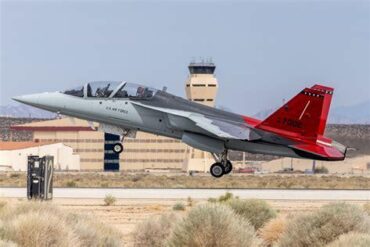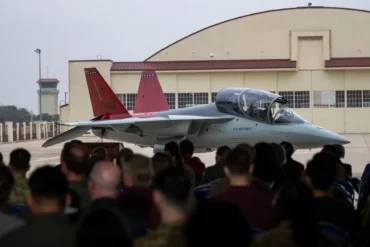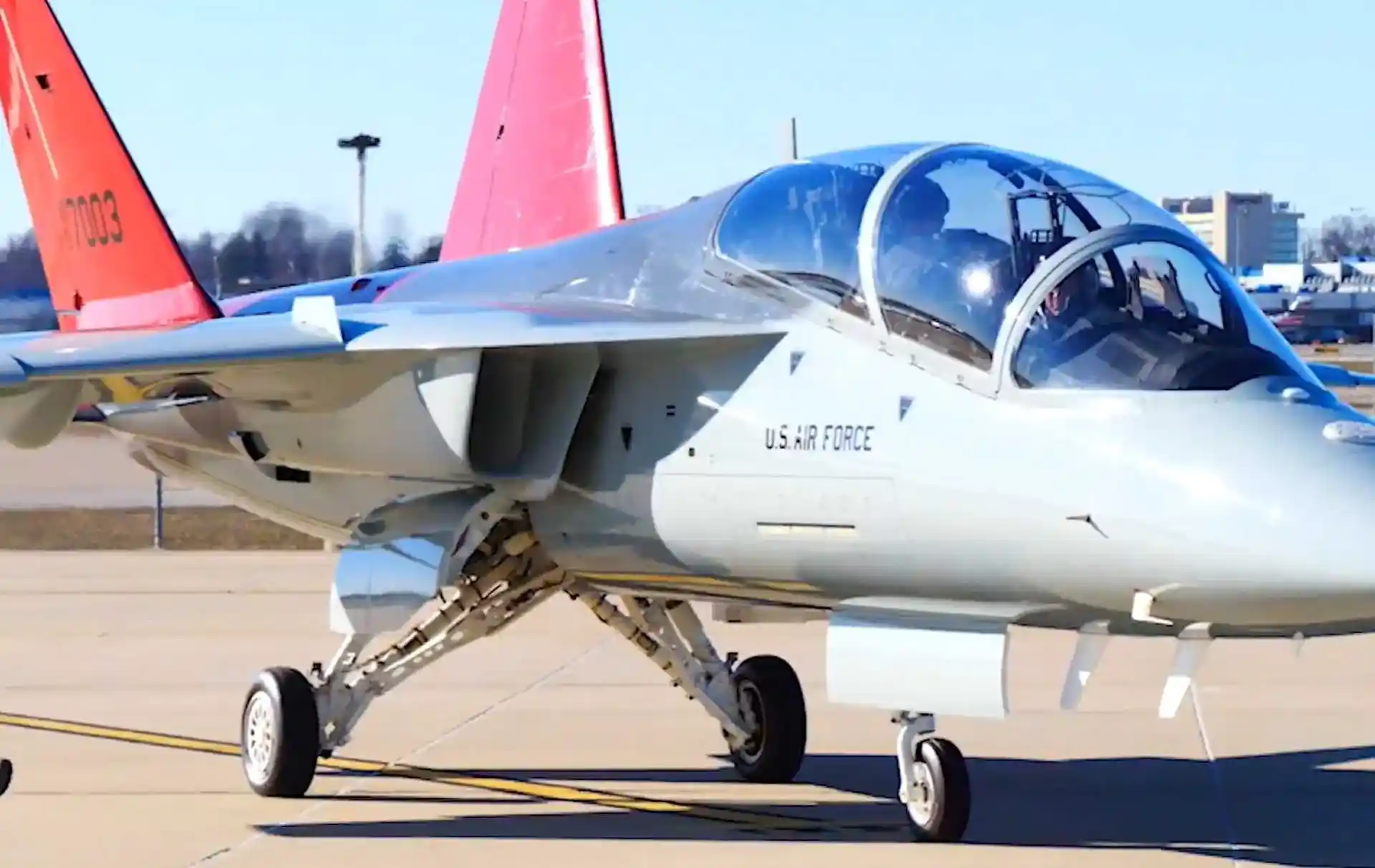
The U.S. Air Force has officially received its second T-7A Red Hawk advanced jet trainer, reinforcing a long-anticipated transformation in how American military pilots are trained for modern air combat. Delivered by Boeing to the Air Education and Training Command (AETC) at Joint Base San Antonio–Randolph, Texas, the aircraft represents more than a routine handover. It signals tangible momentum in a program designed to overhaul a pilot training system that has relied for decades on aging, analog-era aircraft ill-suited for today’s digital battlespace.
This latest delivery follows closely on the arrival of the first production-representative T-7A earlier in January 2026, confirming that the Red Hawk is transitioning from developmental testing into early operational use. Together, the two aircraft will form the nucleus of hands-on evaluation efforts, allowing instructors, maintainers, and training planners to validate procedures, refine curricula, and integrate digital maintenance concepts that underpin the Air Force’s broader modernization strategy.
For the Air Force, the urgency behind the T-7A program is rooted in a stark operational reality. Pilots destined for fifth-generation fighters such as the F-22 Raptor and F-35 Lightning II, as well as future sixth-generation platforms, must master complex sensor fusion, data-driven decision-making, and networked warfare from the earliest stages of their careers. Legacy trainers were never designed to replicate these demands, creating a widening gap between training environments and frontline combat aircraft.
The arrival of a second Red Hawk narrows that gap decisively.
A Digital-First Aircraft for a Digital Battlespace
The T-7A Red Hawk is the first U.S. Air Force trainer designed entirely using digital engineering. This approach allowed Boeing and its partner Saab to model the aircraft’s structure, systems, and performance in a virtual environment long before physical assembly began. The result is a trainer optimized for adaptability, rapid updates, and long-term relevance in an era where combat aviation evolves at software speed.
Inside the cockpit, pilots encounter a high-fidelity, glass cockpit environment dominated by large-area displays, modern hands-on-throttle-and-stick controls, and an architecture that mirrors frontline fighters. The aircraft’s fly-by-wire flight control system allows instructors to tailor handling characteristics, effectively reshaping the jet’s “personality” to emulate different combat aircraft. This capability enables student pilots to experience fighter-like responses without leaving the training pipeline.
Embedded training systems take this realism further. The T-7A can simulate radar operations, electronic warfare effects, and air-to-air threats during live flights, blending virtual adversaries with real-world maneuvering. This integrated approach reduces reliance on expensive aggressor aircraft while exposing students to the cognitive complexity of modern combat much earlier than was previously possible.
Replacing a Legend: The End of the T-38 Era
For more than six decades, the Northrop T-38 Talon served as the backbone of U.S. Air Force pilot training. First flown in 1959, the Talon introduced generations of aviators to supersonic flight and high-performance jet operations. However, despite numerous upgrades, its analog cockpit, limited avionics, and restricted simulation capability increasingly constrained its relevance.
As the Air Force transitioned to aircraft defined by software, sensors, and data fusion, the T-38’s shortcomings became impossible to ignore. Pilots often encountered a steep learning curve when moving from training squadrons to operational units, requiring additional time and resources to bridge the gap. The T-7A was conceived specifically to eliminate this disconnect.
With improved thrust-to-weight ratio, high angle-of-attack tolerance, and the ability to sustain G-loads exceeding 8, the Red Hawk introduces advanced maneuvering and energy management concepts early in training. These performance attributes, combined with digital avionics, ensure that physical skills and mental workload evolve together, producing pilots better prepared for operational conversion.
Accelerating Training While Reducing Long-Term Costs
Beyond the cockpit, the T-7A delivers significant benefits in sustainment and life-cycle management. Boeing’s digital design philosophy extends into maintenance through a continuous digital thread, enabling predictive diagnostics, faster troubleshooting, and streamlined parts logistics. Ground crews can identify potential issues before they ground an aircraft, improving availability and reducing unscheduled downtime.
The Red Hawk’s open-systems architecture is another critical advantage. Software updates, new training modes, and future capability enhancements can be integrated without major structural changes, protecting the Air Force’s investment over decades of service. In contrast to older platforms that require costly hardware modifications, the T-7A evolves largely through code.
These efficiencies are central to the Air Force’s long-term plan to field over 300 T-7A aircraft across multiple training bases by the early 2030s. Locations slated to receive the Red Hawk include Columbus Air Force Base, Vance Air Force Base, and Laughlin Air Force Base, forming a nationwide network of next-generation training hubs.
Symbolism and Heritage at JBSA–Randolph
The second T-7A delivered to Joint Base San Antonio–Randolph will support instructor qualification, syllabus development, and sustainment training within the 99th Flying Training Squadron. The unit’s historical ties to the Tuskegee Airmen add symbolic weight to the aircraft’s presence. Named the “Red Hawk” in honor of those pioneering aviators, the jet carries a legacy of excellence and innovation that aligns with its technological mission.
This blend of heritage and modernity underscores the Air Force’s intent: to respect its past while decisively preparing for future conflicts. The Red Hawk is not merely a new airframe; it is a training ecosystem designed to shape how pilots think, process information, and fight.
From Early Delays to Measured Progress
Like many complex defense programs, the T-7A experienced schedule adjustments as engineers prioritized flight safety, software maturity, and system integration. While initial delivery timelines shifted, the Air Force and Boeing emphasized building a trainer that met long-term operational needs rather than rushing an incomplete solution into service.
The delivery of a second production-representative aircraft within weeks of the first reflects renewed momentum. It also signals confidence that the Red Hawk’s core capabilities are ready for sustained operational evaluation. As additional jets arrive, the Air Force will expand testing to include larger student cohorts, more complex training scenarios, and integrated maintenance workflows.
Preparing Pilots for Contested Skies
The strategic importance of the T-7A becomes clear when viewed against the backdrop of near-peer competition. Potential adversaries are fielding increasingly capable fighters supported by dense air defenses, electronic warfare systems, and networked sensors. Success in such environments depends as much on cognitive agility as on raw flying skill.
By exposing pilots to realistic digital combat conditions early, the Red Hawk shortens the path from novice to mission-ready aviator. Graduates arrive at operational squadrons already familiar with the demands of data-rich cockpits and high-tempo decision-making, reducing training bottlenecks and enhancing combat readiness.
In delivering its second T-7A Red Hawk, the U.S. Air Force has taken another decisive step toward a training system aligned with the realities of modern warfare. The aircraft embodies a shift from platform-centric instruction to systems-level preparation, ensuring that future pilots are not just skilled flyers, but adaptive warfighters ready to dominate contested airspace from day one.