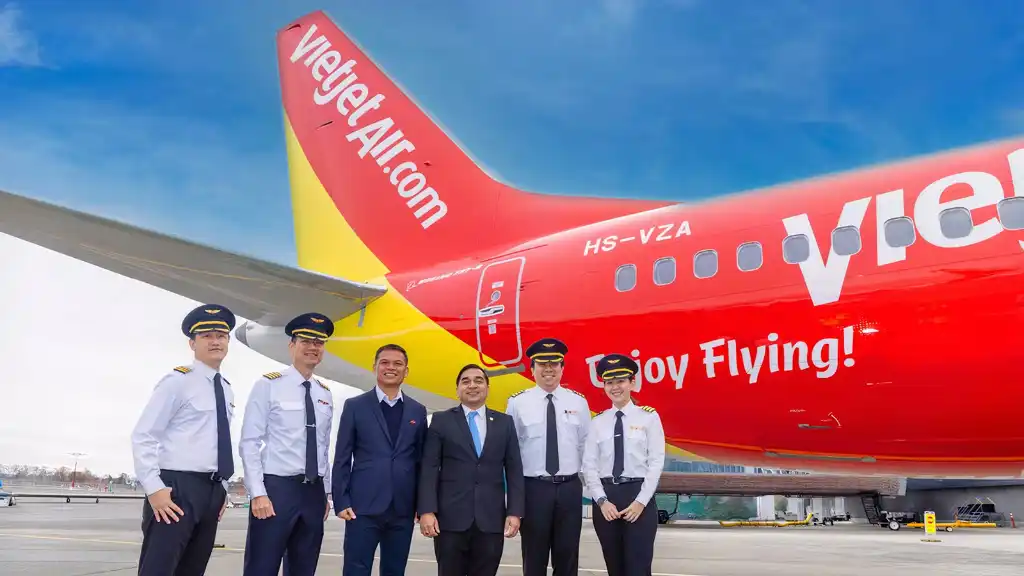
Vietjet Thailand has entered a pivotal new chapter as it officially becomes a Boeing 737 MAX operator, receiving its first 737 MAX 8 at Bangkok Suvarnabhumi Airport on 23 November 2025. This milestone is the opening move in a far larger strategic evolution, with 50 Boeing 737 MAX aircraft set to enter the airline’s fleet under Vietjet Group’s expansive $32 billion order. The arrival of this first aircraft signals a shift in Thailand’s low-cost aviation landscape as Vietjet Thailand transitions toward a leaner, more modern, and more fuel-efficient fleet.
The newly delivered aircraft, registered HS-VZA, becomes the group’s first MAX to enter commercial service, even though Vietjet received its initial MAX in Seattle earlier this year. The Thai subsidiary will debut the type domestically before expanding it onto regional routes. By structuring its deployment this way, Vietjet Thailand aims for a smooth operational introduction while capitalizing on the MAX’s technical advantages, from extended range to substantial fuel savings.
A New Boeing Era for Vietjet Thailand
Vietjet’s acquisition of the 737 MAX is part of a long-term plan years in the making. The airline ordered 200 Boeing jets nearly a decade ago, but certification delays and global grounding issues pushed back initial deliveries. With the first MAX now in Thailand, the long-anticipated rollout has begun. Vietjet Thailand will initially place HS-VZA on the Bangkok–Chiang Mai route before extending service to Bangkok–Cam Ranh in December 2025. Over the coming year, the aircraft will spread its wings across Asia, with scheduled operations into Japan, South Korea, and China beginning in 2026.
The 737 MAX 8’s technology package gives Vietjet Thailand a tangible competitive edge. Its LEAP-1B engines, advanced winglets, and Boeing Sky Interior combine efficiency with improved passenger comfort. The type provides 15–20% lower carbon emissions, notable reductions in noise, and full compatibility with Sustainable Aviation Fuel (SAF)—a feature that aligns with the airline’s environmental objectives and ICAO guidance.
A Strategic Boost for Regional Growth
Beyond the hardware itself, the MAX program strengthens Vietjet Thailand’s operational blueprint. With up to 3,547.5 nautical miles of range, the 737 MAX opens city-pair opportunities previously out of reach for a Thai low-cost operator relying primarily on Airbus narrowbodies. The airline will be able to plug directly into major Northeast Asian markets while reinforcing its domestic network—two pillars of its long-term strategy.
The delivery also formalizes deeper cooperation between Vietjet Group, Boeing, and regional government partners. Earlier in 2025, Vietnam’s and Thailand’s prime ministers jointly witnessed the signing that transferred 50 aircraft from the group’s total order to the Thai arm. Boeing will support the airline with pilot and engineer training, maintenance programs, and technical services to ensure a seamless fleet introduction and reliable day-to-day performance.
Why This Delivery Matters for Southeast Asia
Vietjet Thailand’s fleet modernization reflects a broader shift in Southeast Asian aviation. Airlines across the region are updating their fleets to meet rising demand, increasing fuel costs, and tightening sustainability expectations. For Vietjet Thailand, the MAX gives the carrier a unified platform for scaling capacity, adding frequencies on key trunk routes, and opening new city pairs across the region.
The environmental dimension is just as important. With SAF-ready engines and lower emissions metrics, the MAX supports Vietjet’s long-term sustainability narrative. As fuel remains a dominant cost driver for low-cost carriers, the improved economics of the MAX also give Vietjet Thailand a margin advantage as competition in the region intensifies.
A New Competitive Landscape in Thailand
The Thai aviation market has become increasingly crowded, with multiple low-cost carriers vying for domestic and short-haul traffic. The arrival of a brand-new, fuel-efficient MAX fleet provides Vietjet Thailand with a modern operational backbone that can scale. While other LCCs rely heavily on older Airbus narrowbodies, Vietjet Thailand is now positioning itself as the region’s newest Boeing-powered challenger.
By 2028, all 50 aircraft will be delivered, forming a substantial fleet that will redefine the airline’s network architecture. With cross-border cooperation strengthened and the MAX’s efficiency on its side, Vietjet Thailand is poised to become one of Southeast Asia’s most ambitious low-cost players.
As Vietjet Thailand begins MAX operations, the regional aviation map shifts with it. This delivery is not simply an aircraft arrival—it is the opening thrust of an expansion strategy designed to reshape the airline’s capabilities and elevate Thailand’s presence in the wider Asian aviation ecosystem.