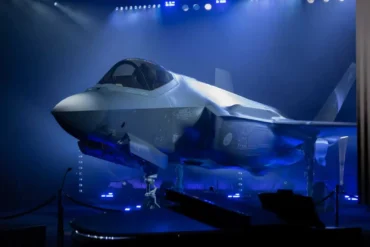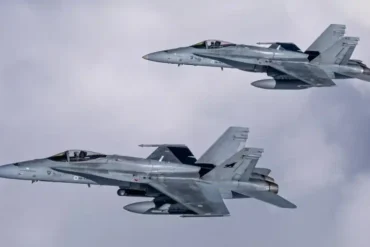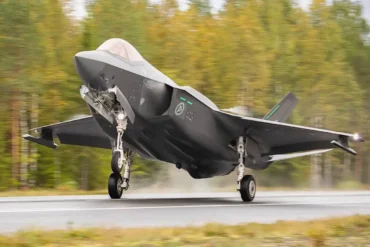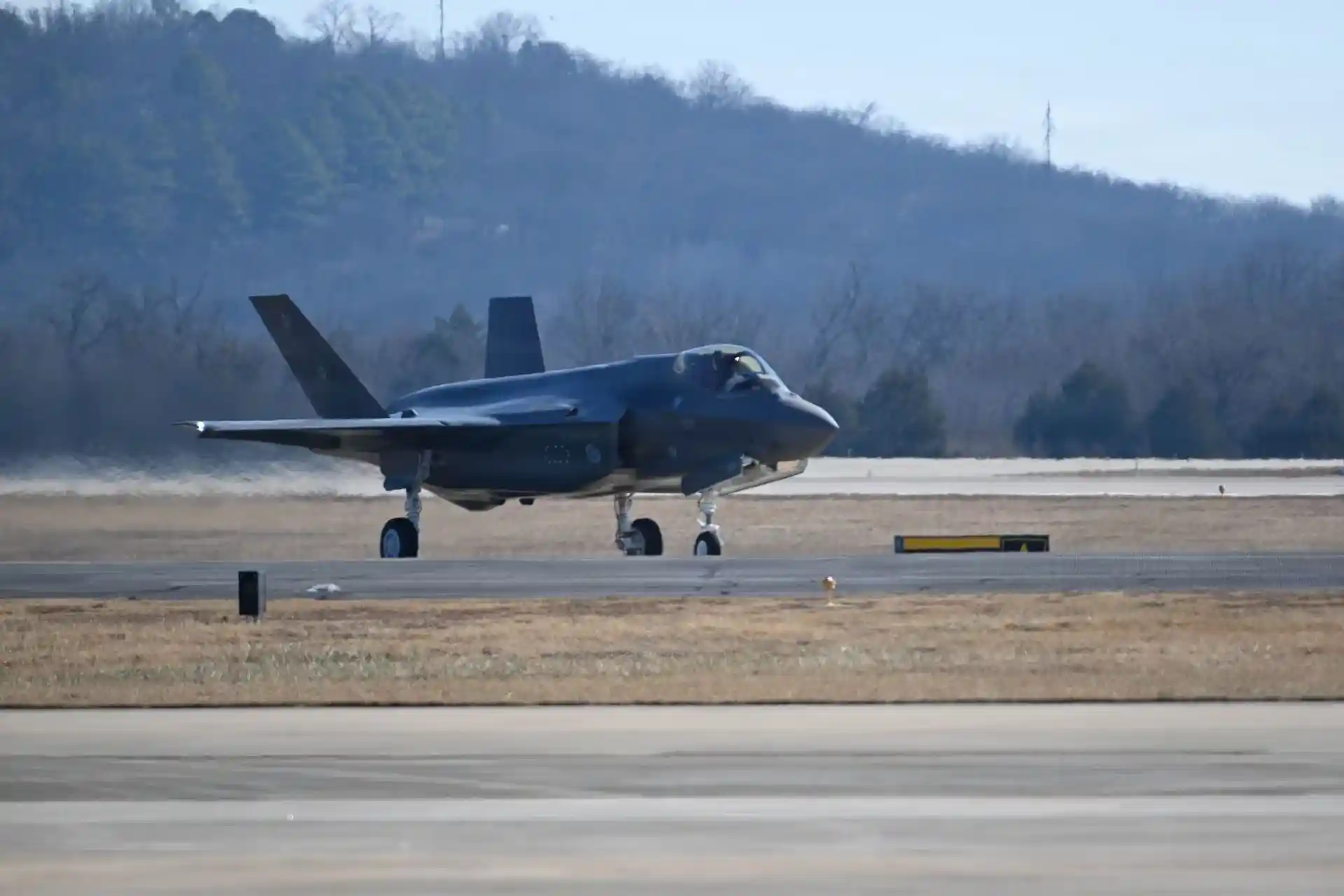
The arrival of Finland’s first F-35A Lightning II marks a decisive turning point in the country’s airpower history, signaling the beginning of the end for the long-serving F/A-18C/D Hornet fleet. Delivered on January 20, 2026, the aircraft—designated JF-501—represents far more than a single airframe changing hands. It is the physical embodiment of Finland’s strategic shift toward fifth-generation combat aviation, deeper NATO interoperability, and a deterrence posture shaped for an increasingly contested Northern European security environment.
The Finnish Air Force confirmed that JF-501 completed its ferry flight from Lockheed Martin’s Fort Worth, Texas production facility to Ebbing Air National Guard Base in Fort Smith, Arkansas. While the aircraft has not yet touched Finnish soil, its delivery formally initiates the operational phase of Helsinki’s largest-ever defense acquisition program. For a nation that has historically balanced technological sophistication with pragmatic defense planning, the F-35A introduces a level of capability previously reserved for only the most advanced air forces.
This milestone follows years of evaluation, competition, and industrial coordination that culminated in Finland’s 2021 decision to procure 64 F-35A fighters under the Joint Fighter program. The selection was driven by survivability in high-threat environments, sensor dominance, and the ability to operate seamlessly within allied command-and-control architectures. With JF-501 now delivered, the transition from planning to execution is no longer theoretical—it is underway.
A Symbolic Arrival with Strategic Weight
JF-501’s delivery comes just weeks after its formal rollout ceremony at Lockheed Martin’s Fort Worth plant, an event attended by senior Finnish and U.S. defense officials. Among them were Finnish Minister of Defence Antti Häkkänen, Air Force Commander Major General Timo Herranen, and Henrik Elo, Director of the Finnish F-35 Programme. The presence of these figures underscored how central the F-35 is to Finland’s long-term defense posture, particularly after joining NATO and recalibrating its deterrence strategy along Europe’s northeastern flank.
The aircraft itself is the F-35A, the conventional takeoff and landing variant of the Joint Strike Fighter family and the backbone of U.S. Air Force fifth-generation operations. Its delivery to Finland places the country firmly within a growing community of F-35 operators across Europe, including Norway, Denmark, the Netherlands, Italy, and the United Kingdom. This common platform dramatically simplifies joint operations, logistics, and mission planning across allied air forces.
Although delivered, JF-501 will remain in the United States during its initial service period. This is by design. The aircraft is assigned to Ebbing Air National Guard Base as part of a structured training pipeline that will prepare Finnish pilots, maintainers, and support personnel for the type’s eventual deployment at home. In total, around 150 Finnish personnel will be trained in the United States during this first phase.
From Hornet to Lightning: A Generational Leap
The transition from the F/A-18C/D Hornet to the F-35A Lightning II is not a simple upgrade; it is a generational leap in how air combat is conducted. The Hornet has served Finland reliably for decades, but it was designed for a very different threat environment. The F-35A, by contrast, is built from the ground up to survive and dominate in airspace saturated with advanced surface-to-air missiles, electronic warfare systems, and integrated sensor networks.
At the heart of the F-35A’s advantage is its low-observable design, which reduces detection across multiple radar bands. Combined with internal weapons carriage, this stealth profile allows the aircraft to penetrate defended airspace without relying on escort jamming or large support packages. For Finland, whose defense planning emphasizes rapid response and survivability against technologically sophisticated adversaries, this capability is transformative.
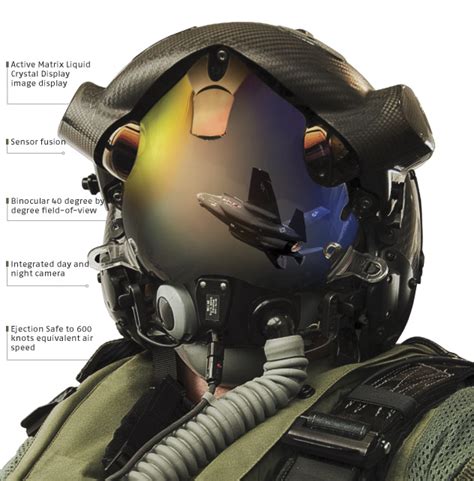
Equally critical is the aircraft’s sensor fusion architecture. The AN/APG-81 AESA radar, Distributed Aperture System, and Electro-Optical Targeting System work together to create a continuous, 360-degree view of the battlespace. Instead of juggling multiple displays and data sources, the pilot receives a single, integrated tactical picture through the helmet-mounted display. This reduces workload, accelerates decision-making, and allows Finnish pilots to act as information nodes for joint and allied forces.
Power, Performance, and Production Precision
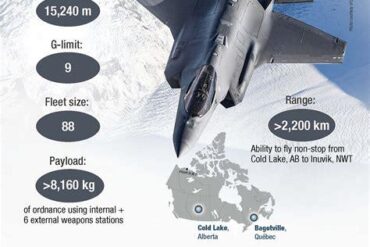
The F-35A is powered by the Pratt & Whitney F135-PW-100 engine, delivering up to 43,000 pounds of thrust with afterburner. This allows the aircraft to reach Mach 1.6, operate above 50,000 feet, and maintain a combat radius of approximately 2,200 kilometers using internal fuel alone. These performance characteristics give Finland the ability to project airpower across its territory and beyond without immediate reliance on aerial refueling.
JF-501’s journey to delivery reflects the industrial complexity behind each F-35. Manufacturing began in 2023, with major milestones including a forward fuselage signing in October 2024, engine installation in September 2025, and final assembly and low-observable surface treatments later that year. The aircraft completed its maiden flight on December 8, 2025, before entering acceptance testing by U.S. and Finnish authorities.
This meticulous process is central to ensuring that each aircraft meets the stringent performance and survivability standards expected of a fifth-generation fighter. For Finland, it also reflects confidence in a global supply chain capable of sustaining the fleet over decades of service.
Training Today, Operational Power Tomorrow
The first eight Finnish F-35As—designated JF-501 through JF-508—will be based at Ebbing Air National Guard Base to support training operations. Finnish pilots will begin with academic and simulator instruction at Eglin Air Force Base, followed by live flying and maintenance training in Arkansas. This phased approach ensures that when the aircraft arrive in Finland, the supporting ecosystem of trained personnel and operational doctrine is already in place.
Finland plans to receive its first F-35As on home soil later in 2026, with initial operational capability expected by the end of 2027. Full operational capability is targeted for 2030, aligning with the planned retirement of the Hornet fleet. From 2031 onward, the F-35A will form the backbone of Finnish combat aviation.
A Strategic Signal to Northern Europe
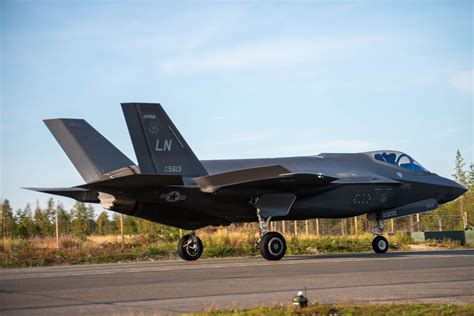
The delivery of JF-501 sends a clear strategic message. Finland’s F-35 program is no longer an abstract future capability; it is a living, growing force. As Northern Europe becomes a focal point of NATO defense planning, Finland’s adoption of the F-35A strengthens collective deterrence and enhances the alliance’s ability to operate as a cohesive, technologically unified force.
JF-501 stands today as a training aircraft on American soil, but its significance reaches far beyond the runway at Ebbing. It represents Finland’s commitment to long-term defense modernization, alliance interoperability, and air superiority in an era where information dominance and survivability define victory. The Hornet era is closing. The Lightning era has begun.