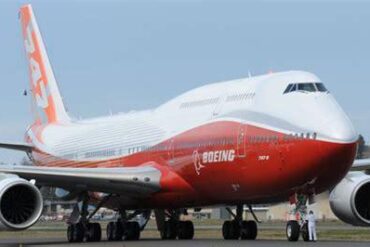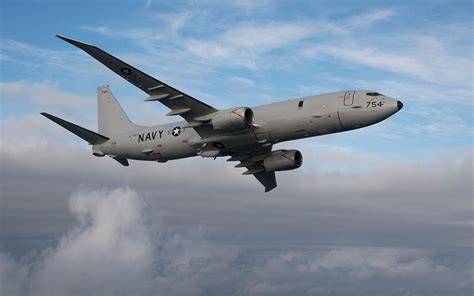
The Boeing P-8A Poseidon is not an aircraft designed with fuel economy in mind. It is a long-range maritime patrol and anti-submarine warfare aircraft built to travel far from its home base, remain over the ocean for hours, search enormous areas for ships and submarines, process information from sophisticated sensors, and, when necessary, deploy weapons against targets beneath or on the surface. Yet there is a simple question that naturally follows from all that capability: how many miles per gallon does a P-8A Poseidon actually get?
At first glance, the answer looks remarkably poor compared with almost any road vehicle. The Poseidon is derived from the Boeing 737-800, but its military mission adds radar, acoustic equipment, communications systems, mission computers, weapons, sonobuoys, structural modifications, and additional equipment. It also carries enough fuel to travel thousands of miles across the world’s oceans. When the aircraft’s published range and fuel capacity are converted into familiar American fuel-economy terms, the result is a number that sounds almost absurdly inefficient.
The important thing, however, is that miles per gallon is not a particularly useful measure of a maritime patrol aircraft’s performance. A P-8A does not simply fly from one airport to another while trying to cover the greatest possible distance with every gallon of fuel. Its mission involves transit, surveillance, maneuvering, searching, loitering, altitude changes, sensor operation, and potentially aerial refueling. The aircraft’s fuel is therefore being spent on much more than simply moving the airplane forward.
The P-8A Poseidon Gets About 0.42 Miles Per Gallon on Paper
The simplest calculation starts with two published specifications: the P-8A’s fuel capacity and its theoretical maximum range. According to Royal Australian Air Force specifications, the aircraft can carry approximately 74,957 pounds (34,000 kilograms) of internal fuel and has a range of roughly 4,660 miles (7,500 kilometers).
Jet fuel is normally measured by volume when discussing aircraft operations, while aircraft fuel capacity is frequently specified by weight. Using a standard Jet A/A-1 density of approximately 6.68 pounds per U.S. gallon at 59°F (15°C), the Poseidon’s internal fuel load works out to approximately 11,220 gallons, or about 42,470 liters.
Now the calculation becomes straightforward. Dividing the theoretical range of 4,660 miles by approximately 11,220 gallons produces an average of about 0.42 miles per gallon. Put another way, the aircraft would theoretically use approximately 2.4 gallons of fuel for every mile traveled.
That is the figure most often produced when someone asks how many miles per gallon a P-8A Poseidon gets. It is mathematically valid, but it needs a very large asterisk. The number assumes that the aircraft’s entire fuel load is effectively converted into range and that the quoted maximum range can be divided directly by the volume of fuel carried. Real missions are considerably more complicated.
Why the 0.42 MPG Figure Does Not Describe a Normal P-8A Mission
A road car can often be evaluated using a relatively simple relationship between fuel consumed and distance traveled. If a car uses 10 gallons to cover 300 miles, its fuel economy is 30 mpg. Aircraft do not behave quite so neatly, particularly aircraft whose mission requires them to spend substantial amounts of time searching an area rather than simply traveling through it.
The P-8A is typically sent toward a designated patrol area and then spends time conducting surveillance. According to the U.S. Navy’s mission profile, a representative mission can involve traveling to a station approximately 1,200 nautical miles away, remaining on task for around four hours, and then returning to base. The distance traveled is only part of what the aircraft accomplishes during that sortie.
During those four hours, the Poseidon might not maintain one constant speed or altitude. It can conduct surveillance from high altitude, alter its flight path to investigate contacts, descend when the tactical situation demands it, maneuver over an area, deploy or monitor sonobuoys, and then climb again. Every change in speed, altitude, heading, and aircraft weight affects fuel consumption.
The aircraft therefore has no single, universal miles-per-gallon figure for every mission. A long, uninterrupted cruise at an efficient altitude would produce a different fuel-burn rate from a mission involving repeated climbs, descents, turns, lower-altitude operations, and extended time searching for a submarine. Even the amount of fuel remaining in the aircraft changes its weight and therefore changes how much thrust is required to keep it flying.
The P-8A’s High-Altitude Operation Changes the Fuel Equation
One of the most interesting characteristics of the Poseidon is that it is a maritime patrol aircraft that normally spends much of its operational time far higher above the ocean than the low-altitude patrol profile associated with older aircraft.
The P-8A is capable of operating at very low altitude when required, including flight close to the surface, but its modern sensor architecture means that it can normally exploit the advantages of higher-altitude operation. Its radar, communications equipment, electro-optical systems, and acoustic processing capabilities allow the aircraft to search and manage a large maritime battlespace without constantly flying just above the waves.
This represents a major difference from the Lockheed P-3 Orion, the turboprop maritime patrol aircraft that the Poseidon was developed to replace. The P-3 had four turboprop engines and was exceptionally well suited to long-duration patrol work. Its mission architecture also relied more heavily on low-altitude operations, including the use of a magnetic anomaly detector that benefited from operating close to the water.
The Poseidon takes a different approach. It uses the speed and altitude advantages of a modern twin-engine jet to reach a patrol area quickly and exploit sensors from higher altitude, while retaining the ability to descend when a particular tactical situation requires it. That flexibility is valuable, but it also means that its fuel consumption cannot be reduced to one simple number.
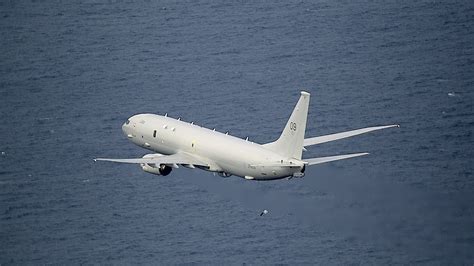
The P-8A Is Carrying Much More Than a Boeing 737
Although the P-8A is based on the Boeing 737-800, treating it as an ordinary 737 with military markings would overlook the equipment that makes it a specialized combat aircraft.
The aircraft carries a sophisticated collection of sensors and mission systems designed for anti-submarine warfare, anti-surface warfare, intelligence, surveillance, and reconnaissance. Its equipment includes the Raytheon AN/APY-10 maritime, littoral, and overland surveillance radar, which provides advanced imaging capabilities, as well as an integrated acoustic system capable of receiving and processing information from deployed sonobuoys.
The aircraft can also carry substantial mission equipment and weapons. Depending on configuration and mission requirements, the Poseidon can carry large numbers of sonobuoys along with AGM-84 Harpoon anti-ship missiles and Mk 54 lightweight torpedoes. These systems are fundamental to its role, but every additional item contributes to the aircraft’s overall operating weight.
That matters because fuel consumption is closely tied to weight. An aircraft carrying weapons, sensors, acoustic equipment, crew, communications systems, and other mission hardware is not going to consume fuel under exactly the same conditions as a lightly loaded commercial 737 cruising between two airports.
The P-8A nevertheless retains considerable commonality with the commercial 737 Next Generation family, which helps explain why the platform has become so widely adopted. Its commercial-derived architecture combines the advantages of an established airframe with a military mission system specifically optimized for maritime operations.
Aerial Refueling Makes MPG Even Less Meaningful
There is another major reason why calculating the Poseidon’s fuel economy from its internal tanks can be misleading: the P-8A can receive fuel in flight.
Aerial refueling changes the fundamental relationship between fuel capacity and mission distance. An aircraft no longer has to complete an entire operation using only the fuel it carried at takeoff. If the mission requires additional time over the patrol area, a tanker can replenish the Poseidon’s fuel supply and allow it to continue operating.
This capability is particularly valuable during a developing maritime crisis. A submarine search may not finish when the aircraft’s original mission plan says it should. A surface vessel may require continued surveillance, or an intelligence mission may become more important as new information arrives. The ability to refuel in the air gives commanders additional flexibility without requiring the aircraft to return to its home base simply because its original fuel load is approaching its planned limit.
As a result, the Poseidon’s practical mission endurance can extend well beyond what a simple 4,660-mile range divided by 11,220 gallons calculation suggests.
The Real Performance Metric Is Time on Station
For the P-8A Poseidon, time on station is generally more meaningful than miles per gallon. Maritime patrol aircraft exist to search, monitor, track, classify, and respond. The distance traveled to reach an operating area matters, but what happens after arrival can matter considerably more.
Imagine two aircraft reaching the same patrol zone. One consumes less fuel but takes much longer to get there and has limited sensor capability. The other burns more fuel but arrives quickly, carries advanced radar and acoustic systems, can deploy weapons, and can receive fuel from a tanker. For a military commander trying to locate a submarine, the second aircraft may be vastly more useful.
This is why the P-8A’s 1,200-nautical-mile operating radius and four-hour on-station profile provide more useful context than its theoretical 0.42 mpg figure. The aircraft is designed around a mission cycle rather than an automotive-style fuel economy cycle.
Its fuel supports the entire operation: accelerating and climbing after departure, cruising to the patrol area, conducting surveillance, maneuvering around contacts, changing altitude, returning to base, and maintaining appropriate reserves. When aerial refueling is available, additional fuel can be added to extend the mission.
Why the P-8A Burns More Fuel Than the P-3 Orion
The P-8A’s fuel consumption also needs to be considered alongside the aircraft it replaced. The P-3 Orion was powered by four turboprop engines and became famous for its ability to conduct long maritime patrol missions at relatively low speeds.
Turboprops are particularly effective at lower speeds and can provide excellent endurance for certain patrol missions. The P-3’s design therefore suited an era when maritime surveillance emphasized long periods of relatively slow searching, with the aircraft spending significant time close to the operating environment.
The Poseidon deliberately changes that equation. Its two jet engines provide substantially greater speed, allowing it to reach distant patrol areas faster. That speed is not merely a comfort or convenience feature. In military operations, the ability to reach a contact area quickly can determine whether an aircraft arrives while the target is still there.
The P-8A therefore accepts a higher fuel requirement per mile in exchange for speed, altitude, modern sensors, weapons capability, networking, and aerial refueling. It is not trying to beat the P-3 at the equivalent of a fuel-economy contest. It is designed to perform a different version of the maritime patrol mission.
What 0.42 MPG Really Means for the P-8A Poseidon
The calculated 0.42 miles per gallon is best understood as an aircraft-arithmetic figure rather than the Poseidon’s real-world fuel economy. It comes from dividing the aircraft’s quoted 4,660-mile range by an estimated 11,220 gallons of Jet A/A-1 fuel, producing approximately 2.4 gallons per mile.
That calculation is useful because it gives readers a familiar way to visualize the enormous quantity of energy required to operate a large military jet. It also demonstrates how much fuel is involved when an aircraft weighing many tons travels thousands of miles.
But it should not be interpreted as the amount of fuel the P-8A consumes every time it flies one mile. Actual fuel burn varies with weight, altitude, speed, weather, routing, payload, engine condition, mission profile, loiter time, and reserve requirements. A surveillance mission can therefore produce a very different result from a theoretical maximum-range flight.
Most importantly, the Poseidon’s purpose is not to maximize distance per gallon. Its purpose is to put a sophisticated maritime surveillance and combat platform over the right piece of ocean, keep it there long enough to accomplish its mission, and bring it home safely.
That makes the P-8A’s apparent fuel economy a little like judging a fire engine by how many miles it gets per gallon. The number may be interesting, and the mathematics may be perfectly sound, but it says surprisingly little about whether the vehicle is doing its job well. For the P-8A Poseidon, the more meaningful questions are how quickly it reaches the patrol area, how long it can remain there, how effectively it can search, and how far its mission can be extended through aerial refueling. On those measures, the aircraft’s fuel is not simply being burned to cover miles. It is being converted into range, endurance, surveillance capability, and combat power.