Flight attendants do not have a standard Monday-to-Friday working pattern, and the number of flights they operate each year can vary dramatically depending on the airline, aircraft, route network, seniority, and type of flying. A short-haul flight attendant might work several sectors in a single day, while a long-haul crew member may operate only one or two flights during an entire trip.
The most useful starting point is that airlines generally track flight hours, duty periods, and rest requirements rather than simply counting individual flights. This matters because a 45-minute domestic sector and a 12-hour international flight both count as individual flights, but they consume vastly different amounts of working time. As a result, two flight attendants can operate very different numbers of flights while working broadly similar annual flight hours.
For a full-time flight attendant, around 900 flight hours per year is a useful broad reference point, although actual schedules can fall substantially above or below that figure depending on the country and airline. In the United States, many full-time flight attendants fly roughly 65 to 90 block hours per month, while European and other international operations are governed by their own flight-time and duty-time frameworks.
The number of flights hidden behind those hours is where the differences become particularly interesting. A short-haul crew member flying several sectors a day could potentially operate hundreds of flights in a year. A long-haul flight attendant might operate only around 150 to 200 sectors over the same period. The annual total therefore depends heavily on how long each flight is.

How Many Flights Does a Flight Attendant Work in a Year?
There is no single annual flight number that applies to every flight attendant. A reasonable estimate for full-time crew is somewhere between roughly 150 and 500 flights per year, although individual schedules can fall outside that range.
Short-haul and domestic flight attendants generally operate the greatest number of sectors. Their workdays can involve two, three, four, or even more individual flights. A crew member based at a busy domestic hub could report early in the morning, operate a flight to another city, turn around quickly, fly somewhere else, and continue this pattern through the afternoon or evening.
Long-haul crews have the opposite pattern. A single flight can consume most of a duty period. A seven-hour international sector followed by a layover may mean that a flight attendant operates only one outbound flight that day. The return flight might occur a day or several days later, depending on the roster.
This produces a major difference in annual flight counts. A flight attendant who works four short sectors on a typical duty day can accumulate a very large number of flights without necessarily exceeding the annual flight-hour totals of a colleague operating long-haul services.
Flight Hours Matter More Than the Number of Flights
The aviation industry uses flight hours as a more meaningful measurement because individual sectors vary enormously in length. A flight attendant might spend less than an hour in the air on one regional sector or spend more than 12 hours working on a long international flight.
In the United States, full-time cabin crew commonly accumulate approximately 65 to 90 block hours per month, although schedules differ by airline and individual contract. Across a year, that can translate into approximately 780 to 1,080 block hours before considering how individual schedules are constructed.
The reference figure of around 900 annual flight hours is therefore useful, but it should not be interpreted as a universal target. Some crews fly considerably less because of reserve assignments, leave, training, reduced schedules, or contractual limits. Others may operate schedules closer to the upper end of their permitted flying time.
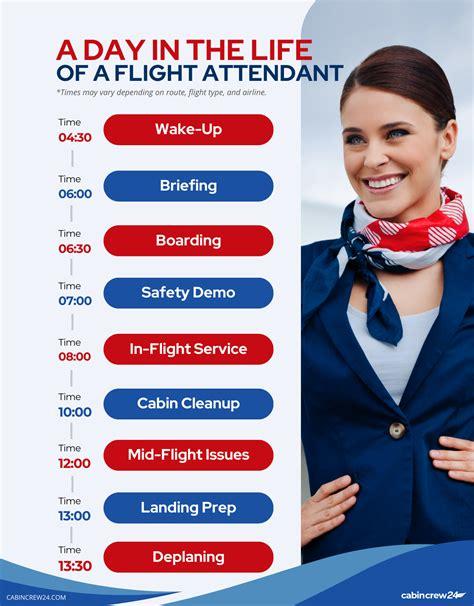
Flight hours also do not represent the entire working day. Flight attendants must report before departure, complete safety checks, participate in briefings, board passengers, prepare the cabin, manage irregular operations, and perform post-flight duties. Delays can extend the working day even when they do not produce additional flight hours.
This is why saying that a flight attendant “works 900 hours a year” would be misleading. The actual amount of time committed to the job can be considerably higher.
How Many Flights Do US Flight Attendants Work?
US flight attendants typically work a highly variable schedule influenced by airline contracts, seniority, fleet assignment, and whether they hold a regular line or are working reserve.
A full-time US flight attendant commonly works around 12 to 14 days per month, although the exact number varies considerably. A month may contain several multi-day trips, domestic turns, overnight stays, training days, reserve periods, or combinations of these.
Junior flight attendants frequently spend significant periods on reserve. Instead of receiving a fixed sequence of trips, reserve crew remain available to cover unexpected staffing requirements. A sick call, schedule disruption, aircraft change, or other operational problem can result in a reserve flight attendant being assigned a trip at relatively short notice.
More senior flight attendants may hold a line and have greater control over their schedules. Depending on the airline and collective bargaining agreement, they may be able to trade trips, drop certain assignments, request particular pairings, or use seniority to improve the structure of their monthly schedule.
That difference can substantially affect annual flight counts. Two employees at the same airline, with the same job title, can have very different years because their schedules are not necessarily identical.

Short-Haul Flight Attendants Can Operate Hundreds of Flights
Short-haul flying produces some of the highest annual flight counts because each duty period can contain several sectors.
A domestic narrowbody flight attendant might operate three to five sectors on a busy working day, although one or two sectors can also occur. In particularly dense operations, four or more short flights may be scheduled when turnaround times are efficient and the duty period allows it.
Consider a simplified example. If a flight attendant operates four sectors on each of 13 working days in a month, that would theoretically produce 52 sectors in one month. Repeated across a year, the arithmetic reaches more than 600 flights.
Real schedules are more complicated. Vacation, training, reserve, cancellations, longer sectors, irregular operations, days with fewer flights, and contractual limitations all reduce the likelihood of maintaining that exact pattern. A more practical annual estimate for a domestic narrowbody line can therefore fall around 500 to 800 sectors, depending on the operation.
That does not mean such a flight attendant is necessarily working more hours than a long-haul colleague. If each sector lasts only one to two hours, hundreds of flights can fit within an annual flight-hour framework.
Long-Haul Flight Attendants Work Far Fewer Flights
Long-haul cabin crew operate fewer flights because each sector consumes so much more time.
An international flight lasting eight, 10, 12, or even 15 hours can dominate an entire duty period. After arriving at the destination, crew normally have a layover before operating the return sector. A single pairing can therefore occupy several days.
A long-haul flight attendant might have only five or six major trips on a monthly roster, with substantial periods away from the aircraft between assignments. Some trips can last three days, while others may extend to a week or more depending on the airline and destination.
If a crew member averages one or two sectors per trip, an annual total of around 150 to 200 flights becomes much more plausible. Again, the number can vary widely depending on the network.
The introduction of longer-range aircraft has reinforced this pattern. Aircraft such as the Airbus A350, Boeing 787 and Airbus A321XLR allow airlines to operate routes that can consume many hours without requiring a traditional widebody aircraft. For cabin crew, longer sectors can mean fewer individual flights while still producing substantial annual flying time.
European and UK Cabin Crew Have Different Rosters
Flight attendants in Europe and the UK often operate under more structured roster systems. Depending on the airline and employment contract, cabin crew may receive their schedules several weeks in advance.
Short-haul crews can commonly work 16 to 22 days per month, although this varies by airline, contract, season, and individual roster. Two flights per day is a common pattern for many short-haul operations, with some schedules involving substantially more sectors.
Low-cost carriers can produce especially intensive short-haul patterns. A crew member may fly to one destination, complete a short turnaround, return to base, and then operate another round trip. In some circumstances, four short sectors can be completed in a day, although such schedules depend heavily on duty-time restrictions and the airline’s operation.
This means a European short-haul flight attendant can accumulate a large number of individual flights over a year. However, the annual total remains constrained by flight-time limitations, duty periods, mandatory rest, and working-time regulations.

How Many Flights Do Long-Haul Crews Work Per Month?
Long-haul cabin crew typically have fewer flight sectors but longer periods away from home.
A monthly roster might contain several long-haul trips, standby duties, training, and rest days. Some trips can involve multiple sectors, especially when the aircraft operates a multi-stop international itinerary, but many long-haul pairings essentially revolve around an outbound flight and a later return flight.
For example, a crew member could report for an overnight departure from a European hub, spend several days at an overseas destination, and then operate the return service. Although this may produce only two flight sectors, it can represent several days of work and recovery.
Long-haul schedules also require careful attention to time-zone changes and fatigue management. A crew member crossing several time zones may receive additional rest before returning to another demanding sequence of flights.
This explains why simply counting flights can give the wrong impression. Someone who works 180 long-haul sectors may have a much more time-intensive flying schedule than someone operating several hundred short domestic flights.
What Are the Legal Limits on Flight Attendant Hours?
Flight attendant schedules are governed by aviation safety rules designed to control fatigue and ensure adequate rest.
In the United States, the Federal Aviation Administration (FAA) establishes requirements governing cabin crew duty periods and rest. A scheduled duty period of 14 hours or less, for example, is associated with a minimum of 10 consecutive hours of rest afterward under applicable rules.
European operations are governed by frameworks involving EASA and national aviation authorities, while the UK operates under its own regulatory framework through the Civil Aviation Authority. The UAE uses requirements established by the General Civil Aviation Authority.
Under European flight-time limitations, commonly cited limits include 100 flying hours in any 28-day period and 900 flying hours in a rolling 12-month period, alongside restrictions on duty periods and required rest.
These rules explain why airlines cannot simply schedule a flight attendant to keep adding sectors until an arbitrary annual flight count is reached. The schedule has to remain within a complex system of limits.
Duty Hours Are Different From Flight Hours
One of the most important distinctions in understanding a flight attendant’s workload is the difference between flight hours and duty hours.
Flight hours generally relate to the time spent operating the flight, while duty can include reporting, preparation, boarding, post-flight work, waiting, positioning, and other assigned responsibilities.
A flight attendant could therefore spend a 12-hour day at work but accumulate substantially fewer than 12 flight hours. If a flight is delayed on the ground, the crew may continue working even though the aircraft has not departed.
Similarly, standby is a form of work availability even when the employee ultimately does not operate a flight. Reserve and airport standby assignments can therefore make a roster look much lighter when viewed only through the number of completed sectors.
This distinction is particularly important when comparing airlines. Two flight attendants might each record roughly 900 flight hours annually while having different amounts of ground duty and different patterns of standby.
Do Flight Attendants Work Every Day?
No. Flight attendants normally have substantial periods away from duty, although the pattern depends on their operation.
Short-haul crew can work several consecutive days followed by days off. Long-haul crew may work a multi-day trip and then receive several days of rest before the next assignment.
A full-time flight attendant may therefore spend roughly 12 to 20 days per month working or assigned to duty-related activities, with the remainder consisting of rest, leave, days off, or other rostered periods.
The number of days away from the aircraft does not necessarily mean the job is easy. A long-haul trip can involve overnight reporting, extended time zones, demanding passenger-service periods, and disrupted sleep. Recovery after such a trip can be an important part of maintaining a safe and sustainable roster.
Seniority Can Change How Many Flights a Flight Attendant Works
Seniority is one of the most influential factors in airline cabin crew scheduling, particularly in the United States.
A junior flight attendant may have relatively little control over the trips assigned to them and may spend considerable time on reserve. A senior lineholder may have more opportunities to select preferred pairings, exchange trips, or structure a schedule around personal priorities.
Consequently, annual flight counts are not determined solely by the airline. Seniority, base, fleet, route network and contractual rights can all influence the actual number of flights a person operates.
A senior flight attendant who prefers longer international trips could potentially operate fewer sectors than a colleague who prefers domestic turns, even if both work full-time.
The Bottom Line: Around 150 to 500 Flights Is a Useful General Range
So, how many flights do flight attendants work in a year? There is no universal answer, but roughly 150 to 500 flights annually provides a useful broad estimate for many full-time crew members when different types of operations are considered.
Short-haul and domestic flight attendants can operate hundreds of sectors because they may complete multiple flights during a single duty day. Long-haul flight attendants typically operate far fewer sectors because individual flights can last seven to 15 hours and trips can span several days.
The more consistent measurement is flight time. Many full-time flight attendants operate somewhere around 75 to 100 flight hours per month, placing annual flying near the 900-hour range in many schedules, although actual figures vary by airline, country, contract and individual roster.
Ultimately, a flight attendant’s workload cannot be understood simply by counting takeoffs and landings. A 500-flight year of short domestic sectors and a 180-flight year of long-haul international services can represent very different working lives. Duty periods, standby, ground responsibilities, delays, rest requirements and time-zone changes all shape the real workload behind the numbers.