The idea of reaching the North Pole still carries a sense of myth, isolation, and extreme human ambition. Unlike most destinations on Earth, the true North Pole is not fixed to land, marked by monuments, or reachable by conventional vessels. It floats atop a constantly shifting skin of Arctic Ocean ice, shaped by pressure ridges, violent winds, and seasonal refreezing. For most of modern history, this moving target remained beyond the reach of surface ships, guarded by ice so thick it could crush steel hulls like paper.
Understanding the North Pole begins with recognizing that several versions exist. There is a town named North Pole in Alaska, the magnetic North Pole that guides compasses and slowly migrates toward Siberia, and the geomagnetic pole used by scientists studying Earth’s field. Yet the most unforgiving of all is the North Pole of Inaccessibility, a point in the Arctic Ocean defined not by coordinates alone but by extreme difficulty. It is here, amid multiyear ice layers stacked and fused together, that only the most advanced ships on Earth can survive.
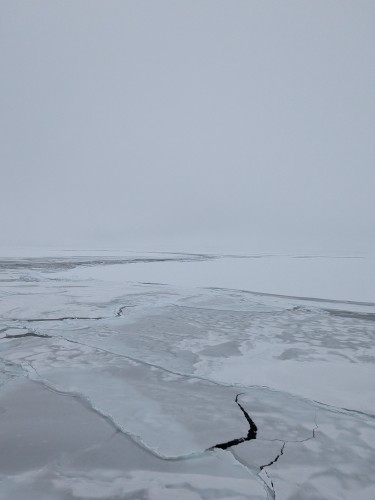
The ice at this location is not uniform. Some slabs are newly frozen, while others have survived decades of seasonal thawing and refreezing, growing denser and harder each year. Thickness can range from six feet to more than twenty-five feet, forming pressure ridges that rise like frozen waves. Ordinary ships would be immobilized or destroyed within hours. Only purpose-built icebreakers, designed to ride up onto ice and crush it with their weight, stand any chance of success.
The North Pole of Inaccessibility Explained
The North Pole of Inaccessibility represents the ultimate challenge in polar navigation. Located far from any coastline, it is surrounded by drifting ice that never truly rests. Even satellites struggle to track its exact conditions in real time. This isolation means that rescue is nearly impossible, making reliability and endurance essential. Reaching this point is not just a navigational achievement but a demonstration of engineering dominance over one of Earth’s harshest environments.
50 Years of Victory: Nuclear Power at the Top of the World
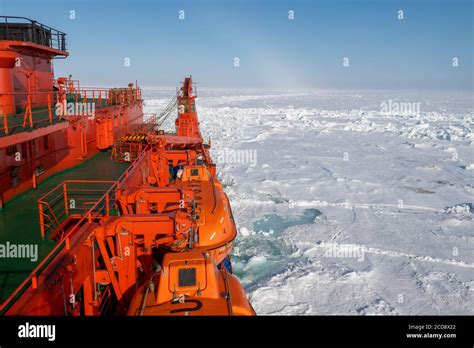
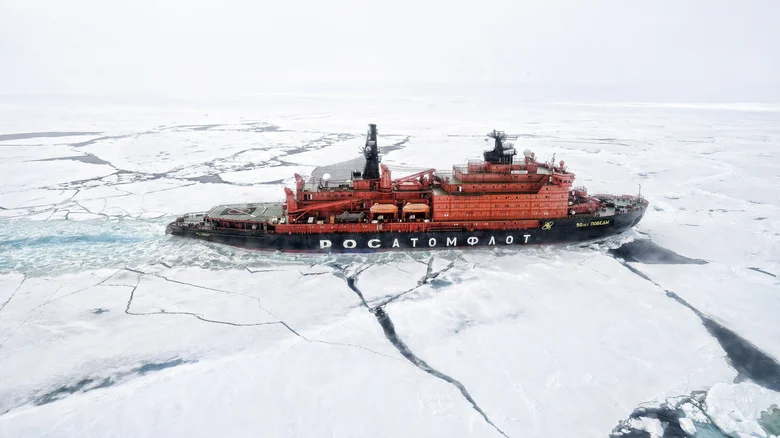
The Russian icebreaker 50 Years of Victory is one of the most formidable ships ever constructed. Launched in 2007, it belongs to the legendary Arktika class, designed specifically to conquer the deepest and hardest Arctic ice. Its double hull is reinforced by an eighteen-foot-wide stainless-steel belt, while a massive spoon-shaped prow allows the ship to climb onto ice and shatter it under immense weight. Two nuclear reactors generate an astonishing seventy-five thousand horsepower, giving the vessel the raw force needed to break through ice up to nine feet thick.
Beneath the surface, hull-mounted jets spray heated water and steam, weakening ice from below. Despite its industrial purpose, the ship is also built for long voyages with passengers, offering cabins, a gym, a library, and even saunas. This combination of brute strength and endurance makes it uniquely capable of reaching the North Pole of Inaccessibility repeatedly and reliably.
Le Commandant Charcot: Luxury Meets Polar Engineering
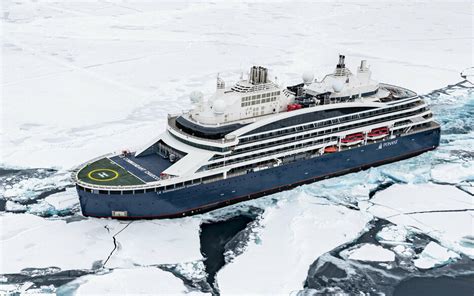
France’s Le Commandant Charcot represents a different philosophy in polar travel. Launched in 2021, it is the first luxury expedition ship purpose-built to break ice while minimizing environmental impact. Rated at Polar Class 2, it cannot match the sheer force of nuclear icebreakers, but it compensates with advanced design and hybrid LNG-electric propulsion. Six engines power massive electric pods that allow precise maneuvering through eight-foot ice floes and towering compression ridges.
The ship can hold position without anchoring, glide silently with zero emissions for limited periods, and remain autonomous for over a month. Carrying hundreds of guests and crew, it transforms one of the most inaccessible points on Earth into a reachable, though still rare, destination. At the thin edge of the Arctic ice season, it proves that modern engineering can blend exploration, sustainability, and controlled comfort at the top of the planet.