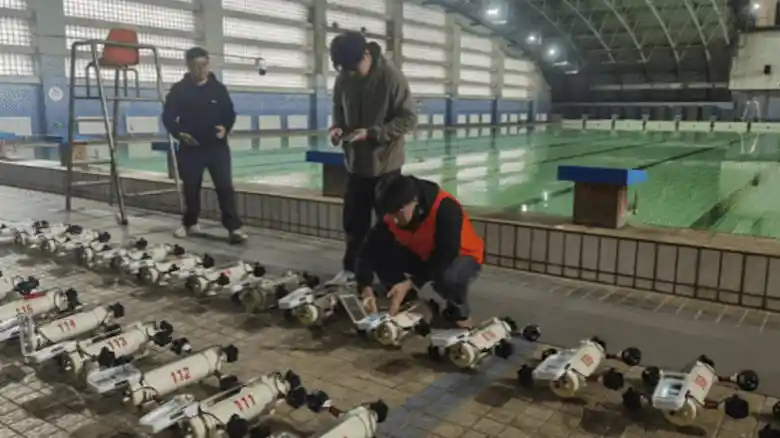
A Chinese research team has achieved a new Guinness World Record after successfully operating 116 autonomous underwater vehicles (AUVs) simultaneously, demonstrating how coordinated robotic systems can function without direct human control. The achievement, completed by researchers at Northwestern Polytechnical University (NPU), represents a significant milestone in underwater robotics and swarm autonomy.
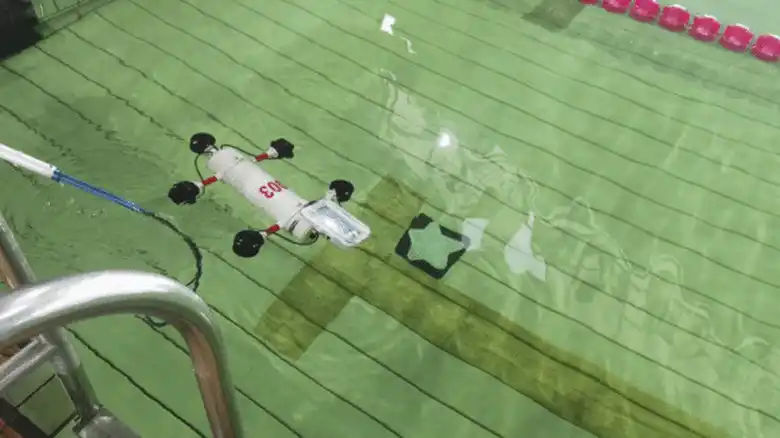
The record-setting demonstration took place on August 29, 2026, in a 50-by-20-meter swimming pool at the university. Although the setting was modest compared with the open ocean environments where such technology could eventually operate, the challenge was substantial: all 116 vehicles had to navigate together along a predetermined route while making autonomous adjustments to their movements.
116 Autonomous Underwater Vehicles Set Guinness World Record
The vehicles used in the demonstration were TH-618 Autonomous Underwater Vehicles, developed through more than two decades of research into underwater sensing, acoustic communications, and visual perception. Northwestern Polytechnical University worked with Xian Tianhe Maritime Technologies to develop the technology, combining research expertise with industrial support.
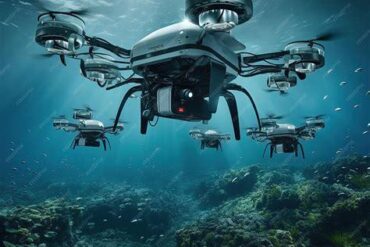
During the official test, the 116 underwater drones entered the pool individually before beginning the coordinated demonstration. Once deployed, they traveled approximately 500 meters over 34 minutes without human intervention. Guinness World Records officials attended the event to verify the operation and certify the new record for the most autonomous underwater vehicles operating simultaneously.
The most important aspect was not simply the number of vehicles in the water. Coordinating a large swarm requires each machine to maintain awareness of its surroundings while following the broader mission. Cameras served as the vehicles’ visual sensing systems, allowing them to detect obstacles and adjust their paths rather than relying on continuous commands from human operators.
TH-618 Underwater Drone Specifications
Each TH-618 measures 61.5 centimeters long and 20 centimeters wide, while weighing approximately 5.14 kilograms. Despite their compact dimensions, the vehicles have a stated maximum operating range of 30 kilometers and battery endurance of up to eight hours.
Those specifications give the system considerably more flexibility than the record demonstration itself required. The pool test lasted only 34 minutes, but the available endurance means the vehicles could potentially undertake substantially longer missions in suitable environments.
The achievement also demonstrates why swarm robotics is becoming increasingly important underwater. Instead of depending on one large and expensive vehicle, researchers can distribute sensing and navigation tasks among many smaller platforms. Losing one unit would not necessarily end an entire mission, while hundreds of vehicles could potentially collect information across a much larger area.
From Swimming Pools to Real-World Underwater Missions
The technology could eventually move beyond record demonstrations into practical marine applications. Coordinated autonomous underwater vehicles could assist with seabed mapping, underwater surveying, and pipeline inspection, particularly in environments where sending divers or operating large crewed platforms would be difficult or expensive.
There is also a potential defense dimension. Xian Tianhe Maritime Technologies is a subsidiary of Xian Tianhe Defence Technology, a private defense contractor, highlighting the broader strategic interest in autonomous underwater systems.
The Guinness record therefore represents more than an impressive swarm demonstration. By proving that 116 autonomous underwater drones can navigate collectively without direct human control, the Chinese research team has shown a scalable approach to underwater robotics that could influence both civilian marine exploration and future unmanned operations.