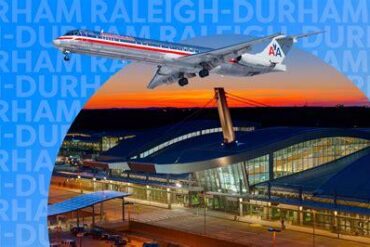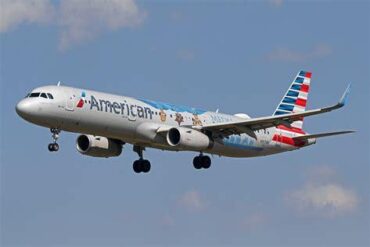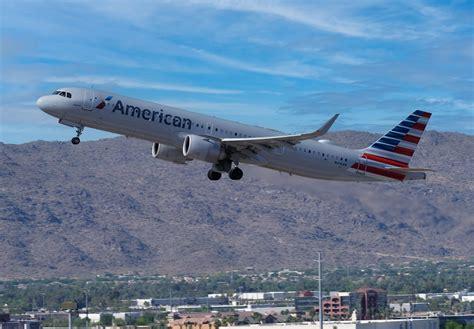
An American Airlines flight from Miami International Airport (MIA) to Raleigh–Durham International Airport (RDU) was rocked by severe turbulence on Sunday night, injuring five individuals and raising serious questions about the airline’s handling of the emergency. The incident, which involved Flight 1286 aboard an Airbus A321-200 (tail number N189UW), is now under investigation by the Federal Aviation Administration (FAA).
Sudden Turbulence Over North Carolina Sky
The flight departed Miami at 21:18 EDT, scheduled for a routine two-hour journey northbound. Approximately an hour into the flight, while cruising at 35,000 feet, the aircraft experienced unexpected and intense turbulence that violently disrupted the cabin environment. Passengers and flight attendants were thrown into the air, beverage carts overturned, and personal items were scattered chaotically.
According to reports, three flight attendants and two passengers were taken to WakeMed hospital in Raleigh upon landing at 23:31 EDT, roughly 40 minutes after the mid-air chaos began. American Airlines stated that the seat belt sign was illuminated at the time of the turbulence, but this claim has been hotly disputed by multiple passengers.
Conflicting Reports and Passenger Testimonies
While the airline maintained that the seat belt sign had been turned on, eyewitness accounts tell a starkly different story. Several passengers interviewed by local news station WRAL insist that the seat belt sign was not illuminated prior to the turbulence. They also noted that flight attendants were actively serving drinks when the aircraft began shaking violently.
One passenger recounted that a male passenger lost consciousness, while a flight attendant suffered a broken arm, and another endured serious burns from scalding water. The force of the turbulence was so extreme that it created a “sudden drop” feeling, which many compared to a free fall.
Passengers were critical of the airline’s in-flight communication, claiming that the captain took too long to make a public announcement after the incident. “It took way too long for the captain to address what happened,” one traveler said. “There were injured people aboard. He should have landed at the nearest airport, not continued to RDU.”
Lightning, Not Turbulence? Growing Skepticism
Fueling passenger frustration are suspicions that turbulence may not have been the only factor. Multiple individuals claimed they saw lightning outside the aircraft around the time of the incident and heard a loud bang, prompting some to speculate a possible lightning strike or even a structural impact.
“Turbulence doesn’t do this,” one frequent flyer asserted. “I’ve been through rough flights before, but this was different. We all saw lightning.”
Although lightning strikes on aircraft are relatively common and rarely dangerous due to shielding and engineering redundancies, they can disrupt avionics and potentially cause turbulence-like jarring movements. However, the airline has not confirmed any lightning strike occurred.
The Descent and Emergency Response
Following the mid-air event, the flight crew descended the aircraft to 22,000 feet, maintaining that altitude briefly before continuing a controlled descent to RDU. Emergency response teams were already standing by as Flight 1286 landed safely, and medical personnel swiftly attended to the injured.
American Airlines issued a public statement expressing appreciation for the professionalism of their crew and understanding from their customers. Yet, that corporate tone has done little to appease those who lived through the terrifying ordeal.
FAA Investigation Underway
The FAA has confirmed that it received a report about injuries sustained by both crew and passengers during the flight and is conducting an official investigation. The probe will evaluate flight data, cockpit voice recordings, weather conditions, and crew compliance with safety procedures.
Investigators are also likely to examine the aircraft’s maintenance logs, weather radar data, and determine whether turbulence forecasts had indicated elevated risk during that air corridor. Should inconsistencies in procedure or communication be confirmed, the FAA could recommend or mandate operational changes for American Airlines.
A Pattern of Recent Incidents
This turbulent episode marks the third serious incident involving American Airlines aircraft in less than two weeks. On June 6, Flight AA37, a Boeing 777-200ER en route from Madrid to Dallas/Fort Worth, also encountered severe turbulence, injuring at least two flight attendants mid-cruise over Memphis.
Just two days later, on June 8, an Airbus A319 operating a Houston–Philadelphia route was similarly battered by mid-air turbulence, sending one flight attendant to the hospital upon landing.
This string of incidents has drawn attention to growing concerns about air turbulence safety, especially amid a backdrop of increasing climate-related disruptions in the upper atmosphere. Atmospheric scientists have pointed to changes in jet stream patterns, driven in part by global warming, as contributing to more frequent and severe clear-air turbulence events.
Industry-Wide Implications for Turbulence Awareness
Experts emphasize that clear-air turbulence (CAT) — turbulence that occurs without visible weather phenomena like thunderstorms or clouds — is particularly dangerous because it is nearly impossible to detect on radar. Pilots rely on forecast models, pilot reports (PIREPs), and onboard sensors, but sudden onset turbulence at cruising altitude often offers little to no warning.
The increasing frequency of such turbulence events raises vital questions:
- Should airlines mandate passengers remain buckled at all times?
- Are cabin crew protocols in need of reform?
- Can aviation weather forecasting tools be modernized or made more precise?
While American Airlines asserts its crews follow established FAA guidelines, passengers across several recent flights are voicing discontent about how these emergencies were managed in real-time.
Passenger Protection and Legal Ramifications
If the investigation finds that safety procedures were not adequately followed — such as failing to switch on the seat belt sign early enough or not issuing turbulence warnings promptly — passengers or crew may pursue legal action. Additionally, liability could emerge if it’s proven that turbulence was foreseeable and not adequately communicated.
“Passenger trust is eroded when basic safety information is disputed,” said an aviation law specialist based in Washington, D.C. “Transparency in communication and clear adherence to established protocols are essential to restoring faith.”
While American Airlines has not indicated whether any compensation will be offered to the affected passengers or crew, aviation industry observers note that reputational damage could exceed the cost of payouts if customer confidence continues to falter.
Conclusion: Turbulence, Trust, and Transparency
As Flight 1286 becomes the latest addition to a troubling pattern of turbulence-related injuries, the airline industry must confront hard truths about safety and customer communication. Whether due to unpredictable weather, inadequate forecasts, or human error, the incident highlights the urgent need for better preparedness, more transparent in-flight communication, and stronger safety measures.
The skies may never be completely smooth, but for the passengers and crew of American Airlines 1286, the scars — both physical and psychological — left by this terrifying flight are very real. As the FAA continues its investigation, the flying public waits not only for answers, but also for assurance that the lessons of this night will lead to safer skies ahead.