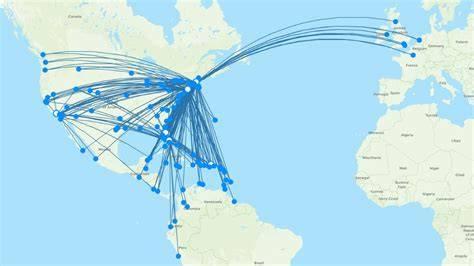
JetBlue Airways has closed the book on four international destinations in 2026, ending service to Antigua, Belize City, Bonaire and Tulum. Every one of the four routes departed exclusively from John F. Kennedy International Airport (JFK), yet their shared origin masks sharply diverging histories. Two were launched as recently as 2024, one arrived in 2023, and Antigua had carried passengers for eleven consecutive years. The withdrawals are not a retreat from international flying; they are the visible edge of JetForward, the airline’s restructuring program, which treats aircraft as capital to be moved rather than commitments to be defended. In JetBlue’s own framing, aircraft freed from weak routes are being redeployed to Fort Lauderdale-Hollywood International Airport (FLL), the base now delivering the carrier’s strongest financial returns.
JetBlue’s 2026 International Route Cuts: The Four Destinations Gone for Good
The exits unfolded across the calendar year, giving each market months of warning but no reprieve. Bonaire departed first in January 2026, little more than a year after its 2024 launch, a route that never had time to build seasonal momentum. Tulum followed in March 2026, also having launched in 2024 from JFK as part of JetBlue’s bet on Mexico’s Caribbean coast beyond Cancún. Belize City closed in May 2026, three years after its 2023 debut. Antigua was the last to go in September 2026, ending a relationship that began in 2015 and had become one of the carrier’s more established Caribbean links. All figures below cover the twelve months ending with each route’s final month of operation.
| Destination | Last Service | First Served | Annual Passengers | Load Factor |
|---|---|---|---|---|
| Bonaire | January 2026 | 2024 | 15,532 | 62.7% |
| Tulum | March 2026 | 2024 | 29,104 | 68.1% |
| Belize City | May 2026 | 2023 | 29,844 | 78.7% |
| Antigua | September 2026 | 2015 | 57,672 | 82.5% |
Reading the Numbers: Load Factors, Fares and the Antigua Paradox
The data tell a story that flatters no single explanation. Bonaire’s 62.7% load factor is the clearest diagnosis of the group: barely three in five seats filled on a route that had not yet completed its second year. Tulum’s 68.1% points to the same problem in a different market, where competing service into Cancún and seasonal demand patterns likely diluted the appeal of a newer, costlier airport. Belize City’s 78.7% looks respectable in isolation, yet the route still departed, suggesting yields or connecting traffic fell short of what the aircraft could earn elsewhere.
Antigua is the anomaly that reveals the strategy’s real logic. Its 82.5% load factor and 57,672 annual passengers would top many route scorecards, and its eleven-year tenure gave it institutional familiarity. It was cut anyway because load factor measures fullness, not profit. A cabin filled with low-fare leisure travelers on a route with demanding block times, seasonal troughs and limited high-yield corporate demand can underperform a sparser but richer market. Profitability depends on fares, unit costs and how many hours each aircraft flies, and by that measure Antigua lost the comparison to the opportunities awaiting capacity in South Florida.
Why JetBlue Cut Routes: JetForward and the Fort Lauderdale Pivot
JetBlue addressed the strategy directly in a statement reported by Aviation Week. To enable what it called “considerable expansion” in Fort Lauderdale, the carrier said it is “ending service on several underperforming routes in other parts of our network, freeing up aircraft availability for our new Fort Lauderdale flights.” The sentence is unusually candid for an airline announcement. Capacity is finite, aircraft are the scarcest asset in the fleet plan, and every route decision in 2026 is effectively an allocation question: where does one airframe earn the most?
Fort Lauderdale answers that question emphatically. After Spirit Airlines’ collapse, JetBlue moved quickly into a vacuum that left South Florida travelers with fewer options and FLL with surplus gate capacity. JetBlue’s Q3 2026 results confirmed the bet: revenue per available seat mile (RASM) rose nearly 15% even as capacity at the airport expanded by more than 65%. Management expects FLL seat share to reach 37% in Q4, up 14 percentage points, and co-branded credit card acquisitions in the region climbed 55%, converting local loyalty into long-tail ancillary revenue. Those are the numbers that justified pulling aircraft from the Caribbean and Central America.
JetBlue’s New International Routes Prove the Retreat Is Selective
Withdrawing from four destinations has not slowed JetBlue’s appetite for new ones. The airline added four international routes in 2026, two in Europe and two in Colombia, each mapped to a specific strategic purpose. Boston–Barcelona launched April 16, 2026, and Boston–Milan Malpensa followed May 11, 2026, both seasonal services flown by Airbus A321LR aircraft equipped with the Mint premium cabin. Milan marked JetBlue’s first Italian destination, extending the transatlantic network that remains anchored at Boston Logan International Airport (BOS) and JFK.
The Colombian additions are a different instrument entirely. Fort Lauderdale–Barranquilla began October 1, 2026, and Fort Lauderdale–Cali began October 15, 2026, both operating daily Airbus A320 service and joining existing Colombian points Medellín and Cartagena. These routes target visiting-friends-and-relatives demand, a segment with predictable year-round traffic and strong local brand loyalty, precisely the profile that supports Fort Lauderdale’s economics. The message is consistent: JetBlue is not shrinking internationally but re-sorting it, keeping long-haul premium flying in Boston and dense VFR markets in South Florida while pruning thinner leisure routes from JFK.

Fort Lauderdale Overtakes JFK as JetBlue’s Busiest Airport
The most consequential outcome of this reshuffling is a change in JetBlue’s own hierarchy. Fort Lauderdale now leads JFK as the airline’s busiest airport by scheduled departures, averaging 133 daily departures in the current winter schedule against 127 at JFK. Boston follows at 119, Orlando at 59 and San Juan’s Luis Muñoz Marín International Airport (SJU) at 38. JetBlue expects to exceed 150 daily departures from FLL in the coming months, a threshold that would widen the gap further.
JFK and Boston remain foundational, particularly for transatlantic flying where the A321LR and Mint cabin justify their costs. Yet JetBlue’s recovery rests on Fort Lauderdale, where capacity, market share and ancillary revenue are all moving in the same direction. The four cancelled destinations are the price of that concentration: Antigua, Belize City, Bonaire and Tulum lost their aircraft so that Barranquilla, Cali and a far larger FLL schedule could gain them.
What the Cancellations Mean for Travelers and the Wider Network
Passengers holding future bookings on the affected routes should expect rebooking options through other carriers or connections via JetBlue’s remaining Caribbean gateways, and travelers who built trips around Tulum’s JFK link now face routing through Cancún instead. For the wider network, the lesson is that international flying remains central to JetBlue’s strategy, with Latin America and the Caribbean still accounting for more than a third of total capacity. The geography is not shrinking, but it is consolidating around fewer, stronger hubs. JetBlue will return to durable profitability only if South Florida keeps delivering the RASM and ancillary gains that justified this reallocation, and the destinations that remain on the map will be judged by the same unforgiving arithmetic that removed these four.