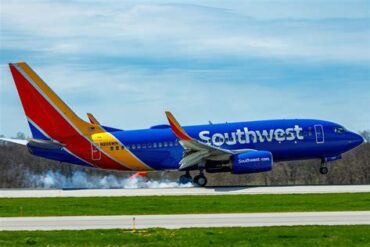
A maintenance-related diversion involving a Southwest Airlines Boeing 737-800 triggered swift operational adjustments on Thursday, leading the airline to deploy a Boeing 737 MAX 8 as a replacement aircraft. The incident unfolded during Flight WN651, a scheduled service from San Diego (SAN) to Indianapolis (IND), carrying 141 passengers and crew. The aircraft diverted to Las Vegas Harry Reid International Airport (LAS) after a recurring cockpit indication prompted the crew to discontinue the flight as a precaution. The sequence of events and the airline’s response highlight the complexity of modern airline operations and the safety-first approach embedded in commercial aviation.
The diversion occurred approximately halfway into the cross-country flight. According to ATC recordings and preliminary reports, the flight crew advised controllers that they had encountered a persistent indication in the cockpit. As the aircraft prepared to approach Las Vegas, the indication disappeared momentarily, only to reappear, prompting the pilots to abandon their initial descent and enter a holding pattern. This allowed them time to run additional checklists and verify system status. Ultimately, ATC declared an emergency for the flight, ensuring priority handling and the positioning of emergency services upon landing.
When the aircraft touched down safely on Runway 26L, the pilots informed ATC they had “run out of cooling,” signaling a potential malfunction with the aircraft’s equipment cooling system or environmental control systems. These systems regulate temperature for avionics and onboard electronics, and any loss of cooling can escalate into an overheating hazard. Emergency crews inspected the aircraft for smoke or hot spots as a precaution.
Southwest activated its contingency procedures shortly after WN651’s diversion. Given its strong operational presence in Las Vegas — where it commands over 40% of the local market and maintains a robust aircraft rotation — the airline was able to swap in a Boeing 737 MAX 8 with minimal delay. This replacement aircraft transported passengers onward to Indianapolis, arriving roughly three hours behind schedule, which is a relatively fast recovery considering the circumstances.
The decision to use a 737 MAX 8 underscores Southwest’s flexibility in deploying its fleet. With nearly 300 MAX 8 aircraft currently in service, the type is rapidly becoming the backbone of the airline’s operations. Its substantial Las Vegas presence ensures aircraft availability during unplanned events, enabling quicker turnarounds for disrupted passengers.
Technical Profile of the Aircraft Involved: Boeing 737-800 N8513F
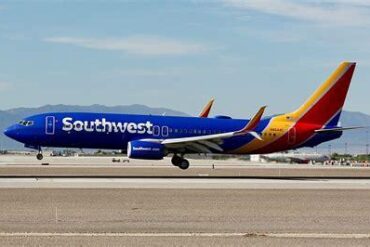
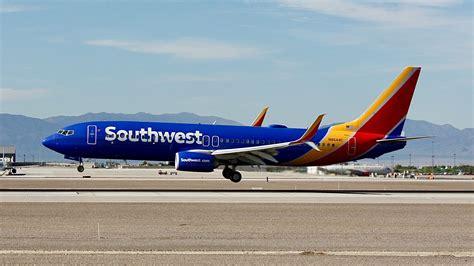
The aircraft at the center of the diversion, tail number N8513F, is a nine-year-old Boeing 737-800 delivered to Southwest in 2016. Throughout its service life, the jet has accumulated more than 30,000 flight hours and 15,000 flight cycles, reflecting extensive domestic operation within Southwest’s high-frequency network.
The Boeing 737-800, part of the Next Generation (NG) series, plays a key role in Southwest’s fleet with nearly 200 units in active service. Its all-economy configuration seats up to 175 passengers, favoring quick turnarounds and high utilization—critical components of Southwest’s operational strategy. WN651’s MAX 8 replacement reinforced the airline’s evolving fleet strategy, in which the MAX series gradually overtakes older NG models.
Data from Flightradar24 confirms that N8513F returned to service the day after the incident, operating flights from Las Vegas to Denver and St. Louis. The rapid return suggests the issue may not have required extensive maintenance, though official details remain limited.
Why Cockpit Indications Prompt Immediate Diversions
Commercial aircraft are engineered with multiple layers of redundancy, but certain system indications require immediate attention. In cases such as WN651, the recurring cooling-related alert signals potential faults in cooling systems crucial for avionics integrity. These systems ensure that electronic components remain within safe temperature thresholds; overheating can lead to system degradation or failure.
When a warning suggests a loss of cooling capability, the crew must act decisively. The standard procedure is to execute checklists and evaluate whether continuing the flight poses any unnecessary risk. A diversion—despite the inconvenience—is the safest outcome. Airlines generally support conservative decision-making in such scenarios to protect passengers, crew, and equipment.
Operational Efficiency and the Role of Las Vegas in Southwest’s Network
Southwest’s response to the diversion demonstrates how strategic airport dominance enhances reliability. Las Vegas serves as one of the airline’s busiest operational hubs, offering abundant aircraft availability, crew resources, and maintenance capacity. The airline’s ability to source a MAX 8 rapidly is not just coincidence—it reflects deliberate fleet positioning and high-frequency scheduling.
This logistical strength enables Southwest to minimize the impact of disruptions like maintenance diversions. While a three-hour delay is never ideal, the ability to avoid overnight rebooking, cancellations, or extended passenger inconvenience shows the value of a well-coordinated operational backbone.
Southwest’s Fleet Evolution: The Growing Presence of the MAX 8
The Boeing 737 MAX 8 now represents Southwest’s second most numerous aircraft type, only slightly outnumbered by the older 737-700 series. The airline continues to phase in the MAX as part of its long-term modernization plan, benefiting from improved fuel efficiency, larger seating capacity, and enhanced avionics. The use of a MAX 8 for WN651’s substitute flight perfectly aligns with this trend.
As more MAX jets join the fleet, Southwest gains added flexibility to manage irregular operations. The MAX 8’s dispatch reliability and availability across high-density bases like Las Vegas—combined with the airline’s preference for single-type operations—help maintain schedule continuity even during unexpected aircraft downtime.
Conclusion: Safety-Driven Decisions and Rapid Fleet Deployment
The diversion of Southwest Flight WN651 serves as a reminder of how quickly technical indications can change the course of a routine commercial flight. The crew’s adherence to safety protocols, ATC’s rapid response, and Southwest’s efficient deployment of a MAX 8 allowed the situation to resolve with minimal disruption and no safety compromise. As the airline continues expanding its MAX fleet and reinforcing operational hubs, its ability to handle such unplanned events with agility and precision will remain a significant advantage.
FAQs
What caused Southwest Flight WN651 to divert to Las Vegas?
A recurring cockpit indication related to the aircraft’s cooling or environmental control system prompted the flight crew to divert for safety.
Was the aircraft damaged or taken out of service?
The 737-800 involved was inspected in Las Vegas and returned to service the next day, suggesting the issue did not require extensive repairs.
Why did Southwest use a Boeing 737 MAX 8 as a replacement?
Southwest maintains a strong presence in Las Vegas and has a large MAX 8 fleet, enabling quick aircraft substitutions for diverted or grounded flights.