Southwest Airlines is stretching its international reach farther than ever before, unveiling a new nonstop link between Las Vegas (LAS) and San José, Costa Rica (SJO) that will become the carrier’s longest international route in its history. For an airline that launched in 1971 and waited until 2014 to cross US borders, this is more than a new city pair. It is a signal that Southwest’s cautious but deliberate global evolution is entering a new phase.
Despite operating one of the largest domestic networks in the United States, international flying still represents just around 2% of Southwest’s total operations. That figure underscores how selective the airline has been beyond US borders. Yet the new Las Vegas–San José service, launching October 1 with daily frequency, redefines what “international growth” looks like for a carrier historically rooted in short- and medium-haul point-to-point flying.
A 2,297-Nautical-Mile Milestone for Southwest
At 2,297 nautical miles (4,254 km) each way, Las Vegas–San José will surpass the airline’s previous longest international route, Denver–San José, by roughly 10% in distance. The significance is not just numerical. It reflects a deliberate shift toward tapping deeper into high-demand leisure corridors connecting the Western United States with Central America.
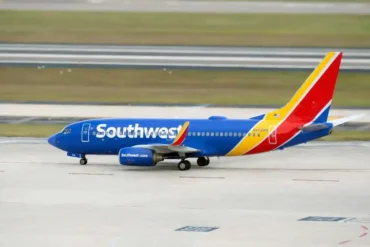
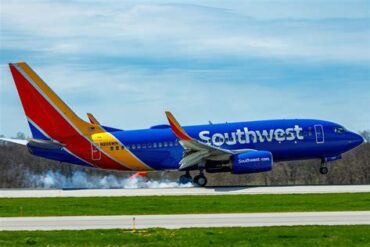
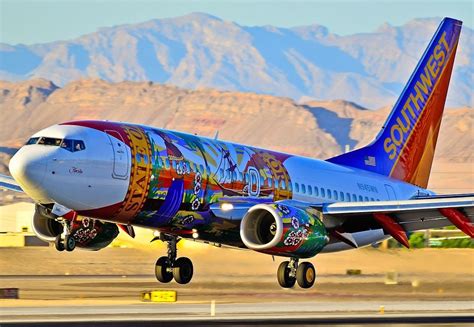
The route will initially be operated by the 137-seat Boeing 737-700, making it the longest 737-700-operated flight touching the United States. For a narrowbody aircraft type long associated with domestic missions, pushing this airframe to the southern edge of its practical range envelope is a notable operational decision.
Historically, Southwest’s longest commercial route had been Los Angeles–Liberia, Costa Rica, at 2,283 nautical miles, a service that ended in 2017. Since then, Denver–San José held the top spot. That changes this October.
Untapped Demand Between Las Vegas and Costa Rica
What makes the new service particularly compelling is that it enters a market previously unserved by nonstop flights. In the 12 months ending November 2025, more than 38,000 round-trip passengers traveled between Las Vegas and San José via connecting itineraries. That figure made the city pair the second-largest unserved US market to Costa Rica’s capital, trailing only Boston.
Nonstop service has a well-documented effect on stimulating demand. Removing connection friction typically increases passenger volume by improving convenience and reducing travel time. In this case, Southwest is not just capturing existing traffic; it is positioned to expand the market itself.
Beyond local traffic, Las Vegas offers formidable connectivity across the Western United States. Southwest’s top potential connecting markets include:
- Los Angeles
- San Francisco
- Seattle
- Phoenix
- San Diego
- Portland
- Salt Lake City
- Sacramento
- San José, California
- Orange County
- Long Beach
- Tucson
- Reno
- Spokane
- Ontario
Only Los Angeles and San Francisco currently offer nonstop links to San José, Costa Rica. That leaves a substantial pool of one-stop passengers who may find Southwest’s schedule and pricing attractive.
Southwest’s First Overnight International Flight
The Las Vegas–San José launch carries another milestone: it will become Southwest’s first-ever overnight international service.
Earlier in 2026, the airline introduced its first domestic red-eye flights. Until now, however, its international departures have largely been daytime or early evening operations. The latest previous international departure this year had been Houston Hobby–Cancun at 6:10 pm. Historically, Houston–Mexico City once featured departures as late as 10:25 pm, but the new Costa Rica service marks a structural shift toward sustained overnight international flying.
The first week of October schedule shows late-night departures from Las Vegas around 11:20 pm and 11:45 pm, arriving in San José at approximately 6:00 am or 6:25 am local time. Return flights operate midday, departing Costa Rica between 12:15 pm and 1:35 pm and arriving in Las Vegas late afternoon.
This pattern allows Southwest to maximize aircraft utilization. Early-morning arrivals in San José enable onward routing within the network, often flowing aircraft to Florida markets such as Orlando. Conversely, aircraft arriving in Costa Rica from Orlando or Houston Hobby can continue onward to Las Vegas. This rotational efficiency is consistent with Southwest’s long-standing operational philosophy of keeping aircraft moving through a tightly integrated system.

Relegating Denver to Second Place
Denver–San José, inaugurated in March 2023, now becomes Southwest’s second-longest international route. Unlike the new Las Vegas service, Denver operates at much lower frequency, typically once weekly. That limited schedule constrained overall passenger numbers.
Between December 2024 and November 2025, Southwest carried 12,114 passengers on the Denver–San José route. Yet despite modest volume, the route posted a robust 90.2% load factor, indicating strong seat occupancy. High load factors do not automatically equate to strong profitability, as yield and cost structures matter, but such performance suggests the route meets internal expectations.
The daily Las Vegas frequency is strategically different. Higher frequency improves schedule flexibility, strengthens competitive positioning, and enhances connectivity. In practical terms, it transforms Southwest from a niche participant in the San José market to a more formidable player.
Strategic Implications for Southwest’s International Growth
Southwest’s international footprint remains small relative to its domestic dominance. However, the Las Vegas–San José announcement demonstrates a pattern: targeted, data-backed expansion into leisure-heavy markets with proven demand elasticity.
Costa Rica continues to rank among the most resilient leisure destinations in the Americas, benefiting from eco-tourism appeal, political stability, and strong brand recognition among US travelers. For Southwest, aligning its Las Vegas base—a powerhouse leisure market in its own right—with San José creates a compelling demand match.
This move also illustrates operational confidence. Operating a near-maximum-range 737-700 sector daily requires precise fuel planning, weight management, and schedule discipline. It is a quiet statement that Southwest is comfortable stretching its narrowbody fleet further when the revenue case justifies it.
A Subtle but Meaningful Evolution
Fifty-four years after its first commercial flight, Southwest remains overwhelmingly domestic. Yet incremental steps like Las Vegas–San José suggest a measured broadening of horizons. The route sets new records for distance, introduces overnight international flying, and taps into an unserved but proven demand pool.
For travelers in the Western United States, it represents a more seamless gateway to Central America. For Southwest, it marks a strategic extension of its playbook: high-frequency, point-to-point service deployed where data shows opportunity.
The airline’s international share may still be modest, but with this launch, Southwest has drawn a longer line on the map than ever before—and it did so with precision rather than spectacle.