Delta Air Lines Adds New Austin–San Jose Connection Amid Network Realignment
Delta Air Lines is reshaping its domestic footprint with a new nonstop service linking Austin and Silicon Valley, even as it trims underperforming routes elsewhere. Beginning October 6, the carrier will introduce daily flights between Austin–Bergstrom International Airport and San José Mineta International Airport, marking a strategic expansion into one of the most tech-driven corridors in the United States.
The timing of the launch is notable. It arrives just one day after Delta phases out services from Austin to Memphis and New Orleans, signaling a sharper focus on markets with stronger business demand and more resilient yield profiles. While Memphis and New Orleans have long served as secondary connection points, San Jose offers direct access to Silicon Valley’s corporate ecosystem, venture capital network, and high-frequency business travel demand. In this sense, the move is less about expansion for its own sake and more about precision route optimization.
The new service will be operated by the Airbus A319, configured with 132 seats across Delta First, Delta Comfort, and Main Cabin. Departures from Austin are scheduled for 9:45 AM under flight DL3128, arriving in San Jose around 11:35 AM after roughly 3 hours and 30 minutes in the air. The return leg departs shortly after midday from California, landing back in Texas in the early evening. The schedule is clearly designed to support same-day business trips in both directions, a hallmark of Delta’s corporate-focused network strategy.
Silicon Valley Access Becomes a Strategic Priority for Delta
The addition of San Jose reflects a broader shift in how airlines value the Bay Area market. Instead of concentrating demand solely through San Francisco International Airport, carriers increasingly treat the region as a multi-airport system, where San Jose and Oakland serve distinct but complementary roles. This allows airlines to better distribute traffic while targeting specific passenger segments, particularly tech professionals who prefer closer access to South Bay corporate hubs.
Competition on the route is already established, with Southwest Airlines operating nonstop service between Austin and San Jose using its Boeing 737 fleet. This creates a dynamic environment where Delta must differentiate through schedule quality, corporate loyalty programs, and onboard product segmentation rather than frequency dominance alone. Although the route is not among the top ten busiest from Austin based on federal transportation data, its strategic importance is amplified by its connection to the broader Bay Area economy.
Delta’s broader presence in the region also strengthens its positioning. Alongside San Jose, the airline maintains service to San Francisco and other West Coast gateways, ensuring network continuity for connecting passengers. This layered approach allows Delta to compete not just on point-to-point demand but also on network connectivity, funneling passengers through hubs such as Atlanta and Salt Lake City when needed.
Memphis and New Orleans Lose Direct Access as Capacity Is Reallocated
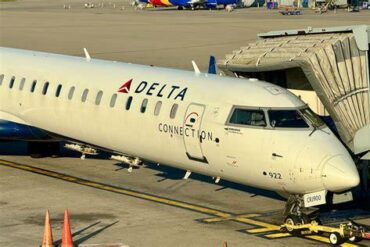
While the San Jose route gains attention, its introduction comes at the expense of two established city pairs. Service to Memphis International Airport and Louis Armstrong New Orleans International Airport will both be discontinued from Austin, with final flights operating in early October. These routes, currently flown by regional jets under Delta Connection branding, have faced weaker demand compared to rapidly growing business corridors.
The adjustment leaves Southwest Airlines as the sole nonstop operator on both routes. In Memphis, Southwest will maintain its presence with Boeing 737 service, while New Orleans will remain connected to Austin exclusively through the low-cost carrier’s network. This shift effectively consolidates point-to-point leisure demand under a single competitor while Delta withdraws to focus on higher-yield markets.
From a network perspective, the decision reflects a broader industry pattern where airlines continuously evaluate marginal routes against opportunity cost. Aircraft like the A319 and regional Embraer jets are increasingly deployed where they can generate stronger revenue per block hour, particularly on business-heavy sectors such as Texas–California flows.
Austin Emerges as a High-Value Network Hub in Delta’s Strategy
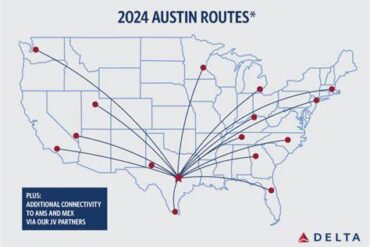
Austin continues to grow in importance within Delta’s domestic system, functioning as a secondary but increasingly strategic node. The airline already operates a wide range of services from the city, connecting it to major hubs such as Atlanta, Minneapolis–St. Paul, Los Angeles, and New York–JFK. It also maintains significant Delta Connection activity across smaller regional markets, reinforcing Austin’s dual role as both a business and feeder hub.
This layered network structure highlights why San Jose fits naturally into Delta’s portfolio. The city pair connects two of the most economically dynamic regions in the country, both heavily influenced by technology, venture capital, and high-skilled labor mobility. In contrast, the retired routes to Memphis and New Orleans, while still important regionally, do not offer the same depth of premium demand or corporate connectivity.
Looking ahead, the Austin–San Jose route may serve as a bellwether for further adjustments in Delta’s transcontinental strategy. If performance meets expectations, similar realignments could follow in other mid-tier markets where demand is steady but not optimal. In an increasingly competitive U.S. aviation landscape, precision has become more valuable than scale, and Delta’s latest move underscores that reality with quiet confidence.