Modern fighter aircraft are often judged by their stealth characteristics, sensor capabilities, and combat performance. Yet one of the most difficult engineering challenges hidden beneath sleek fuselages and radar-absorbing coatings is heat. Every radar pulse, computer processor, electronic warfare system, and jet engine produces enormous amounts of thermal energy. Managing that heat has become as important as generating thrust.
The challenge becomes even more demanding in short takeoff and vertical landing (STOVL) aircraft. Unlike conventional fighters, STOVL jets must hover, land vertically, and operate from amphibious assault ships and small carriers. These unique requirements expose aircraft, ships, and crews to intense thermal loads that can damage equipment, degrade performance, and increase maintenance costs.
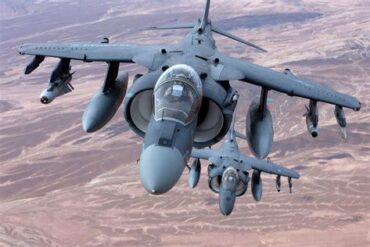
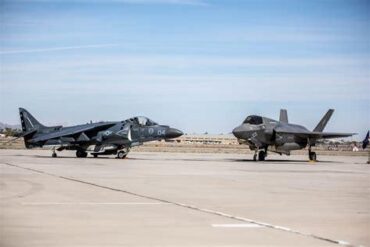
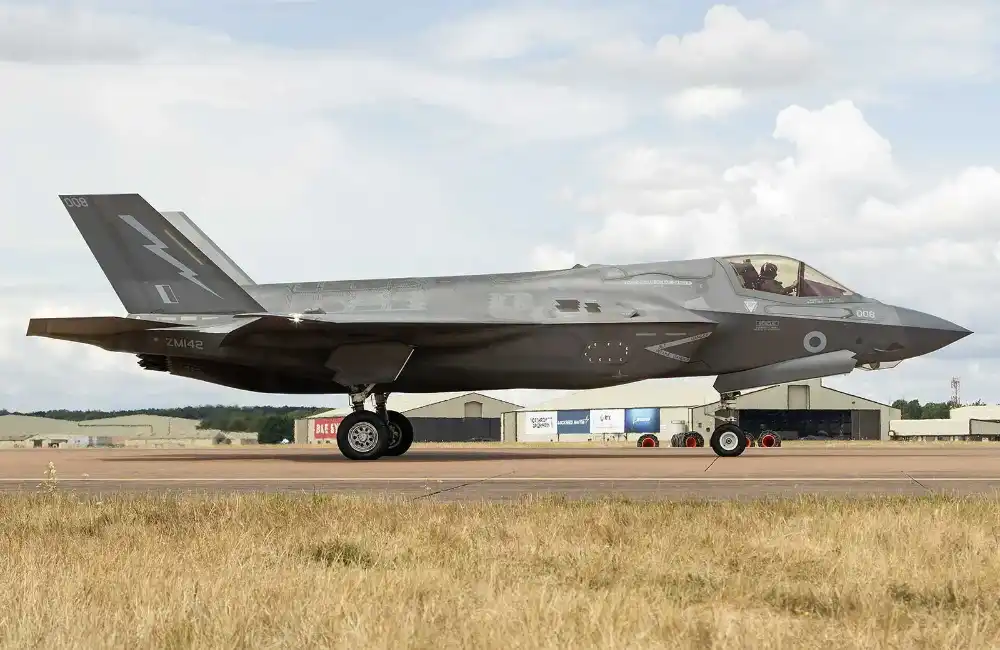
For decades, the AV-8B Harrier II represented both the promise and limitations of STOVL aviation. It provided unmatched operational flexibility but struggled with heat-related issues that affected flight decks, aircraft systems, and operational efficiency. When Lockheed Martin developed the F-35B Lightning II, engineers were tasked with solving many of those longstanding problems while simultaneously creating one of the most technologically sophisticated combat aircraft ever built.
The result was not merely an incremental improvement. The F-35 introduced a fundamentally different approach to thermal management that transformed STOVL operations and established a blueprint for future generations of combat aircraft.
The Harrier’s Long Battle With Heat
The Harrier family earned legendary status through decades of service, particularly during conflicts such as the Falklands War. Its ability to operate from small carriers, improvised airfields, and expeditionary bases gave military planners capabilities unavailable to conventional fighters.
However, those advantages came at a cost.
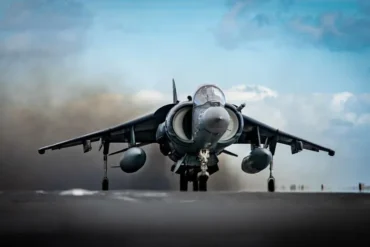
At the heart of the Harrier’s design was the Rolls-Royce Pegasus engine, which directed thrust through four rotating nozzles. During hovering and vertical landings, these nozzles pointed downward, creating a concentrated column of extremely hot exhaust gases.
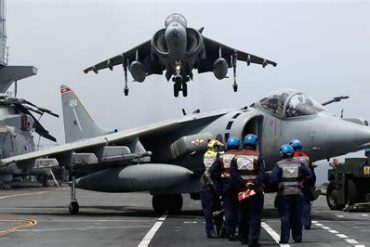
This arrangement generated several major problems simultaneously. The intense exhaust heat could damage ship decks, crack runway surfaces, and increase wear on the aircraft itself. Thermal stress became a constant concern for operators, particularly in hot climates where ambient temperatures were already challenging.
Even more problematic was the phenomenon known as hot gas recirculation. During hover operations, some of the aircraft’s own exhaust could be drawn back into the engine intake. Instead of ingesting cooler outside air, the engine would consume heated exhaust gases, reducing efficiency and potentially compromising performance during critical flight phases.
The Harrier’s design also produced a significant infrared signature. In modern warfare, thermal detection systems have become increasingly effective, making heat management an important component of survivability alongside radar stealth.
Maintenance crews frequently faced the consequences of these thermal stresses. Components exposed to repeated heating cycles experienced accelerated wear, increasing operational costs and maintenance requirements throughout the aircraft’s service life.
Why Vertical Flight Creates Extraordinary Thermal Challenges
To understand the significance of the F-35B’s innovations, it is important to recognize why vertical flight is so difficult from an engineering perspective.
Conventional fighters use forward motion to help dissipate heat. Airflow across the fuselage, engine, and cooling systems naturally removes thermal energy during flight. A hovering aircraft lacks many of these advantages.
When a STOVL aircraft enters hover mode, massive amounts of thrust must be directed downward. The resulting exhaust plume remains close to the aircraft and the surface beneath it. Heat accumulates rapidly, creating an environment where both the aircraft and operating surface are exposed to extreme temperatures.
The challenge extends beyond the engine itself. Modern fighters contain:
- Advanced active electronically scanned array (AESA) radars
- Electronic warfare systems
- Mission computers
- Sensor fusion processors
- Communications equipment
- Navigation systems
Each subsystem generates heat. As computing power increases, thermal loads grow accordingly.
Managing engine heat and electronic heat simultaneously requires sophisticated engineering solutions capable of balancing competing demands without sacrificing performance.
How The F-35B Reinvented STOVL Flight
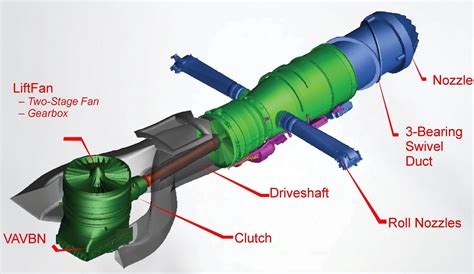
Rather than refining the Harrier’s approach, the F-35B introduced a revolutionary lift system centered around the Rolls-Royce LiftFan.
Unlike the Harrier, which relied primarily on vectored engine exhaust, the F-35B divides vertical lift generation among multiple components. The most visible innovation is the massive LiftFan located directly behind the cockpit.
Driven by a shaft connected to the Pratt & Whitney F135 engine, the LiftFan generates substantial upward airflow while producing significantly cooler air than direct jet exhaust.
At the rear of the aircraft, a sophisticated Three-Bearing Swivel Module redirects engine thrust downward. Additional roll posts located near the wings provide lateral stability during hover.
This distributed approach changes the thermal dynamics of vertical flight.
Instead of concentrating lift generation into a single, intensely hot exhaust stream, the F-35B spreads thrust production across several systems. The result is a more balanced thermal footprint that reduces localized heating effects and minimizes many of the problems that plagued earlier STOVL aircraft.
The LiftFan Advantage
The LiftFan represents one of the most important breakthroughs in modern military aviation.
Measuring approximately 48 inches in diameter, the fan generates enormous vertical lift while producing cooler airflow than pure jet exhaust. During vertical operations, this cooler airflow helps reduce thermal concentration beneath the aircraft.
The benefits extend beyond deck protection.
Because a substantial portion of vertical lift comes from the LiftFan rather than hot exhaust gases, the aircraft experiences less hot gas recirculation. Engine efficiency improves during hover operations, and pilots gain greater control during vertical landings.
The stability improvements are equally significant.
The Harrier effectively balanced on a single primary thrust column. While highly capable in skilled hands, this configuration required constant pilot corrections and imposed operational limitations.
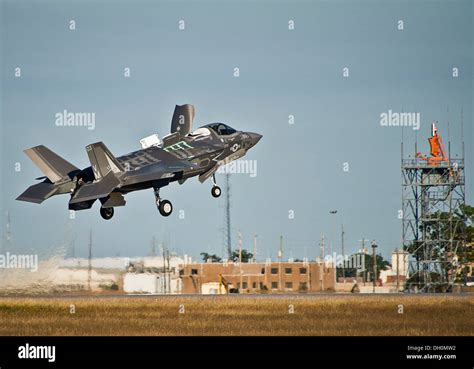
The F-35B distributes lift across multiple points. The LiftFan, rear nozzle, and wing-mounted roll posts create a more stable platform, improving handling characteristics during some of the most demanding phases of flight.
This stability contributes directly to operational safety while reducing stress on both pilots and aircraft systems.
Protecting Aircraft Carriers And Amphibious Ships
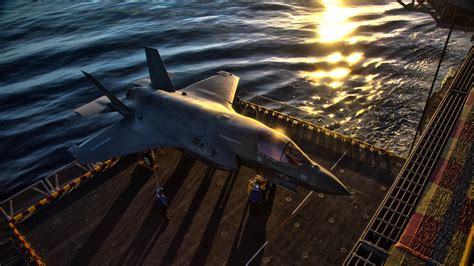
Although the F-35B dramatically improves thermal management compared with the Harrier, it does not eliminate deck heating concerns entirely.
The aircraft remains an exceptionally powerful machine. Its propulsion system generates roughly 40,000 pounds of combined vertical thrust, substantially more than the approximately 23,500 pounds produced by later Harrier variants.
Such power inevitably creates significant thermal effects.
During testing and deployment, military operators discovered that F-35B exhaust could still cause damage to certain deck surfaces. As a result, amphibious assault ships required upgrades, including specialized thermal coatings and reinforced landing areas capable of withstanding repeated exposure to high temperatures.
The U.S. Navy and Marine Corps invested heavily in modifying ships to support long-term F-35B operations. Similar efforts occurred among allied operators introducing the aircraft into service.
The key difference is that these thermal challenges are manageable within the aircraft’s operational framework. The F-35B’s distributed lift system significantly reduces many of the concentrated heating effects that limited earlier STOVL platforms.
Beyond Exhaust Heat: Cooling A Flying Supercomputer
While public attention often focuses on engine exhaust, one of the F-35’s most important thermal challenges comes from its electronics.
The aircraft is frequently described as a flying sensor fusion platform. Its radar, electro-optical systems, electronic warfare suite, networking equipment, and onboard processors continuously exchange and analyze vast quantities of information.
Every one of those systems generates heat.
Compared with the Harrier, the F-35 contains exponentially greater computing power. This creates an entirely different category of thermal management requirements.
Without effective cooling, electronic components can suffer reduced performance, shortened lifespan, or outright failure. Maintaining stable operating temperatures is essential for mission effectiveness.
The solution lies within the aircraft’s sophisticated Power and Thermal Management System, commonly known as PTMS.
Developed by Honeywell, the PTMS integrates multiple functions traditionally handled by separate systems. It provides power generation, environmental control, emergency power support, and thermal management within a unified architecture.
This integrated approach allows the aircraft to continuously regulate internal temperatures while supporting demanding mission systems.
The Power And Thermal Management System Explained
The PTMS serves as the thermal backbone of the F-35.
Its responsibilities extend far beyond simple air conditioning. The system must remove heat generated throughout the aircraft while maintaining operational temperatures for sensitive avionics and mission-critical electronics.
Simultaneously, it supports engine starting functions, emergency power requirements, and cockpit environmental conditioning.
This integration offers several advantages. Rather than relying on multiple independent systems competing for space and resources, the F-35 centralizes thermal management into a coordinated framework.
The PTMS continuously balances heat loads across the aircraft, adapting to changing operational conditions and mission demands.
As sensor usage increases or electronic warfare systems become active, thermal requirements shift rapidly. The PTMS responds dynamically, ensuring critical systems remain within acceptable temperature ranges.
This capability has become increasingly important as F-35 upgrades introduce more powerful hardware.
Lessons Learned From The F-22 Raptor
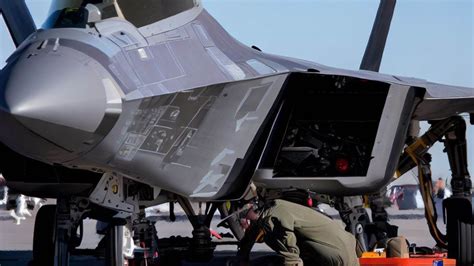
The F-35 benefited significantly from lessons learned during development and operation of the F-22 Raptor.
In 2011, portions of the F-22 fleet experienced operational disruptions linked to environmental control and oxygen-generation issues. Pilots reported symptoms including dizziness, confusion, and oxygen deprivation-like effects.
Investigations identified problems involving the Environmental Control System and On-Board Oxygen Generation System.
Although these issues differed from traditional engine heat concerns, they highlighted the complexity of managing airflows, temperatures, and life-support systems within advanced stealth aircraft.
Engineers working on the F-35 were able to incorporate valuable insights from the Raptor program.
The resulting design placed greater emphasis on integrated thermal management, avionics cooling, and environmental control from the earliest stages of development. Rather than treating cooling as a secondary consideration, designers recognized it as a core requirement essential to mission success.
The F-35 also benefited from broader F-22 experience involving stealth materials, maintenance practices, and systems integration.
Why Block 4 Upgrades Are Creating New Cooling Demands
The thermal management story does not end with the aircraft currently flying.
The ongoing Block 4 modernization program is introducing enhanced sensors, upgraded electronic warfare capabilities, improved processing power, and expanded mission functionality.
These improvements increase electrical demand throughout the aircraft.
More electricity means more heat.
Consequently, thermal management remains one of the most important engineering challenges facing the F-35 program. Future upgrades must balance performance gains against available cooling capacity.
Engineers continue refining systems to accommodate growing thermal loads while preserving reliability and mission effectiveness.
This challenge illustrates a broader trend in military aviation. As aircraft become increasingly dependent on advanced electronics, thermal management evolves from a support function into a primary design driver.
The Road To Sixth-Generation Fighters
The lessons learned from both the Harrier and F-35 are already shaping future combat aircraft.
Programs such as the Global Combat Air Programme (GCAP), the U.S. Navy’s F/A-XX initiative, and America’s emerging sixth-generation fighter efforts face unprecedented thermal challenges.
Future aircraft are expected to combine more powerful radars, larger sensor arrays, advanced electronic warfare suites, artificial intelligence processing, and potentially directed-energy weapons.
Each capability generates additional heat.
At the same time, these aircraft must maintain low infrared signatures to remain difficult to detect by increasingly sophisticated thermal sensors.
This creates a difficult balancing act. Designers must generate and dissipate enormous amounts of heat while ensuring that as little thermal energy as possible becomes visible to adversaries.
Many aerospace engineers now regard thermal management as equally important as aerodynamics, propulsion, and stealth shaping.
In some respects, future fighter development may depend as much on cooling technology as on engine performance.
The F-35’s Quiet Engineering Triumph
The F-35B’s cooling and thermal management systems rarely receive the same attention as stealth features, sensor fusion, or advanced weaponry. Yet they represent one of the aircraft’s most significant engineering achievements.
By replacing the Harrier’s concentrated exhaust-based lift approach with a distributed LiftFan system, engineers dramatically improved hover performance, reduced hot gas recirculation, enhanced stability, and mitigated many of the deck-heating challenges that had constrained STOVL operations for decades.
At the same time, the aircraft introduced an integrated thermal management architecture capable of supporting one of the most electronics-intensive combat platforms ever built.
The result is an aircraft that not only solved many of the thermal limitations of its predecessor but also established a foundation for the increasingly heat-intensive world of next-generation military aviation. As future fighters become more powerful, more connected, and more computationally demanding, the innovations pioneered within the F-35’s cooling system may prove just as important as its stealth characteristics or combat capabilities.