
Air Canada’s public image flies on widebodies. The Boeing 777-300ERs and 787 Dreamliners lifting off from Toronto Pearson International Airport (YYZ) and Vancouver International Airport (YVR) carry the brand across oceans, and they dominate the photographs, the route launches and the premium-cabin headlines. Yet the schedule that actually holds the flag carrier together is stitched from smaller, quieter machines with unmistakably Canadian DNA. Narrowbody jets and regional turboprops built or designed within a few hours’ drive of Montreal and Toronto do the unglamorous work: multiple daily frequencies between business capitals, early-morning feeders from smaller communities, and short hops into downtown airports where widebodies will never land. That domestic spine is what makes the long-haul network financially viable, because intercontinental routes only perform when a dense web of connecting traffic feeds them on both ends.
The scale of that web is easy to underestimate. Air Canada’s domestic-leaning operational strategy sustains schedule density across roughly 50 Canadian airports, plus dozens of transborder gateways in the United States. No single aircraft type can serve that map efficiently. A 300-seat widebody on a 45-minute hop wastes capital and fuel; a 50-seat regional jet on a Toronto–Vancouver trunk route strands demand. The airline’s answer has been a layered fleet in which aircraft of Canadian origin occupy the middle and lower tiers, creating a symbiosis between national manufacturing heritage and the cold arithmetic of airline profitability. Understanding that arrangement explains why the flag carrier can compete on frequency in markets where geography makes surface transport impractical and where business travelers treat hourly departures as a baseline expectation.
The A220-300 as the Narrowbody Backbone of Air Canada’s Fleet
The cornerstone of Air Canada’s modern mainline narrowbody strategy is the Airbus A220-300, an aircraft whose engineering roots run directly into Quebec. Conceived and developed by Bombardier as the CSeries before European stewardship placed final assembly under Airbus at Mirabel, Quebec, the jet was a clean-sheet design rather than a derivative, and that shows in its economics. Air Canada operates between 42 and 47 of the type, with more than 20 additional aircraft on order for a firm commitment of 65 frames. The oldest aircraft in the fleet is roughly seven years old, making the A220 one of the youngest and most efficient core assets in the carrier’s inventory, a position that matters as fuel costs and carbon accounting increasingly shape route decisions.
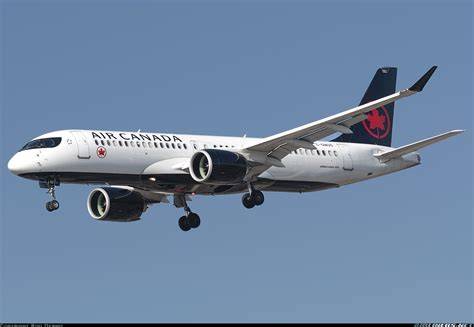
Configuration tells the commercial story. The A220-300 carries 137 passengers in a two-class layout, with 12 business class seats in a 2-2 arrangement and 125 economy seats in a 2-3 layout. The 2-2 business cabin is a genuine differentiator on North American trunk routes, because it eliminates the middle seat entirely in the premium cabin and gives every business passenger either an aisle or a window. The frame is powered by Pratt & Whitney PW1500G geared turbofan engines, whose geared fan architecture allows a smaller, faster low-pressure spool and a larger, slower fan, cutting noise and specific fuel consumption compared with older narrowbodies. Air Canada deploys the type extensively across domestic trunk routes and key US transborder gateways, including services linking Canadian hubs to Los Angeles, Denver and Seattle.
The evolution of this Quebec-built fleet continues to accelerate. New A220 deliveries that began in March introduced Air Canada’s updated cabin standard, bringing the freshest interior specification to the type as frames arrive from the assembly line. That combination of domestic manufacturing lineage and current-generation passenger amenities lets the A220-300 fill the middle ground between domestic mainline flying and cross-border operations, a segment where aircraft size, range and unit cost all have to land within narrow tolerances to make a route work at three or four daily frequencies.
Bombardier CRJ900 Regional Feeder Strategy at Air Canada Express
Mainline narrowbodies handle high-density trunk routes, so the intricate task of feeding regional traffic into the biggest hubs falls to another Canadian-engineered icon: the Bombardier CRJ900. Operated under the Air Canada Express brand by Jazz Aviation, the twin-engine regional jet bridges the gap between smaller Canadian communities and major metropolitan gateways. Corporate fleet profiles and operational analyses place Air Canada’s dedicated CRJ900 fleet at approximately 29 to 30 aircraft, positioned as the high-frequency option for crucial domestic and US transborder corridors where demand supports a jet but not a mainline narrowbody.
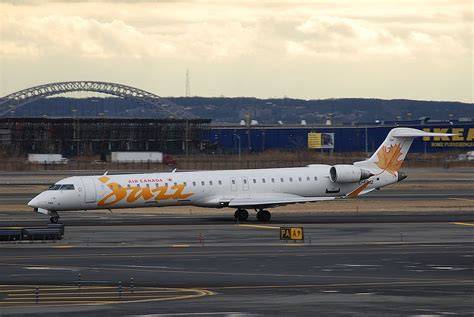
Originally designed and manufactured by Bombardier in Mirabel, Quebec, with the regional program later transitioning under Mitsubishi’s stewardship, the CRJ900 is purpose-built for North American scope clauses and regional economics. It is configured in a standardized 76-seat dual-class layout with 12 business class seats and 64 economy seats, giving the type a premium cabin that mirrors mainline standards rather than the all-economy configuration common on smaller regional equipment. Passengers get personal touch-screen entertainment and robust connectivity, details that matter on two-hour transborder sectors where a bare cabin reads as a downgrade. Twin General Electric CF34-8C5 turbofans mounted on the rear fuselage deliver high cruising speeds alongside the nimble takeoff and landing performance needed for restricted regional runways, an operational profile that keeps secondary airports viable.
The utility of these Canadian-designed jets is reinforced by ongoing fleet modernization. Jazz-operated CRJ900s are receiving Air Canada’s updated cabin standard, aimed at consistent passenger comfort across regional and mainline networks alike. That consistency is strategically important: a traveler who connects from a CRJ900 onto an A220 or a 787 should encounter the same design language, the same seatback screens and the same service expectations, because inconsistency at the regional end of a journey damages the brand as effectively as an unreliable long-haul cabin.
De Havilland Dash 8-400 and the Billy Bishop Toronto City Advantage
Short-haul commuter connectivity across Canada has long been the territory of the De Havilland Canada Dash 8-400. Designed and originally manufactured in Ontario, this high-performance turboprop forms the backbone of Air Canada Express operations on thinner routes, with a fleet of 39 active aircraft flown primarily through regional partners Jazz Aviation and PAL Airlines to sustain high-frequency service across smaller domestic and transborder markets.
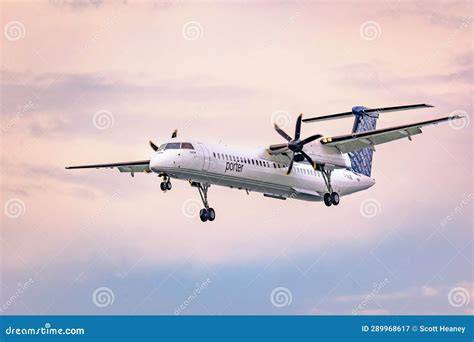
The type’s operational significance is most vivid at downtown Toronto’s Billy Bishop Toronto City Airport (YTZ), where strict noise abatement regulations and runway constraints prohibit commercial jet operations. The 78-seat turboprop is the only realistic option for Air Canada’s downtown Toronto presence, and the airline has exploited that opening aggressively. Air Canada launched a major transborder and domestic expansion from Billy Bishop, introducing new daily US services to LaGuardia Airport (LGA), Boston Logan International Airport (BOS), Chicago O’Hare International Airport (ORD) and Washington Dulles International Airport (IAD), alongside increased frequencies to Montreal and Ottawa. The deployment lets Air Canada compete directly with Porter Airlines in the heart of Canada’s financial district, where a fifteen-minute transfer from the office to the gate is worth more to a banker or consultant than any onboard amenity.
Twin Pratt & Whitney Canada PW150A engines give the Dash 8-400 jet-like cruising speeds with superior short-field takeoff and landing agility. That performance profile makes the aircraft indispensable for navigating tight downtown airspace and connecting regional communities into the flag carrier’s broader transcontinental network. The engines themselves are another piece of Canadian industrial content, produced by a Quebec-headquartered manufacturer, which strengthens the through-line from engine core to airframe to route map.
Cabin Upgrades Across Air Canada’s Homegrown Aircraft
Reliance on Canadian-built and Canadian-designed aircraft has not meant accepting passenger environments of the past. Air Canada’s sweeping cabin renewal spans 2025 and 2026, bringing uniform comfort, advanced connectivity and a distinct national design standard across its domestic assets. The retrofit addresses historical discrepancies between regional commuter hops and mainline transcontinental flights, so that a passenger’s experience depends on the cabin specification rather than the aircraft’s birthplace.
The most transformative upgrade on the late-model A220s is the integration of Airbus’ larger XL overhead bins. These redesigned compartments increase overhead luggage storage capacity by 15 percent and allow standard-sized roller bags to be loaded on their side rather than flat, an ergonomic improvement that frequent business travelers on trunk routes between Toronto, Montreal, Vancouver and key US gateways will notice immediately. Coupled with the aircraft’s wider cabin cross-section, quieter geared turbofan engines and personal touch-screen entertainment at every seat, the structural bin additions give the narrowbody backbone a distinctly superior passenger experience for a single-aisle aircraft.
The overhaul reaches beyond luggage stowage into sensory and structural details across the airframe. Optimized LED ambient mood lighting and a modernized ceiling design create an open, widebody-style atmosphere inside a single-aisle fuselage. With these ergonomic refinements and the A220’s inherently large panoramic windows, Air Canada is delivering both technical efficiency and passenger comfort from the same airframe, a combination that supports premium fares on routes where competitors still fly older-generation equipment.
Intercontinental Widebodies for Global Reach
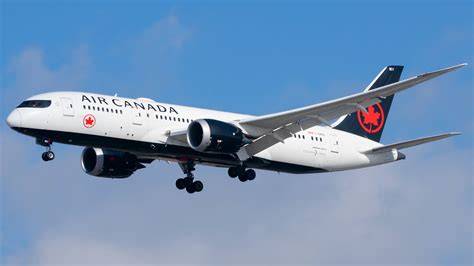
Canadian-engineered aircraft form a huge part of Air Canada’s domestic and regional networks, but the carrier’s global ambitions require a diverse international counterweight of non-Canadian widebody and narrowbody fleets. The airline operates a heavy contingent that includes 19 777-300ERs, 6 777-200LRs, 20 A330-300s and a combined 40 787 Dreamliners across the -8 and -9 variants. These long-haul aircraft handle heavy trunk operations from Toronto Pearson, Montreal-Trudeau and Vancouver across six continents, supported by upcoming widebody orders including 14 787-10s and 8 A350-1000s slated for delivery beginning in 2030.
Domestic and transborder narrowbody structure is balanced through specialized regional and leisure deployments. The Boeing 737 MAX 8 fleet is transitioning to the leisure subsidiary Air Canada Rouge, supported by a new crew base in Vancouver, while mainline narrowbody capacity is reinforced by incoming Airbus A321XLRs featuring true lie-flat Signature Class suites for transatlantic routes. Embraer E175 regional jets operated by Jazz Aviation provide high-frequency, premium-equipped feeder connectivity that mirrors mainline comfort standards across North American corridors. The interplay between Quebec-built domestic options and global heavy jets produces an exceptionally resilient operational matrix, because no single manufacturing disruption, certification delay or fuel price shock can compromise the entire schedule at once.
Honoring Local Aviation History While Securing Future Competitiveness
The enduring success of Air Canada’s route network shows that an airline’s strength is linked directly to the versatility of its fleet. Holding domestic trunk routes with the Quebec-built Airbus A220-300, regional feeders with the Bombardier CRJ900 and downtown commuter links with the De Havilland Dash 8-400, the flag carrier banks on national manufacturing excellence to sustain schedule frequency across North America that no single-type competitor can match.
There is more to watch as Air Canada continues its 2026 cabin modernizations and fleet transitions. From Airbus XL bins through strategic widebody and regional refreshes, homegrown assets remain at the heart of the enterprise. Keeping close ties to local aerospace heritage while pairing it with global widebody reach ensures Canada’s flag carrier is equipped to navigate the future of commercial aviation while honoring the domestic engineering legacy that built its wings.