The idea sounds almost absurd at first: a commercial aircraft engine package costing more than an ultra-luxury private jet. Yet in the case of the Boeing 777X and its massive General Electric GE9X engines, that claim is not only true, it perfectly illustrates how far modern aerospace engineering has evolved into a realm of staggering technological complexity and financial scale.
At current estimated list prices, a single GE9X engine costs roughly $40–45 million. Since every Boeing 777X requires two engines, airlines are effectively paying between $80–90 million just for propulsion before the aircraft even leaves the factory floor. That means the engines alone can exceed the acquisition cost of some of the world’s newest and most capable business jets, including aircraft designed specifically for billionaires, heads of state, and ultra-long-range corporate travel.
The comparison reveals far more than an eye-catching aviation statistic. It exposes the extraordinary engineering demands placed on modern widebody aircraft, the economics of long-haul flying, and the immense challenge Boeing and General Electric face as they prepare the delayed 777X program for commercial service.
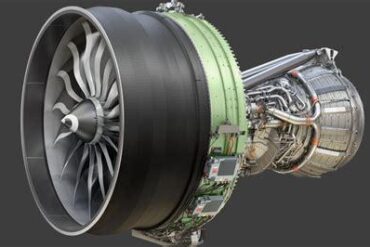
The GE9X is not simply another jet engine. It is the largest and most powerful commercial aircraft engine ever built, designed to push the limits of fuel efficiency, thrust generation, emissions reduction, and operational range all at the same time. That ambition comes at a cost measured not only in billions of dollars of development spending, but also in the astonishing price airlines must pay for each engine.
By aviation standards, the GE9X sits in a category almost entirely by itself.
After years of delays surrounding the Boeing 777X certification process, the engine has become one of the most discussed pieces of aerospace technology in the industry. Airlines are waiting for it. Competitors are studying it. Engineers are obsessed with it. And the economics behind it are rewriting perceptions of what a jet engine can cost.

Why The GE9X Engine Is So Expensive
Modern commercial jet engines are among the most sophisticated machines humanity has ever created. The GE9X takes that complexity to an entirely different level.
Built exclusively for the Boeing 777X family, the engine was developed to produce unprecedented levels of thrust while simultaneously improving fuel efficiency over previous-generation powerplants. That combination is extraordinarily difficult to achieve because greater power traditionally comes with higher fuel consumption, increased temperatures, heavier components, and greater maintenance demands.
General Electric approached the challenge by redesigning nearly every major aspect of the engine.
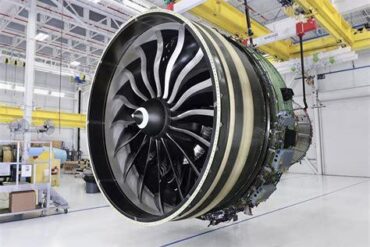
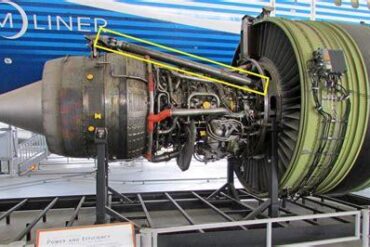
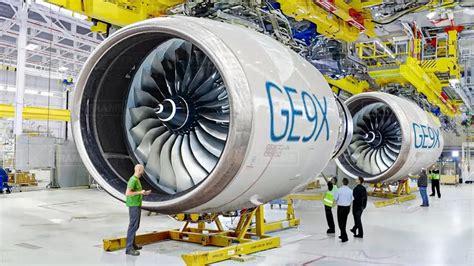
The GE9X uses advanced ceramic matrix composite materials capable of surviving temperatures far beyond what conventional metal alloys can endure. It incorporates carbon fiber composite fan blades, lightweight yet incredibly durable structures, and a huge 134-inch fan diameter that dwarfs nearly every other commercial engine in existence.
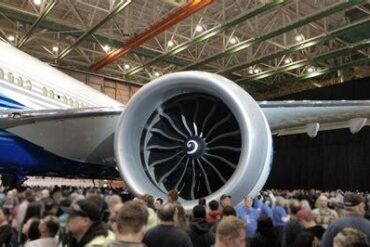
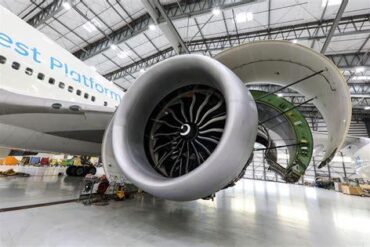
The engine’s front fan alone is so large that its diameter exceeds the width of a Boeing 737 fuselage. Standing next to a GE9X gives a startling sense of scale. Ground technicians appear tiny beside the nacelle, while passengers boarding nearby aircraft often stop simply to stare at it.
That immense size is not just for visual impact. Larger fans increase bypass ratio, which improves fuel efficiency by moving a greater volume of air around the engine core rather than through it. The GE9X achieves a bypass ratio of approximately 10:1, helping reduce fuel burn significantly compared to older widebody engines.
The economics behind that efficiency are enormous. Long-haul airlines burn millions of dollars worth of fuel every single day. Even a small percentage reduction in fuel consumption can save carriers hundreds of millions over an aircraft’s operational lifetime.
As a result, airlines are willing to invest staggering amounts upfront if the long-term operating economics justify the purchase.
The $90 Million Engine Package That Rivals Private Aviation
A pair of GE9X engines costing as much as an elite private jet sounds unbelievable until the numbers are placed side by side.
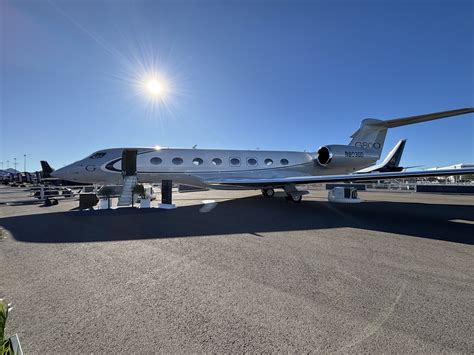
The latest-generation ultra-long-range business jets already operate in a rarefied financial world. Aircraft like the Gulfstream G800 and Bombardier Global 8000 represent the pinnacle of private aviation technology, offering intercontinental range, lavish interiors, and exceptional speed. Yet their list prices still fall within the same range as the engine package powering a single Boeing 777X.
The comparison becomes even more striking when considering what private jets are designed to do. These aircraft cater to celebrities, billionaires, governments, and multinational corporations. They feature handcrafted interiors, private suites, conference rooms, showers, and bespoke luxury finishes that can cost tens of millions of dollars on their own.
And yet, two GE9X engines can still cost more.
That reality highlights the vast difference between luxury aviation and high-capacity commercial aviation engineering. A private jet prioritizes comfort, exclusivity, and prestige. The GE9X prioritizes sustained power generation, extreme reliability, long-haul efficiency, and the ability to move hundreds of passengers across oceans for decades.
The engineering demands are incomparable.
The GE9X Is The Most Powerful Commercial Engine Ever Built
The GE9X’s most defining characteristic is its extraordinary thrust capability.
At maximum output, the engine can produce up to 134,000 pounds of thrust. That figure places it ahead of every commercial aircraft engine currently in airline service.
To understand how massive that number really is, it helps to compare it with engines powering today’s most advanced widebody aircraft.
The Rolls-Royce Trent XWB-97 powering the Airbus A350-1000 generates around 97,000 pounds of thrust. The Rolls-Royce Trent 1000 and GE GEnx engines used on the Boeing 787 Dreamliner typically produce between 53,000 and 78,000 pounds depending on configuration.
The GE9X sits far beyond them all.
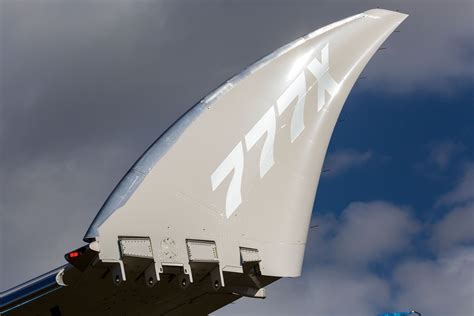
That level of thrust is necessary because the Boeing 777X itself is an enormous aircraft. The 777-9 variant will become the world’s largest twin-engine passenger jet, capable of carrying hundreds of passengers over ultra-long-haul distances while maintaining lower operating costs than older four-engine aircraft like the Boeing 747 and Airbus A380.
In many ways, the GE9X represents the final evolution of the large twin-engine philosophy that transformed commercial aviation over the past three decades.
Instead of relying on four smaller engines, manufacturers increasingly pursued two larger and more efficient powerplants. The strategy reduced maintenance costs, improved fuel burn, simplified operations, and ultimately made massive twin-engine aircraft economically superior on many routes.
The GE9X is the culmination of that philosophy.
Boeing’s Delayed 777X Program Raised The Stakes
Ironically, despite the enormous attention surrounding the GE9X, passengers still have not flown behind it in commercial service.
The Boeing 777X program has faced repeated certification delays, pushing entry into service years beyond original expectations. Airlines that anticipated receiving the aircraft much earlier have been forced to revise fleet plans, extend the life of older aircraft, and adapt long-haul strategies accordingly.
For General Electric, those delays carried enormous implications.
Engine manufacturers typically earn substantial revenue not only from initial engine sales, but also from decades of maintenance contracts, spare parts supply, servicing programs, and long-term support agreements. Every delayed aircraft delivery postpones those revenue streams.
The 777X therefore became more than simply another aircraft development program. It evolved into a critical test of Boeing’s ability to restore confidence following years of regulatory scrutiny and industrial challenges.
At the same time, the GE9X itself underwent intense examination. Regulators closely evaluated durability, safety margins, material performance, and overall reliability before certification could move forward.
That scrutiny is understandable considering the engine’s unprecedented scale and engineering ambition.
Emirates Will Operate More GE9X Engines Than Anyone Else
No airline has committed more heavily to the Boeing 777X than Emirates.
The Dubai-based carrier built much of its modern network strategy around large twin-engine and four-engine aircraft capable of linking virtually any major city nonstop through its Middle Eastern hub. The 777X fits perfectly into that model.
With hundreds of aircraft on order, Emirates is expected to become the world’s largest GE9X operator by a massive margin.
That creates a fascinating operational challenge. Managing hundreds of the world’s most expensive jet engines requires a sophisticated maintenance infrastructure, extensive spare engine inventories, and highly specialized engineering expertise.
Unlike smaller airlines that outsource significant portions of maintenance activity, Emirates has invested heavily in in-house technical capabilities through Emirates Engineering. The airline’s ability to service and maintain complex widebody fleets internally is one reason it can confidently operate such large numbers of high-value aircraft.
Every additional spare GE9X engine stored for operational resilience represents another asset worth tens of millions of dollars.
The scale becomes almost difficult to comprehend. A fleet of spare GE9X engines alone could rival the total value of some regional airlines.
Could Some Private Jets Actually Cost More?
While the headline comparison is true, there are important exceptions.
The private aviation market includes aircraft whose prices can climb dramatically once customization begins. Ultra-high-net-worth individuals often transform business jets into flying mansions complete with bedrooms, showers, lounges, dining rooms, and entertainment suites.
A standard Gulfstream or Bombardier aircraft may start near the $70–80 million range, but highly customized versions can exceed $100 million with ease.
Celebrity-owned aircraft frequently become the most extreme examples. Custom interiors, luxury materials, advanced communications systems, and bespoke layouts can add tens of millions to the final bill.
Then there are Boeing Business Jets and Airbus Corporate Jets — ultra-luxury aircraft based on commercial airliner platforms like the Boeing 737 or Airbus A320 family. These aircraft operate in an entirely different financial category.
Some BBJs and ACJs can exceed $150 million or even approach $300 million depending on configuration and customization. In those cases, the aircraft itself comfortably surpasses the cost of a pair of GE9X engines.
Still, those jets occupy the absolute top tier of private aviation. Most modern business jets remain less expensive than the propulsion system powering a Boeing 777X.
The GE9X Represents The Future Of Large Aircraft Efficiency
The most remarkable aspect of the GE9X may not be its size or price, but what it represents strategically for the future of long-haul aviation.
Commercial airlines face mounting pressure to reduce emissions, improve efficiency, and control operating costs while passenger demand for international travel continues growing. Aircraft manufacturers therefore need engines capable of delivering more power using less fuel.
That challenge grows increasingly difficult as physics imposes harsher limits on traditional engine architecture.
The GE9X attempts to squeeze every possible efficiency gain from the conventional turbofan concept before the industry eventually transitions toward future technologies such as open-rotor propulsion, hybrid-electric systems, hydrogen combustion, or sustainable aviation fuel optimization.
In that sense, the engine is both a technological peak and potentially the end of an era.
Its gigantic fan diameter, advanced composites, and extraordinary thrust output represent the outer limits of what modern turbofan engineering can achieve within current airport infrastructure and airline operating requirements.
Future engines may look radically different.
For now, however, the GE9X stands as the most ambitious commercial aircraft engine in the world — a machine so advanced, so large, and so expensive that its price eclipses some of the most luxurious private aircraft money can buy.

Why The Boeing 777X Engine Story Fascinates Aviation Enthusiasts
The fascination surrounding the GE9X extends beyond aviation professionals because it perfectly captures the staggering scale of modern aerospace engineering.
Most people understand that airplanes are expensive. Few realize just how expensive individual components have become.
A commercial jet engine is not simply machinery. It is a flying powerplant operating under extreme heat, pressure, rotational force, and reliability expectations every second it remains airborne. It must function flawlessly across thousands of flight cycles, in freezing temperatures at cruising altitude and scorching heat on desert runways alike.
When viewed through that lens, the GE9X’s extraordinary price begins to make sense.
It is effectively a technological masterpiece built to power one of the most advanced passenger aircraft ever created. And in an industry where efficiency gains of even a few percentage points can reshape airline economics worldwide, airlines are willing to spend fortunes acquiring it.
The result is one of aviation’s most astonishing financial realities: the engines mounted beneath a Boeing 777X wing can cost more than the sleek private jets parked at elite executive terminals around the globe.