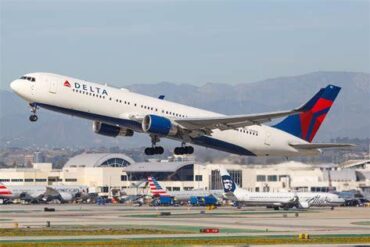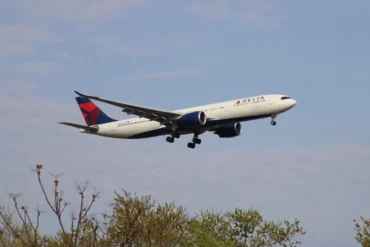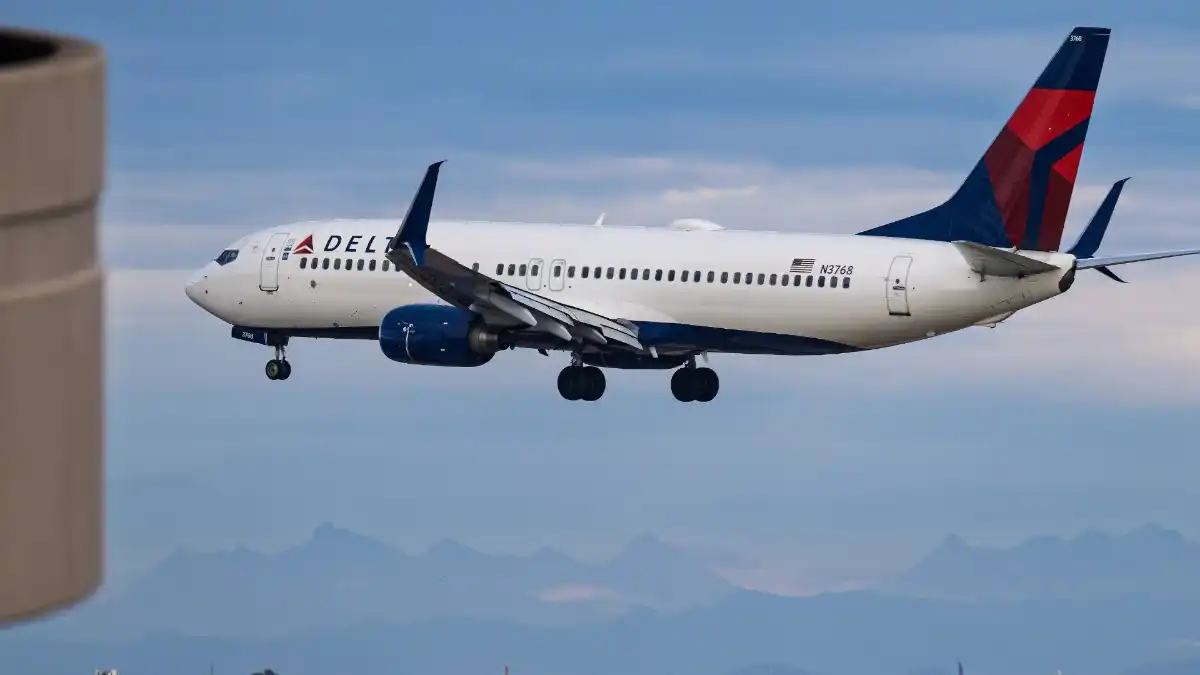
A Delta Air Lines Boeing 737-900ER was forced into a rapid emergency descent shortly before landing after an apparent cabin pressurization failure caused oxygen masks to deploy, turning what should have been the final minutes of a routine flight into a deeply unsettling experience for passengers.
Delta Flight DL2311 was operating from Los Angeles International Airport (LAX) to Salt Lake City International Airport (SLC) on Sunday when the incident occurred. The aircraft was already approaching the Las Vegas area when the crew initiated the rapid descent and diverted to Harry Reid International Airport (LAS).
According to passenger accounts shared after the flight, the cabin pressure problem was accompanied by immediate physical symptoms, including painful ears, while the emergency oxygen masks dropped from the overhead panels. One passenger described the experience as “pretty traumatic,” particularly because those onboard initially had little information about what was happening.
Delta Flight 2311 Makes Rapid Descent Near Las Vegas
Flight tracking data indicates that DL2311 departed LAX at approximately 5:06 p.m. The Boeing 737-900ER subsequently encountered the apparent pressurization problem while nearing Las Vegas, prompting the crew to abandon the original approach to Salt Lake City and descend rapidly toward a lower, safer altitude.
Although the publicly shared air traffic control recording does not contain an explicit Mayday declaration or a detailed explanation from the pilots, the aircraft received priority handling consistent with an emergency. The crew’s decision to divert to Las Vegas also allowed the aircraft to reach an airport quickly rather than continuing toward Salt Lake City.
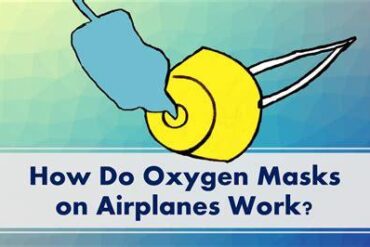
The rapid descent was necessary because loss of cabin pressure at cruising altitude can create a potentially dangerous environment. As the aircraft descends, the outside atmospheric pressure increases, reducing the difference between cabin and ambient pressure and eventually allowing passengers and crew to breathe normally without supplemental oxygen.
Passenger Describes a “Pretty Traumatic” Experience
The most revealing details came from a passenger who later described the event on Reddit. According to the account, the pressurization system failed, causing the passenger’s ears to hurt almost immediately before the oxygen masks deployed.
The passenger said the aircraft then performed a rapid descent toward Las Vegas. Yet the descent itself was reportedly not the most frightening part. Instead, uncertainty inside the cabin made the situation especially stressful.
Flight attendants continued making announcements while wearing their own oxygen masks, but the passenger said those announcements were extremely difficult to hear. That combination of sudden oxygen-mask deployment, physical discomfort and limited information can understandably make an emergency feel far more severe from inside the cabin than it may appear on a flight-tracking map.
Why the Boeing 737 Had to Descend to a Safer Altitude
Commercial aircraft are normally pressurized so passengers can breathe comfortably at high cruising altitudes where the surrounding air is far too thin to support normal unassisted breathing. If cabin pressure falls unexpectedly, pilots must respond quickly because the amount of useful time available before oxygen deprivation becomes serious can be limited.
A rapid descent to approximately 10,000 feet or below is therefore one of the most important procedures following a significant depressurization event. At those altitudes, atmospheric pressure is substantially greater, allowing occupants to breathe without relying indefinitely on the aircraft’s emergency oxygen system.
The deployment of the masks does not necessarily mean that the aircraft was seconds from catastrophe. Rather, it indicates that the aircraft’s systems detected a cabin-altitude condition requiring supplemental oxygen. The crew’s rapid response is precisely what the emergency procedures are designed to achieve.
Delta 737 Diverts to Las Vegas Instead of Salt Lake City
The incident occurred at a fortunate point in the flight. Las Vegas was close, giving the crew an airport capable of receiving the aircraft without requiring a lengthy continuation after the cabin-pressure problem.
The Boeing 737-900ER landed at LAS, where the aircraft was inspected. Surprisingly, the jet returned to service within only a few hours and eventually continued to Salt Lake City later that night. Flight-tracking information shows that DL2311 ultimately reached SLC at approximately 12:24 a.m.
The relatively short period before the aircraft returned to service suggests that the underlying problem may not have involved major structural damage. However, the exact source of the malfunction has not been publicly disclosed, so it would be premature to conclude that a particular valve, sensor or software component was responsible.
Delta Has Experienced Another Pressurization Incident This Year
The DL2311 incident is particularly notable because it follows another Delta pressurization-related event earlier this year. On January 5, Delta Flight 760 experienced a pressure-loss problem involving an Airbus A319 and diverted to New York JFK as a precaution.
Despite the similarities, the two events were technically quite different. The A319 experienced a slow pressure leak, giving the crew indications of a gradual problem. The Boeing 737 incident, by contrast, appears to have involved a much more immediate loss of cabin pressure, requiring the oxygen masks to deploy and the aircraft to descend rapidly.
The Airbus crew was also able to use backup systems to repressurize the cabin before diverting. There is insufficient public information to determine whether similar backup options were available or considered on DL2311.
Different Aircraft, Similar Emergency
The aircraft involved in Sunday’s event, registration N934DZ, is a Boeing 737-900ER that Delta acquired from Lion Air in 2023. According to flight-tracking information, the aircraft is nearly 15 years old and is powered by two CFM International CFM56-7B27 turbofan engines.
The earlier Airbus A319, registration N328NB, is substantially older, having been in service for more than 25 years. It was acquired by Delta from Northwest Airlines in 2009 and uses CFM56-5B4 engines.
The age and history differences are significant, but they also reinforce an important point: cabin pressurization incidents are not exclusive to one aircraft type or manufacturer. They are rare events in commercial aviation, and when they occur, standardized emergency procedures give flight crews a well-established method for protecting everyone onboard.
For the passengers aboard DL2311, however, technical explanations do little to change how frightening the experience must have been. The sudden appearance of oxygen masks, painful ears and a rapid descent can make an ordinary flight feel anything but ordinary. The fact that the crew quickly diverted to Las Vegas and brought the aircraft safely to the ground demonstrates why those procedures—and the training behind them—matter so much.