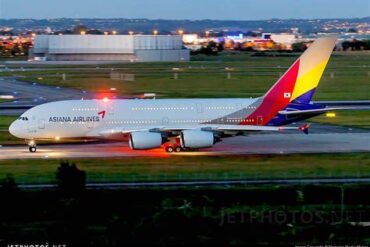
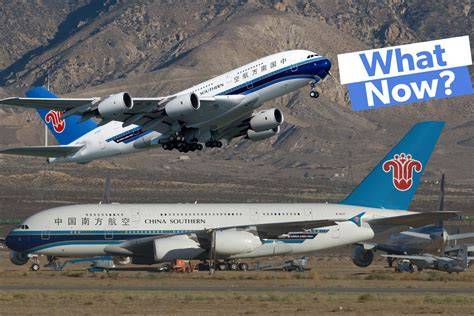
The Airbus A380 was created to be one of the defining aircraft of the modern jet age. Its enormous size, four engines, full-length upper deck, and ability to carry hundreds of passengers made it a symbol of the era when airlines expected traffic between major international hubs to keep growing. Yet some A380s have discovered a very different ending. Instead of spending decades crossing oceans, several former China Southern Airlines superjumbos now sit at California’s Mojave Air and Space Port, where their remaining value is increasingly being measured in engines, landing gear, avionics, and individual components rather than passenger seats.
The story of these aircraft is especially striking because they were not old by normal commercial aviation standards. China Southern received its first A380s beginning in 2011, and the airline’s five-aircraft fleet was still relatively young when it disappeared from passenger service. The youngest aircraft had many potential years ahead of it, at least from a structural perspective. What changed was not simply the condition of the airframes, but the economics surrounding the A380. An aircraft can remain technically capable of flying while becoming commercially difficult to justify, and the former China Southern fleet offers an unusually clear example of that problem.
Several of these aircraft were eventually ferried from Guangzhou to the Mojave Desert after China Southern decided to retire the type. Once there, they entered the aircraft-storage and aftermarket ecosystem surrounding Mojave. Current records from Jet Midwest list multiple former China Southern A380s as “aircraft in dismantle,” while aircraft-tracking records indicate that some have already been partially scrapped. Their story is therefore not simply one of aircraft being abandoned in the desert. Instead, the A380s are gradually being transformed into a pool of scarce components that could help keep other superjumbos flying.
China Southern’s Airbus A380 Fleet Had a Surprisingly Short Life
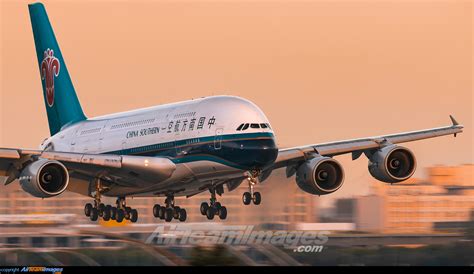
China Southern was the only Chinese airline to operate the Airbus A380, making its superjumbo fleet a particularly important part of the aircraft’s history in the country. The airline received five A380-800s between October 2011 and February 2013, introducing an aircraft that was designed to provide enormous capacity on routes where demand was concentrated between major cities. Guangzhou Baiyun International Airport became the principal base for the fleet, with the aircraft operating important domestic services as well as selected international routes.
The decision to operate five A380s made sense in the environment of the early 2010s. China’s aviation market was expanding rapidly, and airlines were looking for ways to accommodate enormous passenger volumes between major population centers. The A380 offered something few other aircraft could provide: extraordinary capacity without requiring another departure slot. When demand was strong enough, putting hundreds of passengers onto one aircraft could be an efficient way to move large numbers of travelers between constrained airports.
The problem was that the global aviation market gradually moved in another direction. Airlines increasingly discovered that the flexibility of modern twin-engine widebodies was often more valuable than the sheer capacity of a four-engine superjumbo. Aircraft such as the Airbus A350 and Boeing 787 could serve long-distance markets with fewer seats while consuming less fuel and requiring less specialized infrastructure. That allowed airlines to open more routes, adjust frequencies more easily, and reduce the financial risk associated with filling a huge aircraft every time it departed.
The COVID-19 pandemic accelerated this transformation dramatically. International borders closed, passenger demand collapsed, and aircraft designed for high-density global travel suddenly became extremely difficult to operate profitably. Many A380s were parked around the world, and some eventually returned to service when demand recovered. Others never did. By the time the market stabilized, airlines had become even more comfortable with smaller, efficient widebodies, making it harder for the A380 to regain its former position.
China Southern announced in 2022 that it would retire its remaining A380 fleet by the end of that year. Two aircraft, B-6136 and B-6137, had already left revenue service in late 2021 and were ferried from Guangzhou to Mojave in February 2022. The final aircraft followed later that year. B-6139, corresponding to manufacturer’s serial number 88, departed Guangzhou for Mojave on December 21, while B-6140 also made the journey. In little more than a year, China Southern’s entire A380 operation had effectively disappeared.
Why Young Airbus A380s Became Difficult to Sell
At first glance, sending aircraft that were only around 14 or 15 years old to a desert storage facility seems extraordinary. Commercial aircraft frequently remain in service far longer than that. A narrowbody jet of similar age might still be considered an attractive asset for another airline, while a widebody with a strong secondary market could potentially continue operating for decades.
The A380 is different because structural life and commercial life are not the same thing. The airframe may have considerable engineering life remaining, but that does not mean an airline can generate enough revenue from it to cover the costs of operating the aircraft. The larger the aircraft, the greater the penalty when seats go empty. A carrier operating a smaller twin-engine widebody can often reduce capacity or increase frequency depending on demand. An A380 provides an enormous amount of capacity every time it leaves the gate.
Its physical size also creates additional complications. The aircraft uses two passenger decks and requires airports capable of handling its dimensions, boarding arrangements, passenger flows, and specialized ground equipment. Airlines considering a secondhand A380 therefore cannot simply purchase an airframe at a low price and immediately begin selling tickets. They need appropriate airport access, trained crews, maintenance capability, spare parts, cabin support, and a route network capable of consistently filling the aircraft.
This makes the secondary market for used A380s unusually narrow. There are relatively few airlines capable of operating the aircraft profitably, and even fewer may want additional examples at any particular moment. A used aircraft that looks inexpensive compared with its original purchase price can still require substantial investment before entering service. Cabin refurbishment alone can become a major project, while maintenance costs, engine reserves, crew training, and airport compatibility all add to the financial calculation.
The result is one of the most interesting characteristics of the A380’s decline: commercial obsolescence can arrive before structural obsolescence. An aircraft does not have to be worn out to become economically unattractive. In some cases, the value of its components can actually exceed the value of the complete aircraft as a passenger jet.
Four Former China Southern A380s Are Now Being Dismantled
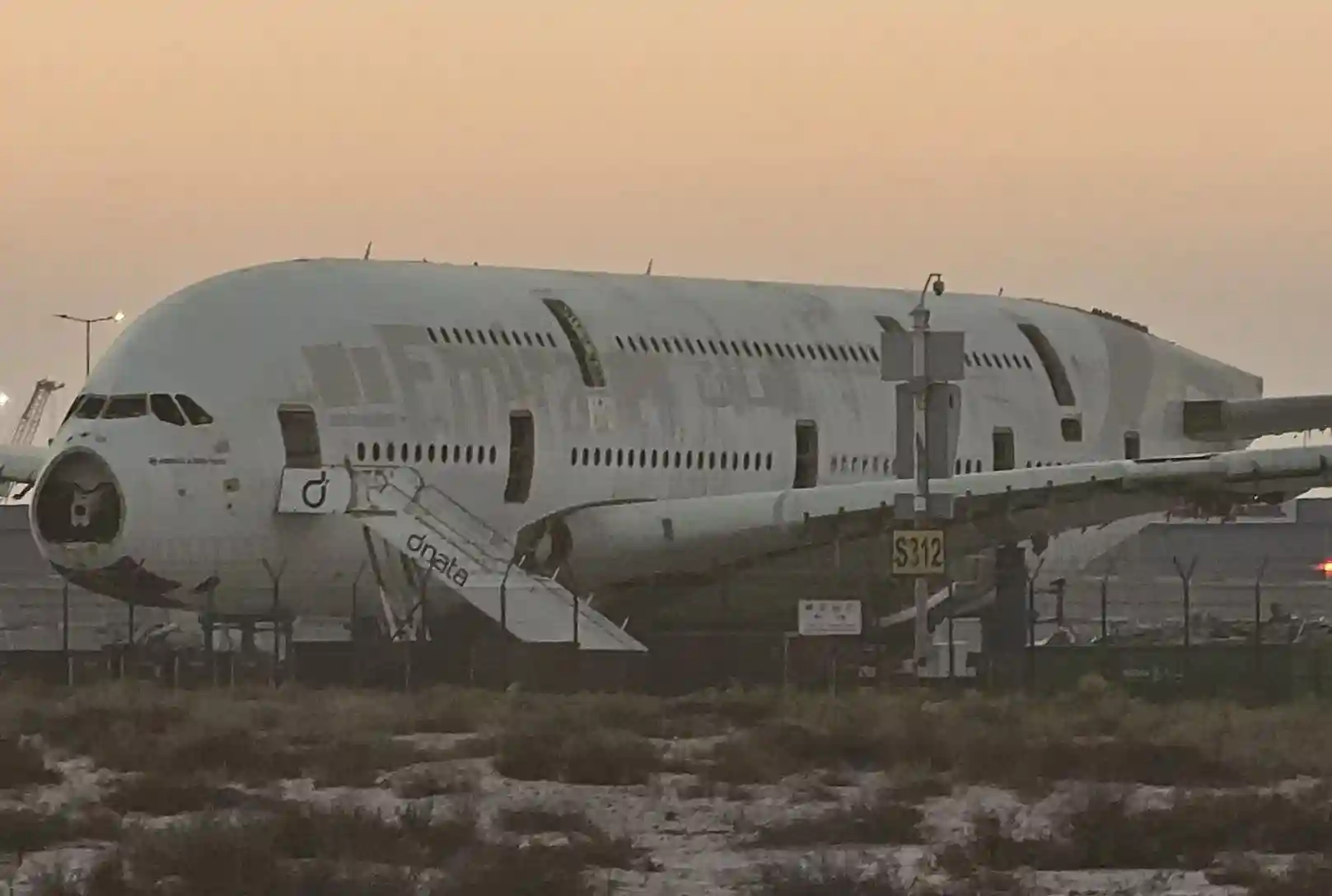
That is increasingly the fate of several China Southern A380s at Mojave. Jet Midwest’s dismantling inventory lists four former China Southern A380-800s, including aircraft identified as N110PK, N291JM, N296JM, and MSN 88. The aircraft are associated with Rolls-Royce Trent 900 engines and China Southern as their previous operator.
N291JM and N296JM were formerly B-6136 and B-6137, respectively. Both reached Mojave in February 2022 after being withdrawn from service. Aircraft records subsequently indicated that dismantling had begun. Another former China Southern aircraft, N115PK, followed a similar path after leaving service in November 2022 and being moved to Mojave the following month, with records later identifying it as partially scrapped.
The terminology is important because “aircraft in dismantle” does not necessarily mean an entire aircraft has already disappeared. Dismantling is a process, and different sections of an airframe can remain in place while valuable equipment is progressively removed. A jet can therefore look largely intact from a distance while already having ceased to exist as a complete commercial asset.
Nor do these records establish that every aircraft was rejected by every potential airline buyer. The more defensible conclusion is that the owners and asset managers determined that dismantling currently offered the most attractive use for those particular airframes. Instead of betting on a future passenger operator, they could extract value from equipment that is needed by the much smaller population of A380s still flying.
Rolls-Royce Trent 900 Engines Are Among the Most Valuable Assets
The engines are perhaps the most obvious reason a retired A380 can still have significant aftermarket value. The former China Southern aircraft in Jet Midwest’s inventory are equipped with Rolls-Royce Trent 900 engines, a powerplant used across a substantial portion of the A380 fleet.
A retired aircraft does not necessarily have engines that are worth exactly the same amount as the airframe around them. Engine maintenance histories vary, and engines can be removed, overhauled, exchanged, and reinstalled during an aircraft’s operating career. A powerplant with favorable maintenance status or useful remaining life can therefore become a valuable asset even when the aircraft to which it was originally attached has reached the end of its commercial career.
Engines can also be dismantled themselves. Individual modules and components may have value to maintenance organizations supporting aircraft that remain in operation. For a shrinking fleet such as the A380, scarcity can make used parts increasingly important. Airlines cannot simply rely on a massive worldwide inventory of surplus aircraft to supply every component they need.
The same principle applies to auxiliary power units, engine accessories, nacelles, and associated systems. The A380’s four-engine configuration means that each retired aircraft represents four potential sources of major propulsion hardware. When the number of active aircraft falls, every serviceable engine and major engine component can become more strategically valuable.
A380 Landing Gear Has Extraordinary Replacement Value
The aircraft’s landing gear is another major source of potential value. An A380 weighs vastly more than a typical narrowbody, and its landing-gear system reflects the enormous loads imposed during taxiing, takeoff, landing, and ground handling. The main gear is particularly large and complex.
That makes serviceable used landing-gear components attractive. Aviation Week has previously reported that a new A380 main landing-gear assembly could cost around $25 million, illustrating why an operator might prefer a properly inspected and serviceable used component when one is available.
A retired aircraft can therefore become something resembling a parts warehouse for the fleet still operating around the world. Landing-gear assemblies, actuators, wheels, brakes, hydraulic equipment, electrical systems, flight-control components, avionics, doors, windows, and cabin equipment can all potentially find another use. The economic calculation becomes especially compelling when the alternative is manufacturing a new component or waiting for one to become available.
The important qualification is that removing a part does not automatically make it ready for another aircraft. Aviation components are tightly controlled, and their maintenance records, condition, certification status, and service history matter enormously. Some parts can be sold as serviceable, some may require repair or overhaul, some may be useful only as sources of material or subcomponents, and others may have little value at all.
Mojave Gives Retired A380s Time and Space
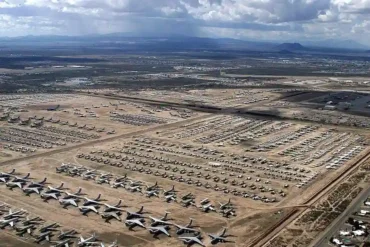
The Mojave Desert is particularly well suited to aircraft storage because its dry environment reduces exposure to moisture, while the enormous airport area provides space for aircraft that have no immediate commercial destination. Aircraft can remain stored while owners evaluate market opportunities, negotiate sales, or determine whether dismantling offers a better return.
Once the decision to dismantle is made, the process is far more systematic than simply cutting up a retired airplane. High-value equipment is generally targeted first. Engines, landing gear, avionics, flight controls, auxiliary systems, and other major components can be removed, documented, inspected, and placed into inventory.
The cabin then offers another layer of recoverable material. Seats, galleys, lavatories, entertainment systems, lighting equipment, emergency equipment, and other fittings may be removed depending on their condition and market demand. Only after the valuable components have been extracted does the remaining structure become primarily a recycling proposition.
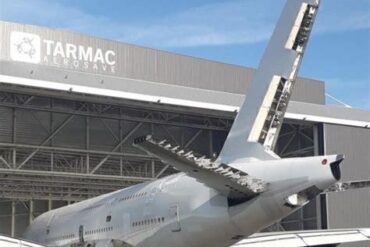
Airbus has already demonstrated the potential recovery value of A380 dismantling through its work with TARMAC Aerosave. When an early A380 was deconstructed, thousands of components were recovered, with Airbus stating that more than 90% of the aircraft could be recovered through the process. That example shows that retirement does not necessarily mean waste. A large commercial aircraft can effectively become a source of material and certified equipment for the aviation industry.
Jet Midwest operates within this broader aircraft-aftermarket ecosystem. The company has acquired, disassembled, sold, or leased hundreds of aircraft and manages extensive inventories of aircraft parts and assets. The former China Southern A380s therefore entered an established industrial process rather than an improvised scrapyard operation.
The A380 Parts Market Could Become More Important as the Fleet Shrinks
There is an intriguing irony in the fate of the China Southern aircraft. Their retirement removes several complete A380s from the world fleet, but dismantling them could make it easier for some remaining aircraft to stay in service. Every recovered component potentially reduces the pressure on operators maintaining their own superjumbos.
That dynamic may become increasingly important as the global A380 fleet continues to shrink. With fewer aircraft being produced and no new A380s entering service, the aftermarket eventually becomes the principal source of many used components. Retired aircraft that once competed for passengers can instead support aircraft that remain economically viable.
For operators such as Emirates, which has built an unusually large A380 operation, the availability of parts is a critical element of long-term fleet management. The more specialized the aircraft, the more valuable a reliable aftermarket becomes. An aircraft that was once considered commercially difficult can therefore gain a different kind of importance after retirement.
This does not mean every component removed from Mojave will end up on another A380. Some will be overhauled, some will become donor parts, and some will eventually be recycled. But the fundamental principle remains the same: the aircraft’s useful life does not necessarily end when its passenger career ends.
The Mojave Desert Is Not the End of the A380 Story
The former China Southern A380s provide a powerful illustration of the strange economics surrounding the world’s largest passenger aircraft. These jets were engineered for decades of service, yet their careers were cut short because the commercial environment they were designed for changed faster than their structures could wear out.
Their journey from Guangzhou to Mojave represents more than the retirement of one airline’s fleet. It reflects the industry’s broader movement toward smaller, more efficient, and more flexible aircraft. The A350 and 787 have made it easier for airlines to match capacity with demand, while the pandemic reinforced the financial risks associated with very large aircraft.
Yet the Mojave airframes are not simply forgotten relics. N291JM, N296JM, N115PK, and the aircraft identified as MSN 88 can continue to provide value through the components they surrender. Their engines, landing gear, avionics, flight-control equipment, hydraulic systems, and other parts can potentially help another A380 remain airborne.
That may ultimately be one of the most fitting endings for these superjumbos. The A380 was built to carry an extraordinary number of people, but its afterlife is likely to be quieter and much more fragmented. Piece by piece, equipment from retired aircraft can return to the aviation system, extending the practical life of other aircraft that still have routes, passengers, and a reason to fly.
The Mojave Desert therefore represents neither a simple graveyard nor the final chapter for these Airbus A380s. It is a transition point between the aircraft’s first life as passenger transportation and its second life as an aviation parts source. Their fuselages may eventually disappear, but their most valuable systems can continue working thousands of miles away. For an aircraft that once seemed destined to dominate the world’s biggest airports, that is an unexpectedly useful final mission.