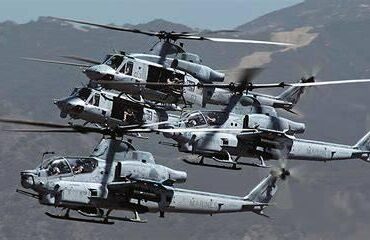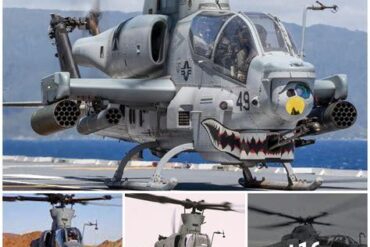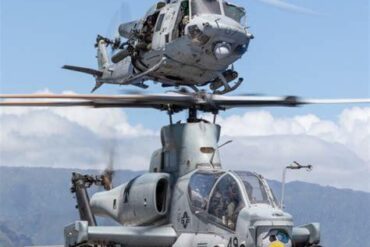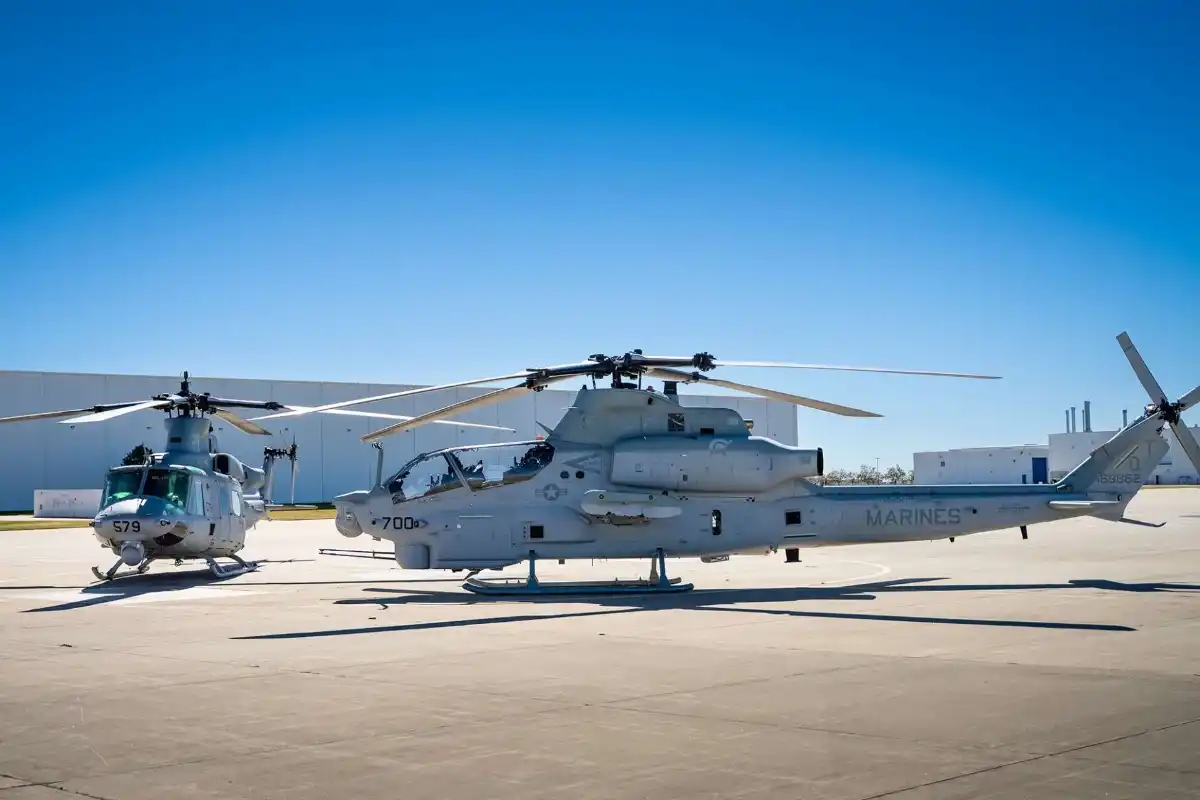
The U.S. Marine Corps is quietly reshaping the future of its rotary-wing combat power, and the latest milestone in Bell’s SPINE (Structural, Power, and Integrated Network Enhancement) program signals a decisive step forward. With the first upgraded AH-1Z Viper and UH-1Y Venom helicopters now delivered to Naval Air Station Patuxent River for flight testing, the transformation of the H-1 fleet is no longer theoretical—it is actively unfolding in hardware, systems, and operational capability.
This modernization effort is not merely about incremental improvement. It represents a deliberate push to ensure that these proven platforms remain viable in high-intensity, network-centric warfare, where survivability, adaptability, and digital integration are just as critical as firepower. By enhancing electrical capacity, structural resilience, and mission system architecture, SPINE is positioning the H-1 family to integrate future weapons, advanced sensors, and next-generation communications systems without compromising performance.
The Strategic Purpose Behind the SPINE Upgrade
At its core, the SPINE program reflects a broader shift in military aviation philosophy: rather than replacing legacy systems outright, the focus has turned toward deep modernization with scalable growth potential. The AH-1Z and UH-1Y are not being retired—they are being re-engineered to thrive in environments defined by electronic warfare, dense air defenses, and distributed operations.
The upgraded helicopters now entering testing embody this shift. Their enhanced electrical power generation and distribution systems allow for the integration of more demanding avionics and mission equipment. At the same time, structural improvements ensure that the aircraft can handle additional payloads and future modifications without sacrificing reliability or flight performance.
This is particularly relevant as modern battlefields demand rapid adaptation. Aircraft must accommodate evolving technologies such as long-range precision munitions, advanced targeting pods, and secure data links. SPINE effectively creates the “digital backbone” required to support these systems, ensuring that the H-1 fleet can evolve alongside emerging threats.
AH-1Z Viper: Reinforcing a Precision Strike Predator
The AH-1Z Viper has long served as the Marine Corps’ dedicated attack helicopter, excelling in roles such as close air support, anti-armor operations, armed reconnaissance, and escort missions. Already equipped with a sophisticated fire-control system, composite rotor design, and multi-weapon capability, the Viper is a formidable platform. SPINE takes that foundation and extends it into the future.
With increased onboard power and expanded digital architecture, the SPINE-enhanced Viper can integrate more advanced targeting systems and next-generation weapons. This includes the potential for improved air-to-ground missiles, enhanced sensor fusion, and expanded network connectivity, all of which are essential in contested environments where rapid decision-making and precision engagement are critical.
Equally important is survivability. Modern air defense systems are increasingly sophisticated, requiring aircraft to operate with greater situational awareness and electronic resilience. The upgraded Viper is better equipped to host defensive systems such as missile warning sensors, electronic countermeasures, and infrared suppression technologies, ensuring it can operate closer to contested zones without unacceptable risk.
In operational terms, the SPINE upgrade ensures that the AH-1Z remains not just relevant, but indispensable—a hunter-killer platform capable of adapting to evolving mission requirements while maintaining its edge in precision strike operations.
UH-1Y Venom: Expanding the Role of a Multi-Mission Workhorse
While the AH-1Z dominates the attack role, the UH-1Y Venom serves as the Marine Corps’ versatile utility helicopter, performing missions that range from troop transport and casualty evacuation to command and control and special operations support. SPINE significantly amplifies this versatility by transforming the Venom into a more capable multi-domain enabler.
The key lies in electrical and digital expansion. Utility helicopters often act as communication hubs and mission coordinators, especially in expeditionary operations where infrastructure is limited. With SPINE, the UH-1Y gains the capacity to host advanced communication suites, networked battlefield management systems, and modular mission kits.
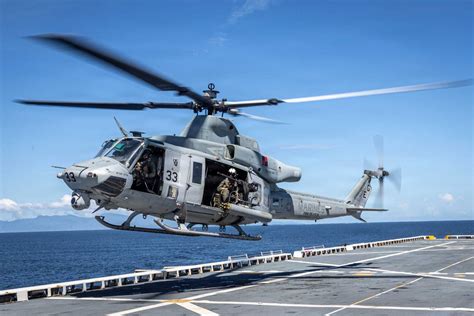
This transformation allows the Venom to function as more than just a transport platform. It becomes a node in a distributed combat network, capable of linking ground forces, coordinating air support, and relaying critical data across the battlespace. In scenarios where small units operate independently across vast distances—such as in the Indo-Pacific—the value of such capabilities cannot be overstated.
Additionally, the upgrade enhances payload flexibility. The ability to carry more advanced equipment without overloading the aircraft ensures that the UH-1Y can adapt to mission-specific requirements, whether that involves ISR (intelligence, surveillance, reconnaissance) packages, electronic warfare systems, or precision-guided weapons.
H-1 Commonality: A Force Multiplier in Expeditionary Warfare
One of the defining strengths of the H-1 program is the 85 percent parts commonality between the AH-1Z and UH-1Y. This design choice has long provided logistical and operational advantages, particularly for Marine Light Attack Helicopter (HMLA) squadrons operating from amphibious ships or austere forward bases.
SPINE preserves and enhances this advantage by upgrading both platforms along a unified modernization pathway. This ensures that the Marine Corps can maintain a streamlined supply chain, simplified maintenance processes, and cohesive operational deployment model.
In practical terms, this commonality is a force multiplier. Expeditionary operations often involve limited deck space, constrained logistics, and rapid deployment cycles. By maintaining compatibility between attack and utility helicopters, the Marine Corps avoids the complexity and inefficiency that would come with managing entirely separate fleets.
The result is a highly deployable aviation element capable of delivering integrated combat power with minimal logistical burden—a critical advantage in modern maritime and littoral warfare.
Preparing for Distributed and High-Intensity Conflict
The SPINE program aligns closely with the Marine Corps’ evolving operational doctrine, particularly its emphasis on distributed operations and expeditionary advanced base operations (EABO). In these concepts, small, dispersed units operate across contested environments, relying on mobility, connectivity, and precision fires to achieve their objectives.
In such scenarios, the upgraded H-1 fleet plays a central role. The AH-1Z provides immediate, precise fire support, while the UH-1Y ensures mobility, coordination, and sustainment. SPINE enhances both platforms’ ability to operate within a networked battlespace, where information flows rapidly and decisions must be made in seconds.
This is particularly relevant in the Indo-Pacific theater, where vast distances and complex terrain demand resilient, flexible, and interoperable aviation assets. The ability to integrate seamlessly with joint and allied forces further amplifies the value of the upgraded H-1 fleet.
Industrial Momentum and Long-Term Modernization
Bell’s announcement that the first SPINE-modified aircraft have entered flight testing marks the beginning of a decade-long modernization effort. The work conducted at Bell’s Amarillo facility is laying the groundwork for a sustained upgrade program that will extend across the entire H-1 fleet.
From an industrial perspective, this approach is both cost-effective and operationally pragmatic. Developing entirely new aircraft platforms is time-consuming and expensive, whereas upgrading existing systems allows for faster capability delivery and reduced risk. It also ensures that the Marine Corps can maintain readiness while transitioning to more advanced capabilities.
The language surrounding SPINE—particularly its emphasis on structural strength, electrical capacity, and digital foundation—underscores its role as a bridge between current capabilities and future requirements. It is not just an upgrade; it is an enabling architecture that will support continuous innovation over the coming years.
A Future-Proofed Helicopter Force
The significance of the SPINE program extends beyond technical specifications. It represents a strategic decision to preserve and enhance a proven aviation pairing that has been central to Marine Corps operations for decades. By investing in adaptability rather than replacement, the United States is ensuring that its rotary-wing forces remain combat-credible in an increasingly complex threat environment.
The AH-1Z Viper and UH-1Y Venom are no longer simply legacy platforms—they are evolving into modular, networked combat systems capable of integrating future technologies as they emerge. This transformation ensures that the Marine Corps can continue to project power, support ground forces, and respond to crises with speed and precision.
As flight testing progresses at Patuxent River, the upgraded helicopters will undergo rigorous evaluation to validate their new capabilities. What emerges from this process will shape the next chapter of Marine aviation—one defined not by replacement, but by relentless evolution and operational relevance.