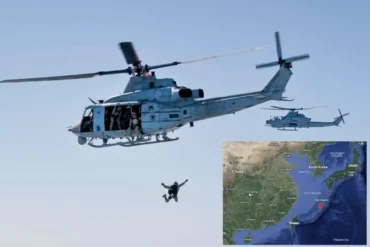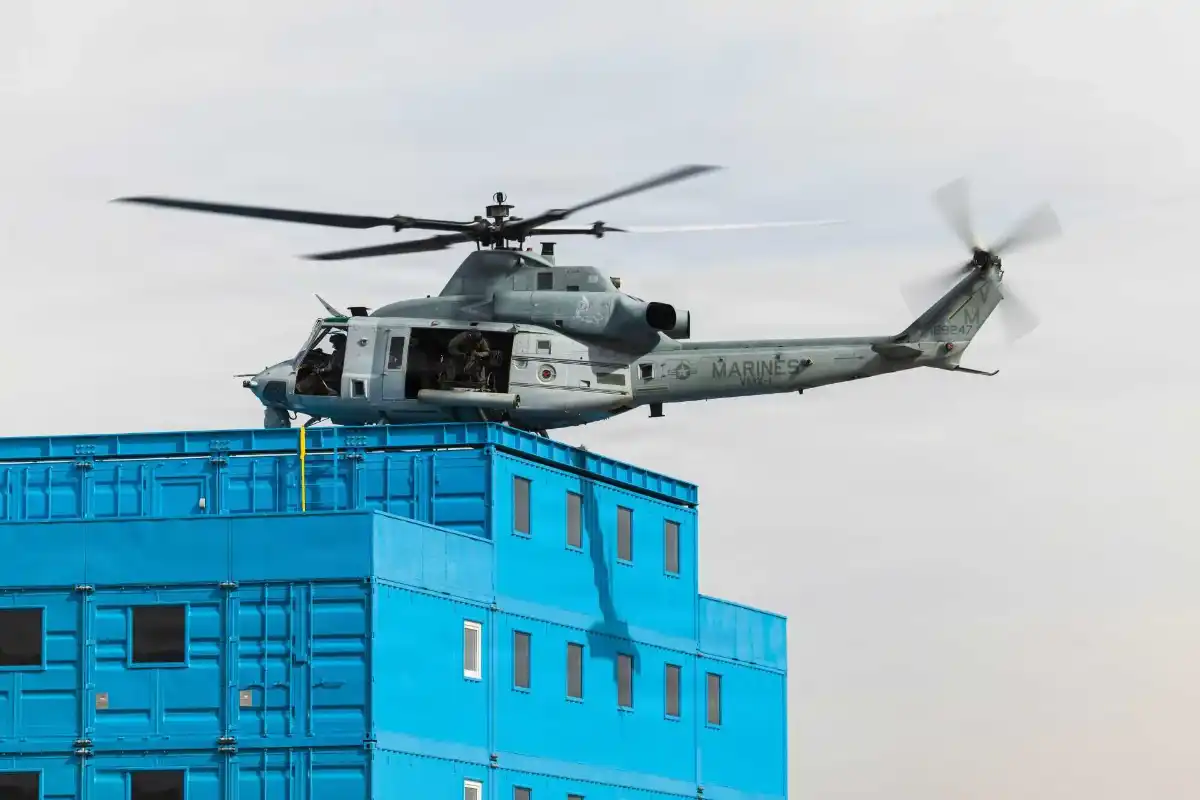
The U.S. Marine Corps is intensifying its focus on urban combat aviation, conducting highly specialized rooftop insertion training using the UH-1Y Venom helicopter in the Arizona desert. The exercise, carried out on January 21, 2026, reflects a deliberate effort to adapt Marine aviation to the realities of modern warfare, where cities, dense infrastructure, and vertical terrain increasingly dominate the battlespace. Precision, restraint, and speed are no longer abstract concepts but daily operational requirements for rotary-wing crews supporting ground forces.
The training took place at Deuce Village, a purpose-built urban operations site located within the Berry M. Goldwater Range Complex near Yuma, Arizona. Operated by Marine Operational Test and Evaluation Squadron 1 (VMX-1), the mission was designed not as a routine proficiency flight but as a demanding evaluation of aircraft handling, crew coordination, and tactical execution in confined, obstacle-rich environments. Rooftop insertions are among the most technically challenging helicopter maneuvers, requiring near-perfect synchronization between pilots, crew chiefs, and embarked Marines.
Urban warfare has transformed how aircrews think about access and maneuver. Traditional landing zones are often unavailable or too exposed, forcing aviation units to operate within narrow margins above rooftops, streets, and vertical structures. In this context, rooftop insertions offer a tactical solution, allowing small units or command elements to be delivered directly onto elevated positions while minimizing exposure to ground threats. The Arizona exercise simulated these conditions with precision, stressing crews under realistic operational constraints.
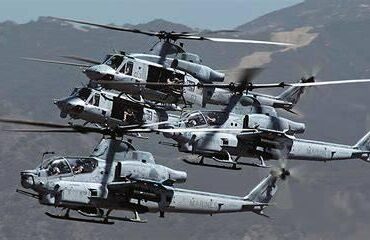
At the center of the training was the UH-1Y Venom, the U.S. Marine Corps’ primary light utility helicopter and a cornerstone of Marine Air-Ground Task Force aviation. The Venom’s design reflects decades of operational lessons, blending agility with survivability and advanced avionics. During the rooftop insertion drills, aircrews were tasked with maintaining stable hover profiles over simulated urban structures while managing rotor wash, visual references, and tight clearances that leave little room for error.
VMX-1’s role in the exercise was particularly significant. As the Marine Corps’ test and evaluation squadron, VMX-1 is responsible for validating not only aircraft performance but also the tactics, techniques, and procedures that will eventually be adopted fleet-wide. By operating in a realistic urban environment, the squadron assessed how the UH-1Y performs under the stresses of confined airspace, degraded visual cues, and complex crew tasking that mirror real combat scenarios rather than controlled training ranges.
Rooftop insertions demand more than technical flying skill. They require constant communication between pilots and crew chiefs, who provide critical visual cues from the cabin doors, and precise timing with ground elements preparing to fast-rope or step onto elevated surfaces. Any miscalculation can amplify risk, especially in environments where buildings channel wind unpredictably and obstacles crowd every approach path. The Arizona training deliberately exposed crews to these variables, reinforcing habits that reduce risk under pressure.
Beyond individual crew proficiency, the exercise highlighted the Marine Corps’ broader emphasis on expeditionary and distributed operations. Modern Marine units are expected to deploy rapidly, operate with minimal infrastructure, and integrate seamlessly with joint and coalition partners. Aviation assets like the UH-1Y Venom are essential enablers of this concept, providing flexible lift, command and control, reconnaissance, and casualty evacuation in environments where ground movement may be constrained or dangerous.
The choice of Marine Corps Air Station Yuma and the surrounding Berry M. Goldwater Range Complex was no accident. The region offers controlled airspace, diverse terrain, and specialized facilities that support advanced aviation testing. Deuce Village, in particular, is engineered to replicate contemporary urban layouts, allowing crews to rehearse realistic mission profiles rather than abstract maneuvers. This level of realism ensures that lessons learned translate directly to operational readiness.
From a strategic perspective, validating rooftop insertion capabilities aligns with the U.S. military’s recognition that future conflicts are likely to unfold in densely populated areas. Potential adversaries increasingly exploit urban terrain to offset technological disadvantages, forcing U.S. and allied forces to operate with precision and discrimination. Aviation units capable of inserting forces accurately into vertical spaces provide commanders with options that reduce collateral damage while preserving operational momentum.
The UH-1Y Venom’s continued relevance lies in its adaptability. Equipped with modern communications systems, enhanced survivability features, and a digital cockpit, the aircraft supports a wide range of missions beyond troop transport. During urban operations, it can function as an airborne command node, a security platform, or a rapid response asset capable of shifting roles mid-mission. The Arizona exercise demonstrated how these capabilities converge during complex insertion scenarios.
Ultimately, the rooftop insertion training underscored a central truth of Marine aviation: readiness is forged through realism. By subjecting crews and aircraft to demanding urban scenarios, the Marine Corps ensures that platforms like the UH-1Y Venom remain effective tools in an increasingly vertical and contested battlespace. As cities continue to shape the character of conflict, exercises like this one ensure that Marine aviation is prepared not just to fly above the fight, but to place Marines precisely where they are needed most.