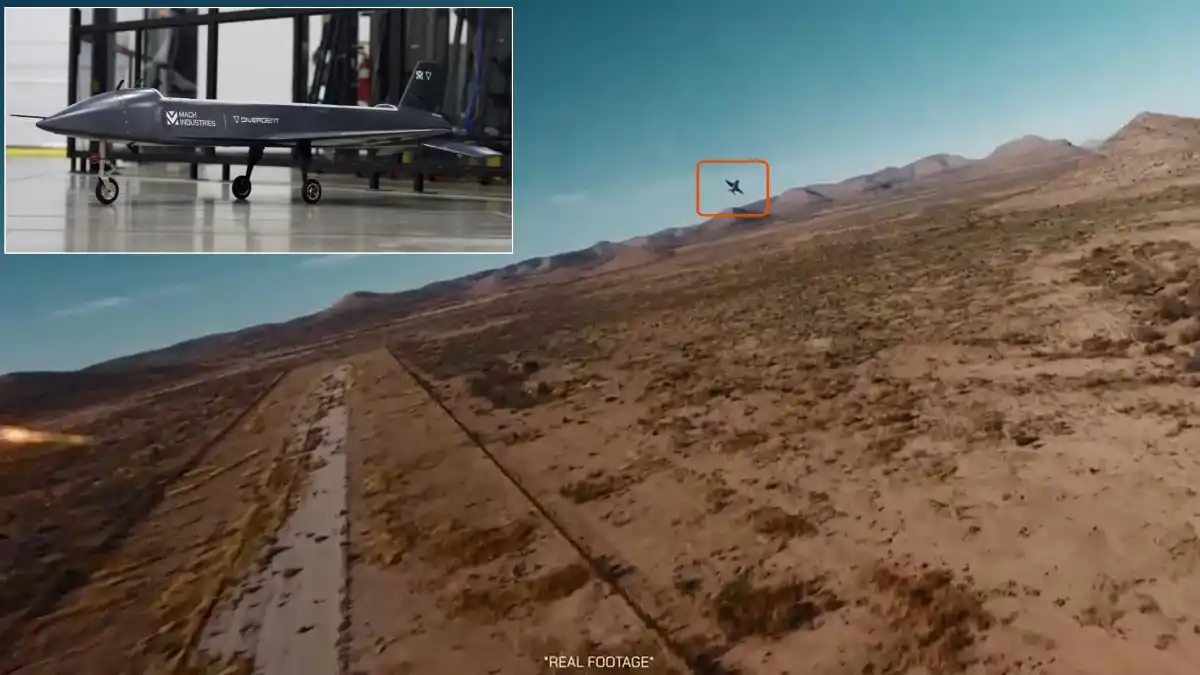
The United States has taken a striking step forward in rapid military aviation development with the successful first flight of the Venom autonomous strike aircraft, a prototype built and tested only 71 days after its initial conception. The program, led by Mach Industries in partnership with Divergent Technologies, is being positioned as a proof-of-concept for a new era of digitally engineered, rapidly manufactured unmanned combat systems designed to meet the Pentagon’s growing demand for scalable, affordable mass.
The first flight, completed on February 17, 2026, signals more than just the debut of another drone platform. It demonstrates how compressed development timelines—once considered implausible in aerospace engineering—may become operationally viable through the fusion of digital design ecosystems, modular systems architecture, and additive manufacturing at industrial scale. Defense officials and industry leaders alike are watching closely, viewing Venom as an early indicator of how future airpower could be built, fielded, and replenished at unprecedented speed.
Photographs released alongside the announcement showed senior U.S. defense leadership, including Secretary of Defense Pete Hegseth, observing the aircraft with company executives—an unmistakable signal that the project has drawn attention at the highest institutional levels.
Digitally Engineered Warfare: From Concept to Flight in 71 Days
The Venom program was conceived as a flight demonstration vehicle rather than a fully specified operational weapons platform. Its primary mission was technological validation: proving that a digitally integrated design and manufacturing pipeline could move from blank-sheet concept to flight-ready aircraft in just over two months.
Mach Industries led the system architecture, avionics integration, and subsystem coordination. The company relied heavily on flight-proven simulation environments and modular open-systems frameworks, enabling engineers to iterate designs in high-fidelity virtual environments before committing to hardware. This approach allowed parallel development across software, flight controls, propulsion integration, and mission systems—compressing validation cycles that traditionally take years.
By building on existing avionics and simulation stacks, Mach avoided reinventing foundational technologies. Instead, it focused on rapid configuration, interoperability, and mission adaptability, aligning the aircraft with emerging Pentagon doctrines that prioritize software-defined capability over bespoke hardware development.
Additive Manufacturing and the Monolithic Airframe Revolution
If Mach supplied the nervous system, Divergent Technologies built the skeleton. The company executed the digital airframe design and produced the physical structure using its proprietary Divergent Adaptive Production System (DAPS)—a manufacturing architecture centered on large-scale metal 3D printing and robotic assembly.
Rather than assembling the aircraft from hundreds of discrete components, Divergent fabricated large monolithic aluminum structures—including fuselage sections, wing assemblies, skins, and control surfaces. This radically reduced part counts and eliminated the need for traditional aerospace tooling, which often requires massive capital investment and long lead times.
The production workflow begins with AI-assisted engineering software that optimizes structural geometry for strength, weight, and manufacturability. Once finalized, design instructions are transmitted directly to industrial additive printers, producing application-specific alloy nodes and structural elements. These components are then joined using a universal robotic assembly process that requires no design-specific tooling—an innovation that allows different aircraft models to be built on the same manufacturing line.
Divergent reports that this method can reduce part counts by up to forty-five times compared to conventional builds, while also lowering variable costs and accelerating program timelines severalfold.
Affordable Mass and the Pentagon’s Drone Dominance Vision
The Venom initiative aligns closely with the Pentagon’s strategic concept of “affordable mass.” This doctrine emphasizes producing large numbers of relatively low-cost unmanned systems capable of saturating contested environments, overwhelming air defenses, and sustaining attrition without the financial and political costs associated with crewed aircraft losses.
Senior defense official Alex Lovett, serving as Principal Deputy Assistant Secretary of War for Mission Capabilities, linked the 71-day development cycle directly to the Department of Defense’s push for accelerated acquisition pipelines. Rapidly fielded drones, he suggested, are central to achieving “Drone Dominance” in future conflicts.
Recent battlefields—most notably Ukraine—have demonstrated how inexpensive unmanned systems can reshape force design, surveillance doctrine, and air defense planning. Low-cost drones have proven capable of destroying high-value assets, conducting persistent reconnaissance, and forcing adversaries to expend costly interceptors.
Venom’s development timeline therefore functions not just as an engineering milestone, but as a strategic signal: the United States is preparing for wars where production speed may rival technological sophistication in importance.
Capabilities Still Cloaked in Secrecy
Despite the high-profile unveiling, critical performance specifications remain undisclosed. Neither Mach Industries nor Divergent Technologies released data on:
- Operational range
- Payload capacity
- Endurance
- Propulsion type
- Weapons integration
- Autonomy architecture
- Unit cost projections
This absence of detail suggests the prototype’s role is primarily experimental. It may serve as a modular testbed for autonomy software, low-cost strike packages, or swarming coordination technologies rather than a finalized weapons system.
Still, the lack of specifications has not dampened interest. Analysts view the platform’s real significance as residing in its production methodology, not its immediate battlefield performance.
Vertical Integration and Rapid Iteration at Mach Industries
Founded in 2023 and headquartered in Huntington Beach, California, Mach Industries has built its operational philosophy around vertical integration. The company develops propulsion systems, weapons interfaces, avionics frameworks, and manufacturing processes in-house—reducing dependency on external suppliers that often slow defense programs.
Mach reports that within the past 18 months it has taken four separate aerospace products from concept to flight test through rapid iteration cycles. This tempo reflects a Silicon Valley-inspired development culture applied to defense aviation—fast prototyping, continuous testing, and software-driven refinement.
In January 2026, the company unveiled another system: the Dart counter-drone interceptor, designed to neutralize Group 1–3 unmanned aerial threats. Dart integrates ground radar, sensor fusion, and low-cost interceptors deployable from vehicles, fixed sites, or launch stations. Its design philosophy mirrors Venom’s—scalable, affordable, and rapidly manufacturable.
Scaling Production Through Adaptive Manufacturing
Divergent Technologies’ broader industrial model extends well beyond a single drone program. The company envisions an end-to-end software-hardware ecosystem capable of transforming production across aerospace, automotive, and defense sectors.
Its adaptive production system leverages AI-enabled engineering to optimize structural performance before fabrication begins. The firm holds more than 700 filed patents and claims its approach can:
- Reduce development cycles by up to tenfold
- Accelerate new program launches two to five times
- Lower development costs by half
- Cut variable production costs by two to three times
- Eliminate tooling capital expenditure
Divergent has stated that its manufacturing infrastructure could eventually produce thousands of airframes annually, a scale aligned with Pentagon ambitions for mass-deployable autonomous fleets.
Cross-Industry Innovation: From Hypercars to Strike Drones
An intriguing dimension of Divergent’s technology lineage lies in its automotive crossover. Founder Kevin Czinger and co-founder Lukas Czinger also lead the company behind the Czinger 21C hypercar, whose chassis and structural elements are built using the same additive manufacturing principles applied to Venom.
This cross-pollination illustrates how high-performance automotive engineering—where weight reduction and structural strength are paramount—can inform next-generation military airframe design. The shared manufacturing DNA underscores a broader industrial trend: defense innovation is increasingly drawing from commercial advanced manufacturing ecosystems rather than operating in isolation.
Strategic Implications for Future Air Warfare
Venom’s first flight may ultimately be remembered less for the aircraft itself and more for what it represents: the maturation of software-defined aerospace production. If aircraft can be designed, printed, assembled, and flown in just over two months, force planners gain a radically new lever—time.
Rapid manufacturing could enable militaries to:
- Replace combat losses quickly
- Tailor drones to specific missions on demand
- Field experimental systems without decade-long programs
- Sustain high-intensity conflicts through industrial agility
In this paradigm, warfare begins to resemble an iterative engineering cycle—design, deploy, learn, redesign—compressed into operational timescales.
Venom stands at that threshold. Its silent first flight marks the convergence of digital engineering, additive manufacturing, and autonomous warfare doctrine. Whether it evolves into an operational strike platform or remains a technological demonstrator, its true payload is conceptual: proof that the future of airpower may be built at the speed of code and printed in metal layers, one algorithmically optimized node at a time.