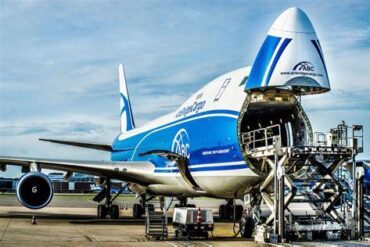
The Boeing 747-8 carries an aura of spectacle that goes far beyond its unmistakable hump and four-engine silhouette. To passengers, it is a cathedral of long-haul travel, built to swallow oceans and continents in a single stride. Yet hidden behind locked doors and unmarked staircases lies a parallel interior world that most travelers never see. This concealed architecture is not designed for luxury or spectacle, but for something far more critical: human endurance.
On ultra-long-haul routes, aviation is as much a biological challenge as it is a technical one. Pilots and cabin crew must remain alert across time zones, through circadian disruption, and over duty periods that can stretch well beyond half a day. The Boeing 747-8 was engineered with this reality in mind, embedding dedicated crew rest areas deep within its structure. These spaces are not optional extras; they are essential systems, as fundamental to safety as avionics or fuel management.
Unlike improvised rest solutions seen on shorter-range aircraft, the 747-8’s crew rest areas are purpose-built, certified, and rigorously regulated. They form a hidden nervous system that allows crews to rotate duties, manage fatigue, and arrive ready to perform during the most critical phases of flight. To understand the true sophistication of the “Queen of the Skies,” one must explore these secret compartments where the aircraft, and its crew, quietly recharge.
Why Crew Rest Areas Exist at All
Long-haul aviation operates under strict fatigue-risk management rules. Regulatory authorities require additional pilots and cabin crew once flight durations exceed certain thresholds. These extra crew members are not carried as backups in name only; they must be able to achieve genuine sleep, not mere physical relaxation. Sitting upright in a jump seat or blocking a passenger row does not meet the physiological or regulatory definition of rest on flights that last 12, 14, or even 16 hours.
This is where dedicated crew rest compartments become indispensable. They are acoustically dampened, ventilated, temperature-controlled, and isolated from passenger activity. Their purpose is deceptively simple: allow the human brain to disengage long enough to reset attention, reaction time, and decision-making capacity. In the context of aviation safety, these hidden rooms are as important as redundant hydraulic systems.
On aircraft like the Boeing 747-8, which was designed from the outset for intercontinental endurance, these rest areas are integrated into the fuselage in ways that minimize weight penalties while maximizing rest quality. They are engineered solutions to a biological problem, shaped by decades of operational data and medical research into fatigue.
The Boeing 747-8: A Platform Built for Endurance
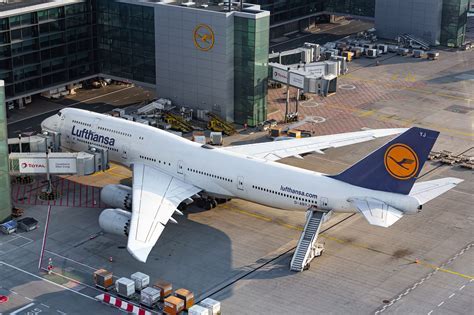
The Boeing 747-8 represents the final and most advanced evolution of the legendary 747 family. Derived from the 747-400 but extensively redesigned, it introduced a new wing with raked wingtips, quieter GEnx-2B engines, and modernized flight-deck systems that significantly reduced pilot workload. Despite its immense size, the aircraft achieved improved fuel efficiency per seat, enabling airlines to deploy it on some of the world’s longest commercial routes.
With ranges exceeding 8,000 nautical miles and cruise altitudes reaching 43,000 feet, the 747-8 routinely operates sectors where crew duty time becomes a central operational constraint. Routes such as Frankfurt to Buenos Aires, Seoul to Atlanta, or Beijing to New York are not simply long in distance; they are physiologically demanding. The aircraft’s internal architecture reflects this reality, dedicating valuable volume to rest spaces that most passengers never suspect exist.
The 747-8’s length and upper-deck configuration make it uniquely suited to hiding these compartments without compromising passenger cabin flow. Unlike twin-engine widebodies that must squeeze rest modules into tighter spaces, the jumbo jet offers vertical and longitudinal flexibility that designers used to great effect.
The Pilot Rest Compartment: Silence Behind the Flight Deck
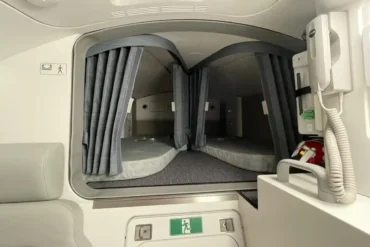
Directly behind the cockpit, tucked discreetly into the upper deck, lies the pilot rest compartment. Accessed through an unassuming crew-only door, this space is entirely invisible to passengers. Inside, the atmosphere changes instantly. The ambient noise of the cockpit and cabin fades, replaced by muted airflow and controlled lighting designed to encourage sleep.
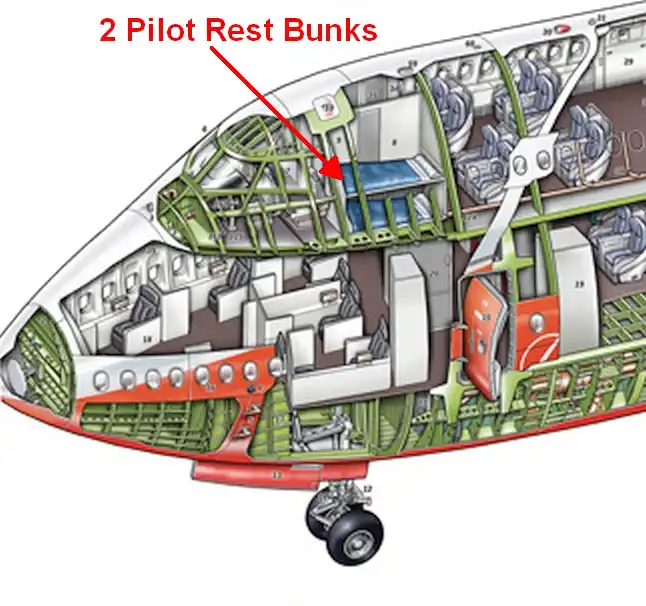
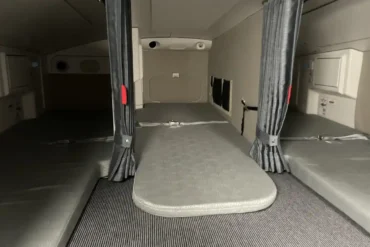
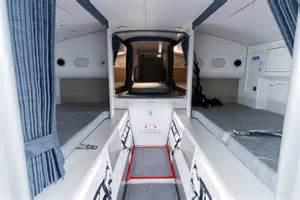
The compartment typically contains two full-length horizontal bunks, stacked vertically. Each bunk is equipped with privacy curtains, reading lights, adjustable ventilation, and secure restraints. Sound insulation plays a critical role here, dampening engine hum and airflow noise that would otherwise fragment sleep. The design is intentionally minimal, eliminating distractions and visual clutter.
This is not a lounge or a comfort space in the passenger sense. It is a tool. Pilots rotate through the compartment in accordance with duty schedules, allowing one crew member to rest while others remain at the controls. When a pilot emerges from this space hours later, the goal is simple: cognitive sharpness restored, reaction times reset, and situational awareness fully intact.
The Cabin Crew Rest Area: A Hidden Dormitory in the Sky
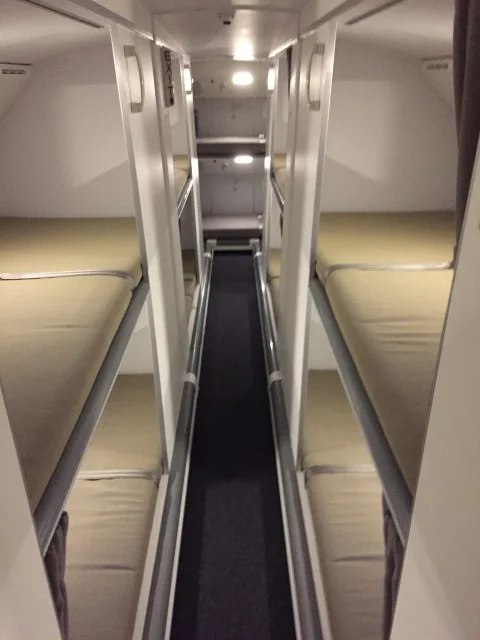
Further aft, usually above the rear portion of the main deck, is the cabin crew rest area. This compartment is larger and more complex than the pilot rest space, reflecting the greater number of flight attendants carried on long-haul 747-8 flights. Access is typically via a narrow, steep staircase concealed within a service galley, guarded by crew-only signage.
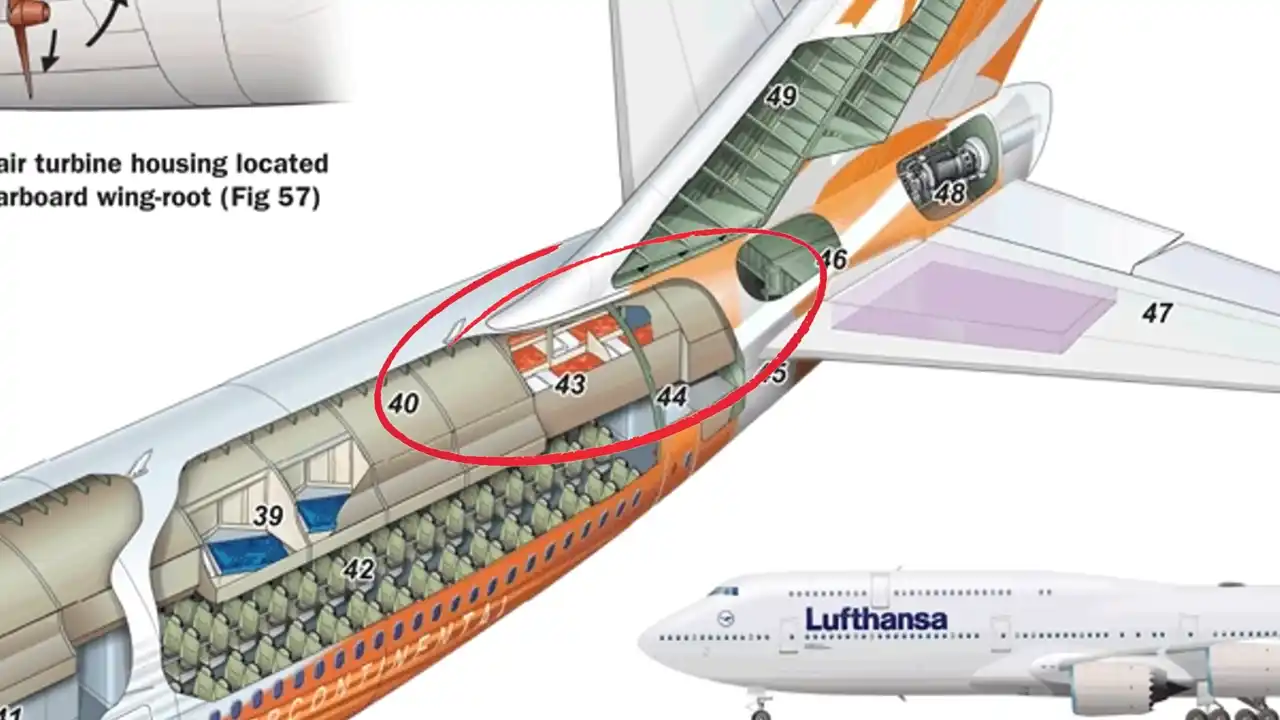
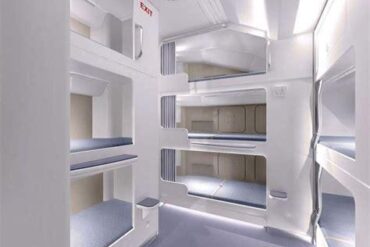
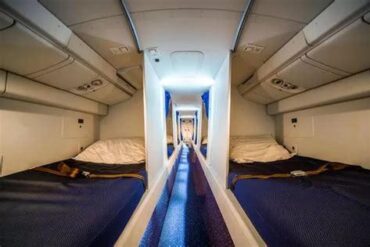
Inside, the layout resembles a compact dormitory. Multiple bunks are arranged along the walls, each enclosed by curtains to provide visual privacy. Lighting is dimmable, allowing the space to shift from pre-rest preparation to near-darkness. Ventilation systems ensure fresh air circulation without drafts, while temperature controls keep the environment slightly cool, an intentional choice to promote deeper sleep.
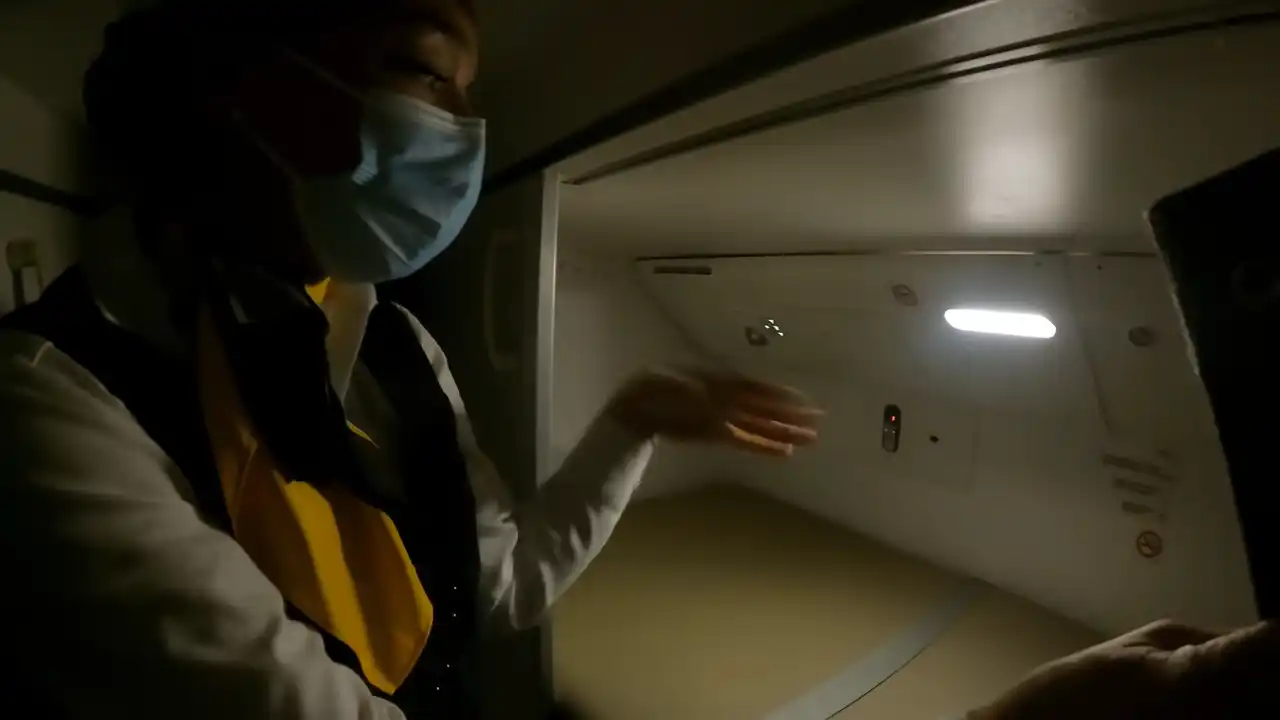
Despite the tight quarters, these bunks offer something invaluable at 37,000 feet: the ability to lie flat, close one’s eyes, and disengage. For cabin crew who may spend hours on their feet managing service, safety checks, and passenger needs, this rest is not a luxury. It is the difference between alert professionalism and creeping fatigue during critical phases such as turbulence or descent.
Longest Routes Where These Spaces Earn Their Keep
The true value of the 747-8’s crew rest areas becomes clear on its longest scheduled routes. Flights exceeding 13 or 14 hours are not endurance tests for passengers alone. Crews must manage multiple service cycles, time-zone shifts, and extended vigilance periods, all while maintaining composure and procedural precision.
Routes like Seoul–Incheon to Atlanta, stretching over 7,000 miles, or Frankfurt to Buenos Aires, pushing close to 14 hours of flight time, demand carefully choreographed rest rotations. Crew rest compartments allow airlines to schedule relief pilots and additional cabin crew without sacrificing operational efficiency or safety margins. Without these hidden spaces, such routes would either be impossible or economically unviable.
In this context, the rest areas are not passive features. They actively shape route planning, crew pairing strategies, and even aircraft assignment decisions. The 747-8’s ability to support deep rest mid-flight is one reason it continues to serve demanding intercontinental missions long after newer twin-engine jets entered the market.
How the 747-8 Compares to Other Long-Haul Aircraft
While the Boeing 747-8 is not unique in offering crew rest areas, its implementation reflects the advantages of a very large airframe. Aircraft like the Boeing 787, Airbus A350, and Boeing 777 also feature dedicated rest compartments, often located above the passenger ceiling or integrated near the rear fuselage. These spaces share common design principles: flat bunks, noise insulation, and circadian-friendly lighting.
What sets the 747-8 apart is scale and separation. The jumbo jet’s architecture allows clearer physical distinction between pilot and cabin crew rest zones, reducing cross-traffic and preserving quiet. The upper-deck pilot rest area, in particular, benefits from distance from galleys and passenger movement, enhancing sleep quality during cruise.
Despite differences in placement, the underlying philosophy remains consistent across modern long-haul aircraft. Rest quality, not just rest duration, has become the benchmark. Airlines and regulators increasingly recognize that fatigue mitigation depends on environment as much as scheduling.
Engineering Sleep at 40,000 Feet
Designing a space where humans can sleep inside a pressurized aluminum tube hurtling through the stratosphere is a non-trivial challenge. Crew rest areas on the 747-8 incorporate layered solutions: acoustic insulation to blunt engine noise, vibration damping to reduce low-frequency hum, and airflow systems tuned to avoid dryness without creating drafts.
Lighting systems are carefully calibrated. Bright white light is avoided, replaced with warmer tones that signal the brain to wind down. Emergency lighting and oxygen systems are seamlessly integrated, ensuring safety compliance without intruding on rest. Every element serves a single goal: create a micro-environment where genuine sleep is possible, even as the aircraft cruises at nearly 570 miles per hour.
This engineering discipline reflects a broader shift in aviation thinking. Fatigue is no longer treated as a personal resilience issue but as a system-level risk that can be mitigated through design.
The Future of Crew Rest, Seen Through the 747-8
The Boeing 747-8 stands as both a pinnacle and a bridge. Its crew rest areas embody decades of learning about human performance, yet they also point toward future innovations. Emerging concepts include smart lighting synchronized to flight phase, adaptive climate controls, and data-driven fatigue monitoring that integrates rest quality into crew scheduling.
While the 747-8 itself is nearing the twilight of its production life, its approach to crew rest continues to influence aircraft design philosophy. The lesson is clear: long-haul aviation is not just about range and efficiency. It is about sustaining human alertness across vast distances.
Hidden above ceilings and behind locked doors, the secret crew rest areas of the Boeing 747-8 reveal the aircraft’s true sophistication. They are quiet, unseen, and rarely discussed, yet they are among the most important spaces on board. In the world of ultra-long-haul flight, this is where safety sleeps, and where the Queen of the Skies quietly earns her crown.