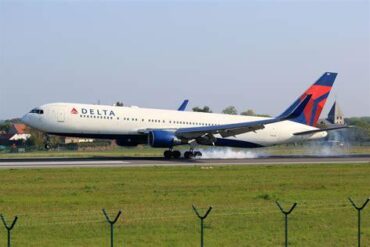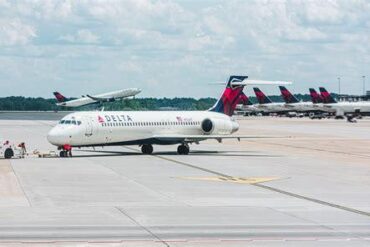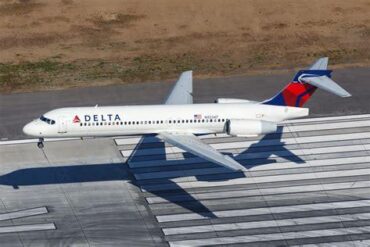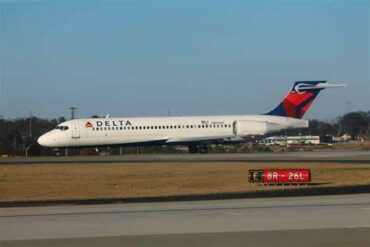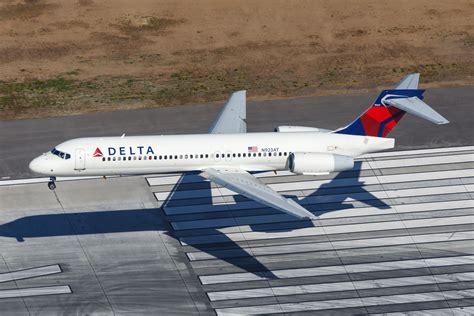
Delta Air Lines is reportedly taking the first tangible step toward retiring its iconic Boeing 717 fleet, with six of the carrier’s oldest aircraft expected to leave service nearly four years earlier than originally anticipated. The move marks a significant moment in Delta’s long-term fleet modernization strategy and could signal the beginning of the final chapter for one of commercial aviation’s most enduring aircraft families.
Industry sources indicate that the aircraft slated for retirement include consecutive registrations N943AT through N948AT, all of which are more than 26 years old. According to fleet data, these aircraft range in age from approximately 26.6 to 27.1 years, placing them among the oldest active narrowbody jets operating within a major global airline fleet.
For decades, Delta has built a reputation for successfully operating older aircraft long after competitors deemed them uneconomical. Yet even by Delta’s standards, the Boeing 717 fleet is now approaching a crossroads shaped by maintenance realities, changing economics, and the arrival of newer-generation aircraft.
After years of speculation surrounding the type’s eventual retirement, the latest developments suggest that Delta’s carefully planned transition may finally be underway.
Delta’s Boeing 717 Fleet Has Played A Unique Strategic Role
The Boeing 717 occupies a distinctive position within Delta’s domestic network. Unlike many carriers that standardized around larger narrowbody aircraft, Delta leveraged the 717 as an efficient workhorse on short- and medium-haul routes where capacity requirements did not justify larger jets.
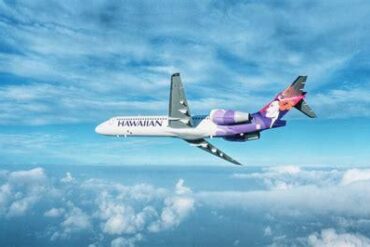
Most of Delta’s 717s originated with AirTran Airways before joining the airline following Southwest Airlines’ acquisition of AirTran. Rather than integrating the fleet, Southwest chose to divest the aircraft, creating an opportunity for Delta to acquire them at attractive prices.
The decision proved remarkably successful.
Delta utilized its extensive technical expertise—particularly its long-standing experience maintaining older McDonnell Douglas aircraft—to maximize the value of the fleet. The airline had already demonstrated similar success with the MD-88 and MD-90, operating both types substantially longer than rival US carriers.
The 717 subsequently became an ideal replacement for aging DC-9 derivatives while providing reliable service on hundreds of daily departures throughout Delta’s network.
Its relatively small seating capacity, strong short-field performance, and proven reliability allowed Delta to efficiently serve markets where deploying larger aircraft would have reduced profitability.
Why Delta Is Retiring These Six Aircraft Earlier Than Planned
The retirement of six airframes should not be interpreted as an immediate withdrawal of Delta’s entire Boeing 717 fleet. Instead, industry observers believe the decision reflects a targeted economic assessment focused on individual aircraft.
As aircraft age, they become subject to increasingly intensive maintenance requirements, including expensive structural inspections, corrosion prevention programs, and major component overhauls. Airlines frequently retire aircraft when upcoming maintenance events become prohibitively costly relative to the aircraft’s remaining economic value.
The six identified aircraft are among the oldest examples in Delta’s fleet and have accumulated decades of operational cycles across multiple operators.
For an airline, continuing to invest millions of dollars in heavy maintenance checks on aircraft approaching three decades of service can become difficult to justify—particularly when newer aircraft promise significantly lower operating costs.
Delta historically bases fleet decisions on a combination of factors rather than age alone. The carrier carefully evaluates fuel consumption, maintenance expenses, operational flexibility, residual value, and network requirements before determining whether an aircraft should remain in service.
Consequently, these early retirements likely represent highly calculated business decisions rather than a sudden shift in fleet strategy.
Airbus A220 Emerges As The Natural Boeing 717 Successor
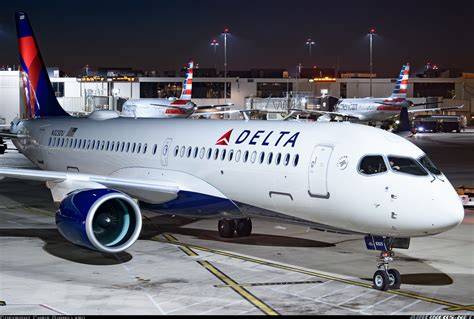
Among aviation analysts, the consensus is clear: the Airbus A220 family is poised to become the primary successor to Delta’s Boeing 717 operations.
Delta has invested heavily in the A220 program and continues taking deliveries of both the A220-100 and A220-300 variants. The aircraft offers substantial improvements across nearly every operational metric.
Fuel efficiency alone represents a major advantage. Powered by advanced Pratt & Whitney geared turbofan engines, the A220 consumes significantly less fuel than the aging 717, reducing both operating expenses and carbon emissions.
Beyond economics, the aircraft delivers a markedly improved passenger experience.
Travelers benefit from:
- Wider economy seats
- Larger overhead storage bins
- Substantially quieter cabins
- Larger passenger windows
- Enhanced onboard connectivity options
These features align closely with Delta’s broader strategy of modernizing its fleet while elevating the customer experience.
However, replacing the 717 is not entirely straightforward. The Boeing 717 excels on specific short-haul missions, and no modern aircraft replicates its exact operating profile. As a result, Delta may adopt a flexible replacement strategy involving both Airbus A220s and regional aircraft depending on route requirements.
The Retirement Signals The Gradual End Of The DC-9 Family Legacy
The Boeing 717 traces its lineage directly back to the legendary Douglas DC-9, an aircraft family first introduced during the 1960s. Through successive developments—including the MD-80, MD-90, and ultimately the Boeing 717—the design has remained in commercial service for more than six decades.
Delta has long been regarded as the spiritual home of this aircraft family.
The airline operated some of the world’s largest fleets of DC-9 derivatives and maintained them with exceptional efficiency. Even after many global airlines retired their final examples, Delta continued flying MD-88s and MD-90s well into the modern era.
The Boeing 717 represented the final evolution of that heritage.
As the global operator base for the aircraft continues to shrink, maintaining specialized parts inventories, engineering support, and technical expertise becomes increasingly challenging. These pressures inevitably accelerate retirement timelines, even for carriers with extensive maintenance capabilities.
What Comes Next For Delta’s Narrowbody Fleet
Despite these six planned retirements, Delta remains the world’s largest Boeing 717 operator, and the aircraft will likely continue serving passengers for several more years.
A gradual phase-out remains the most probable scenario. Rather than rapidly removing the entire fleet, Delta is expected to retire aircraft incrementally as maintenance costs rise and additional replacement aircraft arrive.
Looking further ahead, the airline may evaluate additional narrowbody acquisitions to address broader fleet renewal requirements extending beyond the Boeing 717 alone. Future decisions could influence replacements for other aging aircraft categories while shaping Delta’s domestic network strategy for decades to come.
For aviation enthusiasts, the retirement of these six aircraft may appear modest in scale. Yet symbolically, it represents something much larger: the beginning of the end for one of commercial aviation’s most resilient and recognizable aircraft families.