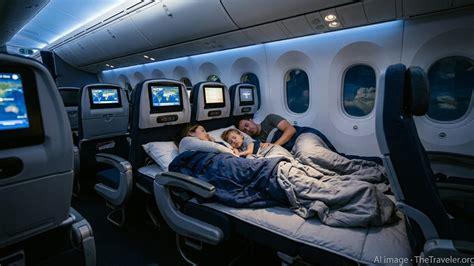
United Airlines is preparing to rethink what passengers can expect from a long-haul economy cabin, and its upcoming Relax Row is already attracting attention for a reason that extends well beyond ordinary comfort. The new concept transforms three adjacent economy seats into a couch-like resting area, giving travelers the ability to stretch out across an entire row after takeoff. For passengers who regularly find conventional economy seating restrictive, the idea represents a potentially meaningful change in how limited cabin space can be used.
The concept has received particular praise from travel journalist and author Robin Raven, who described United’s planned product as “a wonderful reimagining of what’s possible with economy travel.” Her reaction came after reflecting on an uncomfortable nine-hour transatlantic journey in a standard economy seat. For Raven, the problem was not simply that the seat was less luxurious than a premium alternative. It was the accumulated effect of narrow personal space, restricted movement, neighboring passengers, and a cramped cabin environment.
That perspective makes the Relax Row especially interesting for plus-size passengers, who can encounter challenges in economy that are rarely captured by basic seat-width or seat-pitch measurements. A larger usable surface could potentially provide more freedom to move, rest, and sleep without constantly negotiating personal space. Although United has not positioned the product specifically as a solution for plus-size travelers, Raven’s experience demonstrates why its design could resonate with passengers who find conventional economy seating particularly difficult.
United Airlines Relax Row Creates a New Economy Experience
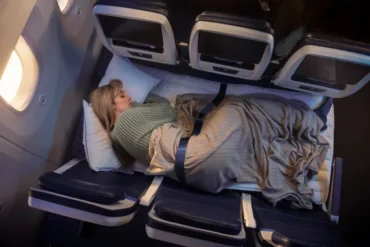
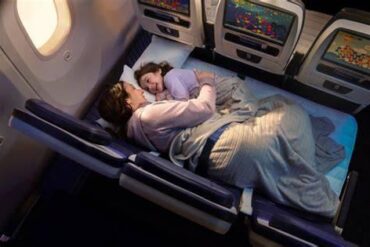
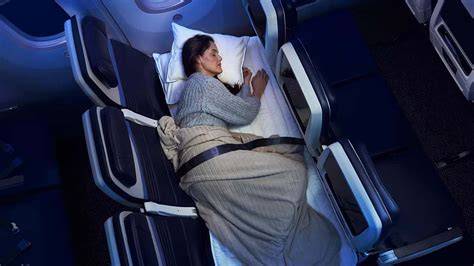
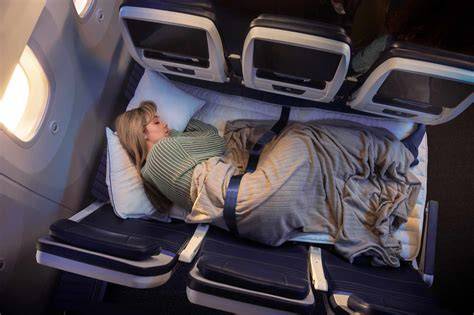
United’s Relax Row is built around a deceptively simple idea: instead of treating three economy seats as three completely separate spaces, the airline can combine them into a larger resting area. Each seat features an adjustable leg rest that folds upward to approximately 90 degrees. Once the configuration is activated after takeoff, the three seats form a broader, mattress-like surface designed for sleeping or relaxing.
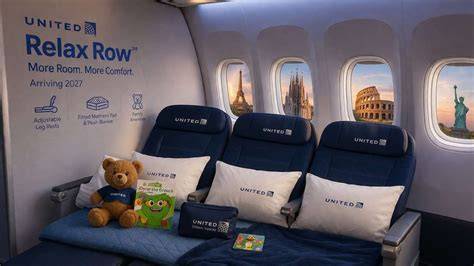
That approach changes the purpose of the seats without requiring passengers to move into a traditional premium cabin. A traveler could remain seated normally during much of the flight and then convert the row into a larger horizontal surface when it is time to rest. United plans to provide a custom-fitted mattress pad, a specially sized blanket, and two additional pillows, making the experience more substantial than simply reclining three ordinary economy seats.
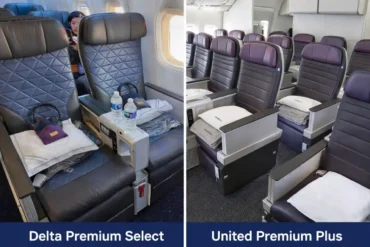
The product is expected to sit between United Economy and United Premium Plus, giving passengers another option between standard economy and a premium-cabin ticket. United intends to introduce Relax Row in 2027, with the concept eventually expanding to more than 200 Boeing 787 Dreamliner and 777 aircraft by 2030. Individual aircraft could ultimately feature as many as 12 Relax Row sections, although the precise configuration may vary.
Why Plus-Size Passengers May Find the Concept Significant
Raven’s experience helps illustrate the difference between having a slightly better economy seat and having fundamentally different access to space. During her transatlantic flight, she described a seatbelt buckle pressing against her side and the passenger beside her repeatedly intruding into her already limited personal area. Even eating became uncomfortable because the reclined seat ahead reduced the available room around her tray table.
The lavatory presented another challenge. Raven described its entrance as sufficiently narrow that she had to enter sideways. After returning to her seat, the fully reclined seat in front of her made the remaining space feel even tighter. These experiences reveal why usable space can matter as much as the published dimensions of a seat.
A conventional economy seat is designed primarily for sitting. Even when its back reclines, the passenger remains within a relatively confined individual footprint. Relax Row takes a different approach by allowing one passenger, or passengers traveling together, to make use of the combined width of three seats. That could make a meaningful difference for travelers who feel physically constrained by the traditional economy layout.
The potential benefit is not limited to physical comfort. Raven specifically emphasized the appeal of not having to worry constantly about sharing an armrest, touching a neighboring passenger, or feeling as though every movement might intrude into someone else’s space. For many travelers, that psychological burden can make a long flight considerably more exhausting.
It is important, however, not to overstate what the product guarantees. United has not said that Relax Row was developed specifically for plus-size passengers, and important details remain unavailable. The eventual experience will depend on the converted area’s actual usable width, seatbelt arrangements, access between seats, and the policies governing passengers using the space. Those practical factors will matter just as much as the concept itself.
Economy Beds Could Offer an Alternative to Business Class
The broader significance of Relax Row is that it introduces a different definition of comfort into the economy cabin. Airlines have traditionally improved economy through incremental changes, such as additional legroom, redesigned cushions, upgraded entertainment systems, or better meal services. United’s concept instead focuses on changing the geometry of the passenger’s space.
That distinction could be particularly valuable on long-haul flights. A passenger who wants to sleep often faces an uncomfortable choice: remain upright in economy or pay substantially more for a premium cabin with a lie-flat bed. Relax Row does not attempt to duplicate every feature of business class, but it creates another possibility. Passengers can purchase additional economy seats and gain access to a much larger surface for resting.
The concept also has applications beyond individual travelers. United expects Relax Row to appeal to solo travelers, couples, and families, particularly those who value additional room without paying for a premium cabin. Families with children will receive a Children’s Travel Kit and plush toy, adding another element to the experience.
The Price Will Determine Whether United’s Economy Beds Succeed
The biggest unanswered question is currently the price of Relax Row. United has not yet disclosed how much passengers will pay for access to the converted three-seat space. That figure will determine whether the concept becomes a practical alternative for ordinary travelers or remains a niche product for passengers willing to spend significantly more for additional comfort.
This is where United’s strategy could become particularly important. A product can be innovative without necessarily being accessible. If Relax Row is priced close to a traditional premium-cabin upgrade, some passengers may simply choose Premium Plus or another premium product instead. If the surcharge is reasonable, however, the concept could attract travelers who would never consider paying for business class but are willing to spend more to make a nine- or ten-hour flight substantially easier.
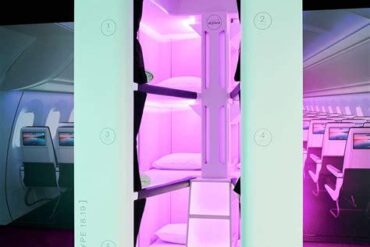
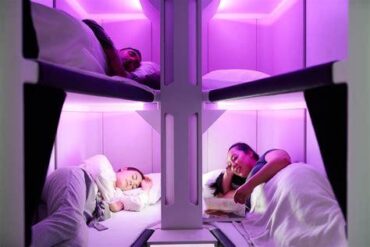
United is also entering a market where the basic idea has already been demonstrated. Air New Zealand’s Economy Skycouch has shown that passengers can be interested in purchasing multiple economy seats that create a larger resting surface. United’s approach brings a similar philosophy to a major U.S. carrier and plans to deploy it across a substantial widebody fleet.
United’s Relax Row Could Change the Meaning of Economy Comfort
For plus-size travelers, the most important question will ultimately be how the Relax Row works in real-world conditions. Seat dimensions, belt placement, row access, privacy, pricing, and the ease of converting the seats will determine whether the experience matches the promise. Yet the attention surrounding the concept already points to an important issue in modern air travel: comfort is not simply about adding inches to a seat.
Raven’s enthusiastic response captures that distinction. The attraction is the possibility of having enough room to stop thinking about the limitations of an economy seat for a few hours. Instead of constantly adjusting posture, protecting personal space, or worrying about neighboring passengers, travelers could potentially stretch out and sleep across a dedicated resting surface.
United Airlines is therefore testing something more ambitious than another economy-seat upgrade. The Relax Row represents an attempt to rethink how passengers interact with economy-cabin space itself. If the airline can combine a genuinely useful sleeping surface with sensible pricing, its new economy beds could become an important middle ground between conventional economy and expensive premium cabins—and for passengers who struggle most with cramped seating, that could be a genuinely welcome change.