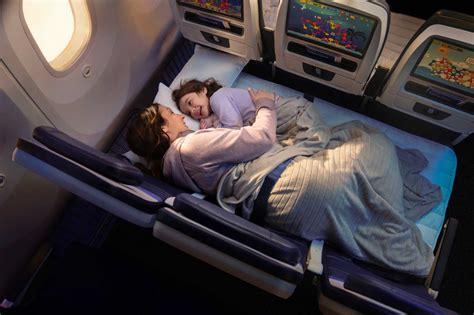
United Airlines is preparing to change the long-haul economy experience with Relax Row, a new seating option designed to let passengers turn three adjacent economy seats into a couch-like resting surface. Scheduled to debut in 2027, the product will offer travelers a way to stretch out during overnight flights without paying for a separate premium cabin. However, its appeal will ultimately depend on one crucial question: How much will United Airlines charge for a Relax Row economy bed?
United has not announced official pricing, but Air New Zealand’s Skycouch provides a useful benchmark for estimating what passengers might pay. The competing product reportedly costs between $550 and $1,000 per person for a two-person upgrade from the United States, while solo travelers can pay between $1,100 and $2,000, according to AFAR. United may seek a lower entry price to attract couples and families who want more room without paying for Premium Plus. A price in the low-to-mid hundreds of dollars per traveler could make Relax Row an appealing alternative, although the final amount will depend on the route, demand, and booking conditions.
The new product is particularly interesting because it does not require United to introduce an entirely separate cabin class. Instead, the airline can monetize three-seat sections within its existing economy cabins, creating an additional revenue opportunity while giving passengers a more comfortable way to travel long distances. If the pricing is right, Relax Row could appeal to travelers who find conventional economy too restrictive but consider premium cabins too expensive.
What Is United Airlines Relax Row?
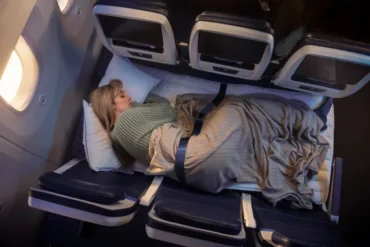
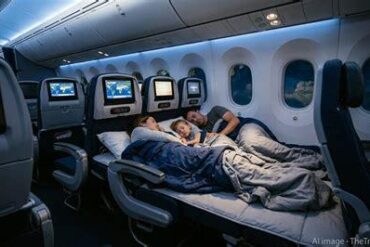
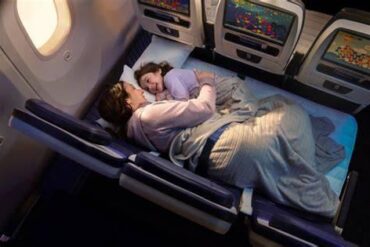
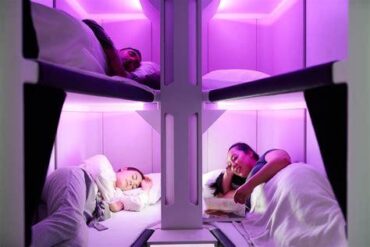
United Relax Row is a new long-haul economy product that converts a block of three neighboring seats into a more spacious surface for resting. Rather than introducing fully redesigned seats, United will use adjustable leg rests that fold upward to approximately 90 degrees, helping fill the gap between the seat cushions and the floor. Once the leg rests are positioned, passengers can spread out across the available space instead of remaining upright in a conventional economy seating position.
The concept is intended to provide a middle ground between standard economy and United Premium Plus. Traditional economy seats are designed primarily for sitting, and even passengers who secure an empty neighboring seat may find it difficult to lie down comfortably. Relax Row formalizes that extra space into a product that travelers can reserve and pay for in advance, making the experience more predictable than simply hoping adjacent seats remain unoccupied.
United also plans to provide bedding and other amenities to make the experience more practical. Passengers booking Relax Row will receive a custom-fitted mattress pad, a specially sized blanket, and additional pillows. Families traveling with children can also receive amenities such as a plush toy and a children’s travel kit when children are included in the reservation.
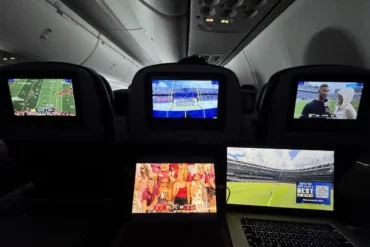
Importantly, the three seats will retain their individual seatback entertainment screens and charging access. Passengers will therefore have access to the familiar features of United’s economy cabin while gaining additional room to stretch out. The product is not a fully enclosed sleeping pod or a conventional lie-flat business-class seat. Instead, it is a more flexible resting arrangement designed around the space already available in the main cabin.
How Much Will United Relax Row Likely Cost?
United has yet to disclose a price list, so any estimate must be treated as a projection rather than a confirmed fare. The most useful reference point is Air New Zealand’s Economy Skycouch, which has established a market for selling a row of economy seats as a shared resting space.
According to the pricing figures cited by AFAR, a Skycouch upgrade for two travelers departing from the United States can cost approximately $550 to $1,000 per person. Solo travelers may pay between $1,100 and $2,000. These figures illustrate how much airlines can charge when they reserve several economy seats for a single passenger or a small group rather than selling each seat individually.
United may not replicate those prices exactly. Relax Row will compete within a different route network and customer base, and its commercial success will depend on how the airline positions the product against its own premium cabins. If the price approaches the cost of Premium Plus on a particular flight, passengers may prefer the upgraded cabin, especially when premium economy offers a more substantial improvement in seating, personal space, and overall comfort.
A more accessible price could help United reach travelers who would not otherwise consider paying for a premium cabin. For couples, a modest additional charge per person could make a shared sleeping surface attractive on an overnight flight across the Atlantic or Pacific. Families might also see value in securing a larger resting area for a child, particularly when the alternative is purchasing multiple premium seats.
A reasonable working estimate is therefore that United Relax Row could cost several hundred dollars per traveler on selected long-haul flights, with the possibility of higher charges when demand is strong or when a passenger wants to occupy the entire three-seat section alone. The exact amount remains uncertain until United publishes its pricing structure.
Why Air New Zealand Skycouch Is the Best Pricing Benchmark
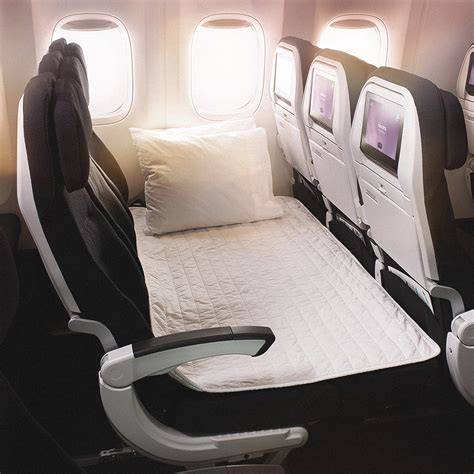
Air New Zealand’s Skycouch is the closest established equivalent to United Relax Row. The New Zealand carrier has spent years marketing its economy seating arrangement as a flexible space that can function as a couch, a resting area, or a place for younger children to relax during long flights.
The basic concept is similar. Three adjacent economy seats are allocated to the same booking, and adjustable footrests help create a flatter surface across the row. Bedding and pillows make the space more suitable for resting, while adjustable armrests can provide additional room. Rather than attempting to reproduce the luxury of business class, Skycouch offers a practical improvement for travelers who want more room without purchasing a premium cabin.
Skycouch is available in the forward economy cabin on Air New Zealand’s Boeing 777s and Boeing 787-9s. The airline has also developed family-oriented accessories, including an infant harness, belt, and pod. These details demonstrate that an economy bed is not simply a matter of moving seat components. It requires suitable bedding, clear usage arrangements, and equipment that accommodates different types of passengers.
United can learn from this established model while adapting the concept to its own network. Its large long-haul operation provides opportunities to offer Relax Row on a broad selection of international routes, potentially making the product available to more travelers than a limited, flagship-only service would.
However, the Skycouch price range should not be mistaken for a direct forecast of United’s fares. The two airlines have different route economics, competitive conditions, cabin layouts, and customer expectations. Skycouch establishes that travelers may be willing to pay substantially more for a shared economy resting area, but it does not establish what United will charge.
Which United Airlines Flights Will Offer Relax Row?
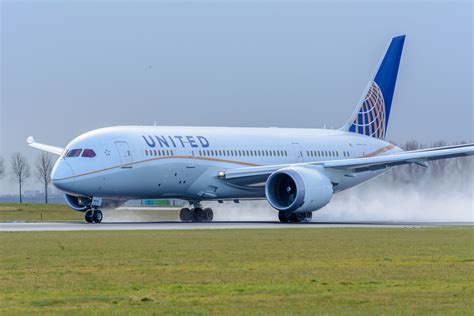
United plans to introduce Relax Row in 2027 on its Boeing 787 and Boeing 777 widebody aircraft. These aircraft serve many of the airline’s long-haul international markets, including transatlantic and transpacific routes where passengers may spend many hours aboard a single flight.
The rollout is intended to extend well beyond a handful of aircraft. United has said the product will be installed on every Boeing 787 in its fleet and on a large number of its Boeing 777s. By 2030, the airline aims to equip more than 200 aircraft with Relax Row.
United Chief Commercial Officer Andrew Nocella outlined the scale of the plan at the airline’s March 24 launch event in Los Angeles. He indicated that an aircraft could have as many as 12 Relax Row sections, although the average would be around nine. The number available on an individual flight will therefore depend on the aircraft configuration and installation.
This scale matters because it suggests United intends to make Relax Row a regular commercial offering rather than an occasional perk. Passengers could eventually encounter the product across a broad range of long-haul services, giving the airline more opportunities to sell additional comfort to leisure travelers and families.
Nevertheless, availability will not necessarily be identical across every flight. The planned installation numbers do not guarantee that every departure will offer the same number of sections, and the rollout will take time. Travelers interested in booking the product will need to check whether Relax Row is available on their specific aircraft and itinerary once reservations open.
Will Relax Row Be Cheaper Than Premium Economy?
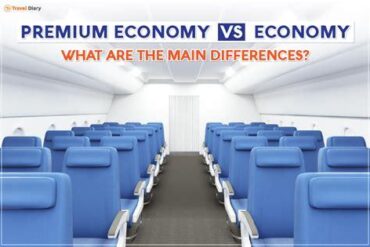
United Relax Row is designed to occupy a different position from United Premium Plus, the airline’s premium economy product. The distinction is important because passengers will be evaluating more than the ability to lie down. They will also consider seat width, personal space, privacy, service, and the overall experience offered for the price.
Premium economy generally provides a more conventional upgraded seating experience, with a dedicated seat designed for sitting and reclining. Relax Row, by contrast, prioritizes the ability to spread out across three adjacent economy seats. It may be especially attractive to passengers who value a larger resting surface more than a dedicated premium seat.
For a couple traveling overnight, the decision could depend on the difference in total cost. If Relax Row is available for a manageable supplement over economy, it may offer enough additional comfort to justify the expense. If the price climbs close to Premium Plus, however, the upgraded cabin could become more appealing, particularly for travelers who want greater personal space without sharing a row.
Families may evaluate the product differently. Parents traveling with young children could appreciate the ability to create a more flexible resting area without buying a separate premium cabin. The additional bedding and child-focused amenities may make the experience particularly useful on overnight journeys, although the suitability of the arrangement will depend on the family’s needs and the airline’s operating rules.
Solo travelers face a different calculation. Paying to reserve a three-seat section for one person means covering the cost of space that could otherwise accommodate additional passengers. United could offer a premium solo option, but its price would need to be low enough to justify the benefit while still compensating the airline for the seats removed from ordinary sale.
Why United Is Turning Economy Space Into a Premium Product
Relax Row is part of a broader airline strategy: generating more revenue from existing cabin space without creating an entirely new seating class. Building a separate premium cabin requires a dedicated configuration and can reduce the number of seats available for other passengers. Relax Row offers a different approach by creating an additional product within the existing economy cabin.
The commercial logic is straightforward. Some travelers are willing to pay more for extra room but do not want to purchase business class or premium economy. Others may be traveling with children and value the ability to rest together more than they value a traditional premium seat. Relax Row gives United another option to serve these customers while maintaining the basic structure of its main cabin.
United reported record revenue of $59.1 billion for 2025 and an adjusted pre-tax margin of 7.8%, according to the supplied reference material. Those figures provide context for the airline’s emphasis on premium products and additional revenue streams. Relax Row fits that strategy by attempting to extract more value from space that might otherwise generate less revenue when sold as ordinary economy seats.
The financial result will depend on how effectively United manages inventory. Every Relax Row section uses three seats, so the airline must weigh the extra income from selling the section against the revenue it might have earned by selling those seats individually. The bedding, pillows, cleaning requirements, and distribution process also introduce costs that ordinary economy seating does not carry in the same way.
Pricing will be central to the outcome. A low price might attract many customers but fail to compensate United for the seats and amenities involved. A high price might improve revenue per booking while discouraging passengers from buying the product. The airline will need to find a balance between customer demand and the opportunity cost of taking three seats out of the conventional economy inventory.
Is United Relax Row Worth Paying For?
Whether Relax Row represents good value will depend on the flight length, the passenger’s needs, and the final price. On a short journey, the extra cost may be difficult to justify. On a transpacific flight lasting many hours, the ability to stretch out and rest could be substantially more appealing.
The product’s greatest advantage is its position between ordinary economy and premium cabins. It offers a more deliberate resting arrangement than an empty neighboring seat, along with dedicated bedding and accessories, without requiring passengers to purchase a business-class ticket. Couples and families are likely to be among the most natural potential customers because they can share the space and distribute its cost.
There are limitations. A couch-like economy surface is not equivalent to a fully flat business-class bed, and passengers should not assume it will provide the same level of privacy or personal space as a premium cabin. The experience will also depend on the aircraft configuration and the practical space available around the seats.
Ultimately, United Airlines Relax Row pricing will determine whether the product becomes a popular economy upgrade or a niche option for travelers willing to pay considerably more for rest. Air New Zealand’s Skycouch demonstrates that an economy bed can command a substantial additional fare, but United will need to establish its own price point to attract customers across its extensive long-haul network.
With deployment planned across more than 200 widebody aircraft by 2030, Relax Row has the potential to become a familiar part of United’s international economy experience. Until official fares are announced, several hundred dollars per traveler is a reasonable broad estimate for planning purposes, not a confirmed price. The decisive question will be whether United can offer enough additional comfort to make the upgrade worthwhile while generating more revenue than it would earn from selling the same seats individually.