The long-haul economy experience has always lived in a paradox: affordable access to global travel, paired with physical discomfort that becomes increasingly difficult to ignore somewhere over the Pacific. Now, United Airlines is attempting to reshape that equation with a bold new concept—Relax Row, a hybrid product that introduces lie-flat-style rest without the premium cabin price tag.
What makes this innovation especially compelling is not just its design, but the economic strategy behind it. Positioned carefully between standard economy and premium economy, Relax Row is less about luxury and more about strategic comfort monetization. The real intrigue lies in what travelers will ultimately pay—and whether that price will feel like a bargain or a stretch.
A New Pricing Frontier Between Economy and Premium Comfort
United has yet to release official pricing for Relax Row, but the structure of the product and industry comparisons reveal a surprisingly clear picture. The closest benchmark comes from Air New Zealand and its widely recognized Skycouch product, which has quietly dominated this niche for years.
Skycouch pricing typically ranges:
- $550 to $1,000 per person for two travelers sharing
- $1,100 to $2,000 for solo travelers occupying the entire row
These figures provide a strong directional signal. United is unlikely to exceed these price bands significantly, especially given its scale ambitions. Instead, the airline is expected to land in a low-to-mid hundreds range per passenger for couples, with solo travelers paying a notable premium to secure the entire row.
This positioning is deliberate. Relax Row must feel:
- More attainable than Premium Plus
- More valuable than standard economy upgrades
- Flexible enough to appeal across multiple traveler types
The result is a pricing “sweet spot” where comfort becomes aspirational but not exclusive.
What Exactly Is United’s Relax Row Experience?
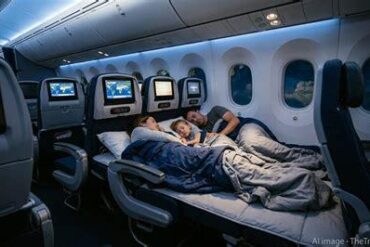
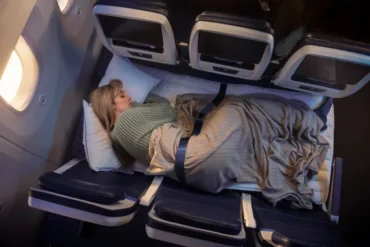
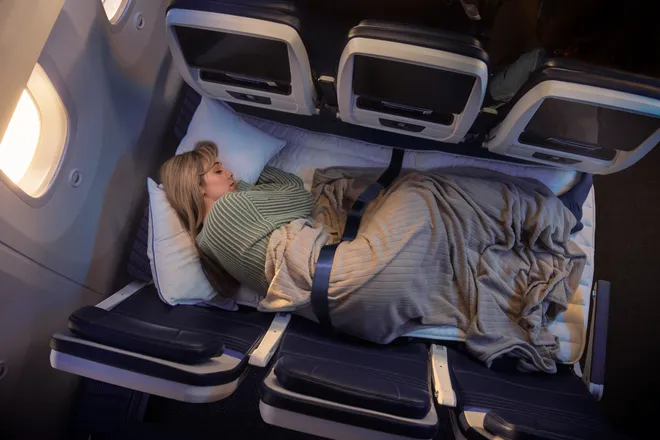
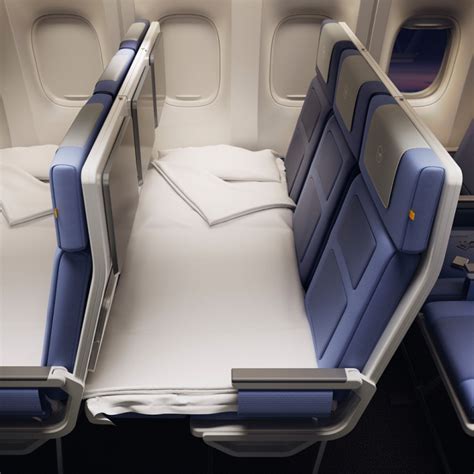
Relax Row is not a new cabin. That distinction matters more than it might initially seem. Instead, it is a reconfiguration of existing economy seating, transforming three adjacent seats into a couch-like surface once airborne.
The innovation lies in its mechanics. Adjustable leg rests rise to meet the seat cushions, creating a continuous, semi-flat lounging space. This is not a fully flat business-class bed, but it is a dramatic improvement over upright seating.
The product will debut on widebody aircraft including the Boeing 787 and Boeing 777 starting in 2027. Each aircraft will feature up to 12 Relax Row sections, with an average closer to nine.
This scale is critical. Unlike boutique upgrades, Relax Row is designed to be:
- Repeatable across routes
- Available to a broad passenger base
- Integrated into standard booking flows
It transforms what was once a lucky empty row into a predictable, bookable experience.
Who Will Actually Pay for Relax Row?
United’s strategy becomes clearer when examining its intended audience. Relax Row is not targeting traditional premium travelers. Instead, it’s crafted for a new category: value-driven comfort seekers.
Three primary groups stand out:
Couples are perhaps the most obvious fit. Splitting the cost of a Relax Row transforms it into a relatively affordable way to gain shared space and horizontal rest without stepping into premium economy pricing territory.
Solo travelers represent a more complex equation. While the cost per person rises significantly, the appeal of owning an entire row—especially on ultra-long-haul routes—creates a compelling trade-off between cost and comfort autonomy.
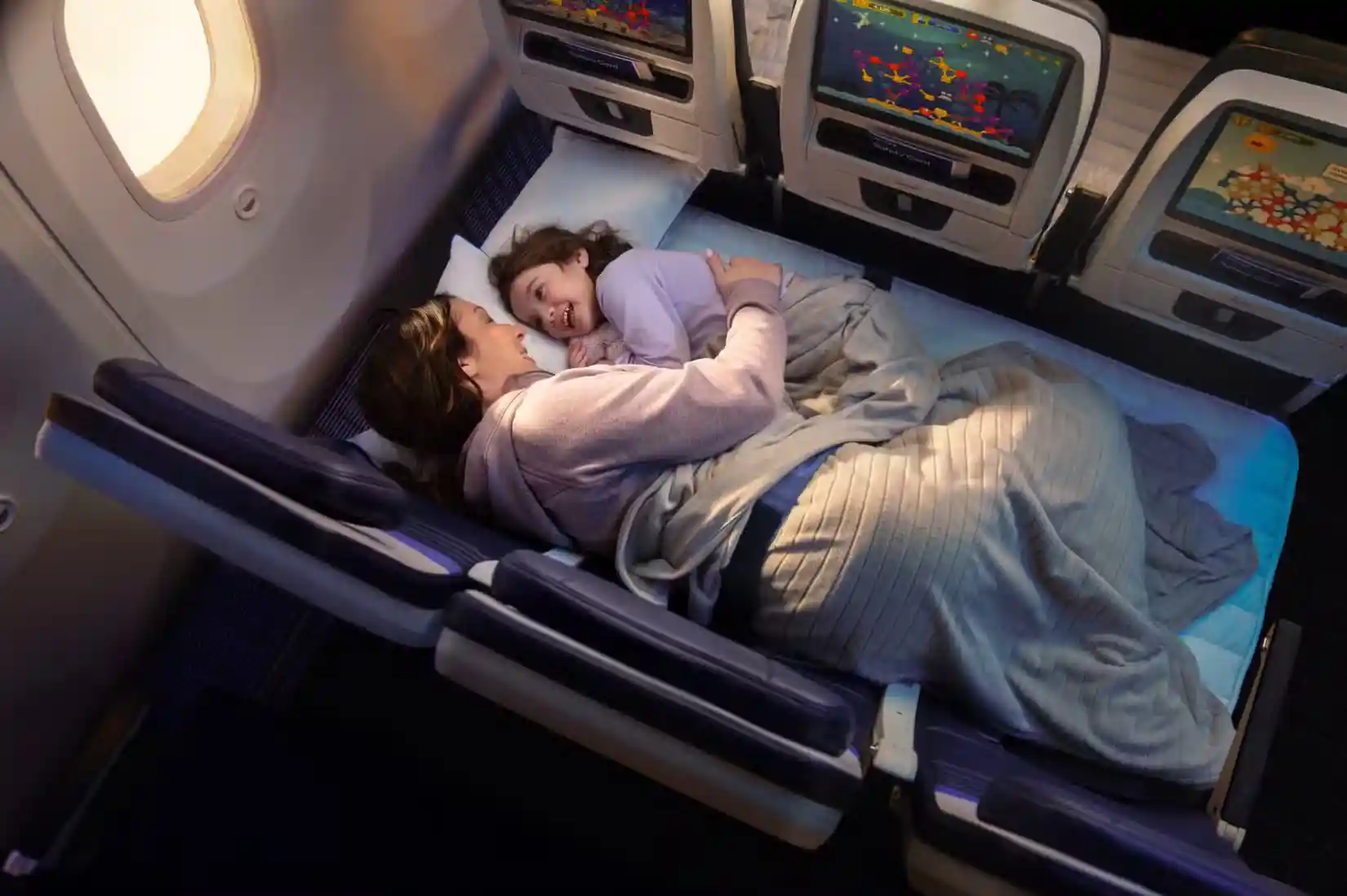
Families, particularly those traveling with young children, may find the greatest value. The ability to convert seating into a resting or play area mid-flight introduces a level of flexibility that traditional economy simply cannot match.
This multi-segment appeal is precisely what makes Relax Row so strategically powerful. It is not niche—it is broadly adaptable.
Amenities That Elevate the Experience Beyond Empty Seats
Relax Row is not merely about space; it is about curated comfort. United is packaging the experience with thoughtful additions that transform it from a seating hack into a legitimate product.
Passengers can expect:
- A custom-fitted mattress pad designed for the seat configuration
- A dedicated blanket sized for full-body coverage
- Multiple pillows for support and flexibility
- Family-oriented extras like plush toys and children’s kits
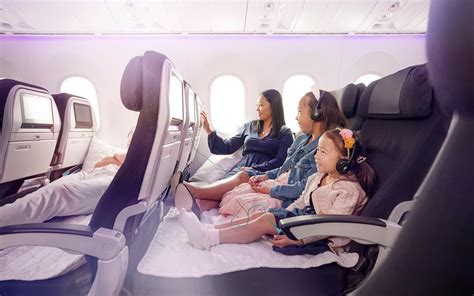
Each row retains individual seatback screens and charging access, ensuring that comfort does not come at the expense of connectivity or entertainment.
This attention to detail matters. Without these enhancements, Relax Row would risk feeling like a repurposed economy compromise. With them, it becomes a distinct, branded experience.
Why United Is Scaling Relax Row Across Its Fleet
The most ambitious aspect of Relax Row is not its design—it is its rollout. United plans to install the product on over 200 aircraft by 2030, signaling a commitment far beyond experimental deployment.
This includes widespread integration across:
- Boeing 787 fleets
- A substantial portion of Boeing 777 aircraft
Such scale transforms Relax Row into a network-wide revenue engine rather than a novelty.
From a financial perspective, this is a highly efficient move. Instead of dedicating space to a new cabin class—which would require additional crew training, service layers, and structural modifications—United is extracting incremental revenue from existing real estate.
This approach aligns with broader airline industry trends, where ancillary revenue has become a critical profitability driver.
How Relax Row Compares to Air New Zealand’s Skycouch
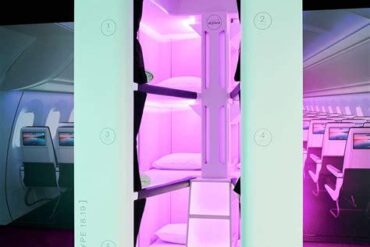
Any serious discussion of economy bed concepts inevitably leads back to Air New Zealand and its Skycouch.
The similarities are clear:
- Both convert three seats into a couch-like surface
- Both use adjustable leg rests to create a flatter profile
- Both include bedding and soft amenities
Yet there are subtle but important differences. Skycouch has long emphasized flexibility, positioning itself as a multi-use space—seat, bed, or play area. United appears to be taking a more structured, productized approach, with clearer branding and integration into its broader cabin strategy.
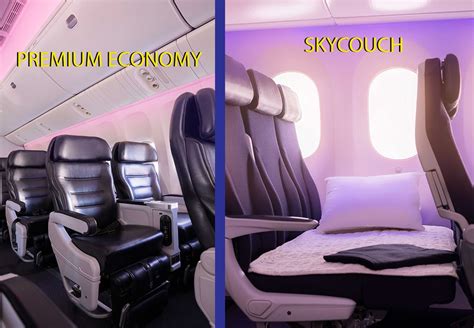
Another distinction lies in scale. While Skycouch is limited to certain aircraft and routes, United’s plan suggests far greater availability, which could normalize the concept globally.
This raises an intriguing possibility: Relax Row may not just compete with Skycouch—it may mainstream the entire category.
The Pricing Psychology Behind Relax Row
Pricing Relax Row correctly is not just a financial decision—it is a psychological one.
If priced too low, passengers may question its value or simply expect similar comfort from standard economy. Worse, United risks cannibalizing its own seat inventory by underselling space that could have been sold individually.
If priced too high, the product faces a different threat: irrelevance. Travelers may skip it entirely and either endure economy or upgrade directly to Premium Plus.
The ideal pricing window must achieve three outcomes simultaneously:
- Feel like a meaningful upgrade
- Remain accessible to a wide audience
- Deliver strong incremental revenue per flight
This balancing act is delicate. But if executed well, it could redefine how airlines think about mid-tier comfort offerings.
Operational Challenges That Could Shape the Final Cost
Behind the scenes, Relax Row introduces new layers of complexity that will inevitably influence pricing.
Inventory management becomes more intricate. Airlines must decide when to sell a row as individual seats versus bundling it into a Relax Row product. Demand forecasting becomes critical, especially on routes with fluctuating passenger loads.
There are also logistical considerations:
- Cleaning and resetting bedding between flights
- Managing onboard storage for additional amenities
- Training crew to handle a hybrid seating product
These factors add cost—but they also reinforce the product’s perceived value. Travelers are not just paying for space; they are paying for a seamless, prepared experience.
A Strategic Bet on the Future of Long-Haul Economy
Relax Row reflects a broader shift in airline strategy. Instead of drawing a hard line between economy and premium cabins, carriers are increasingly exploring gradient-based experiences—products that blur traditional boundaries.
This approach acknowledges a fundamental truth: not all travelers fit neatly into predefined categories. Many are willing to pay more, but not dramatically more, for comfort.
By targeting this middle ground, United Airlines is tapping into a vast, under-served segment of the market.
The timing is also significant. Post-pandemic travel trends have shown a willingness among passengers to invest in comfort, particularly on long-haul routes. Relax Row is perfectly positioned to capture that sentiment.
So, What Will Relax Row Actually Cost?
While official numbers remain undisclosed, all indicators point toward a pricing structure that looks something like this:
For couples:
- Likely $300 to $700 per person depending on route length and demand
For solo travelers:
- Potentially $800 to $1,500 to secure the full row
These estimates align with industry benchmarks while reflecting United’s scale-driven cost efficiencies.
Crucially, this pricing keeps Relax Row:
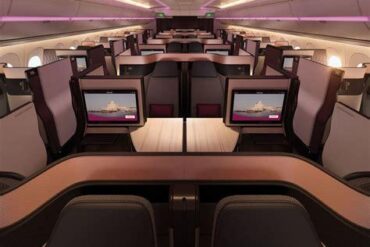
- Below Premium Plus
- Above standard economy upsells
- Squarely in the “worth considering” zone for most long-haul travelers
The Bottom Line: A Product That Could Redefine Economy Travel
Relax Row is more than a clever seating configuration. It represents a fundamental rethinking of how airlines can monetize comfort without alienating price-sensitive passengers.
If priced correctly, it has the potential to become one of the most successful ancillary products in modern aviation. It bridges a gap that has long existed but rarely been addressed effectively.
And perhaps most importantly, it acknowledges something every long-haul traveler already knows: sometimes, the difference between surviving a flight and actually enjoying it comes down to just a little more space—and the willingness to pay for it.