The aviation industry has spent decades refining how passengers sit. Now, it is finally confronting a more fundamental question: how passengers sleep. With the introduction of Relax Row by United Airlines, the focus shifts away from upright comfort and toward horizontal rest—without the price tag of business class. This shift is not subtle. It reflects a deeper transformation in how airlines monetize space, how passengers value comfort, and how long-haul travel is evolving in a post-premium economy era.
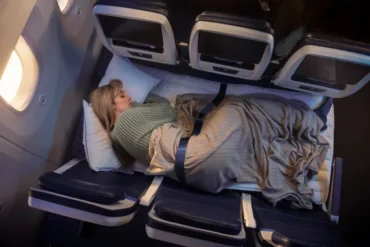
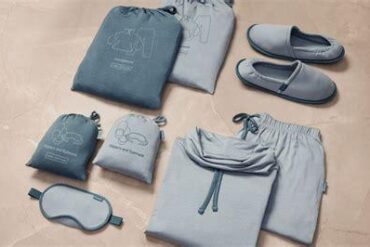
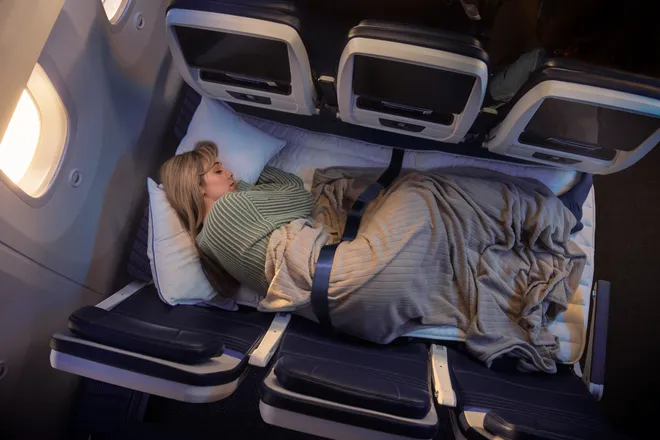
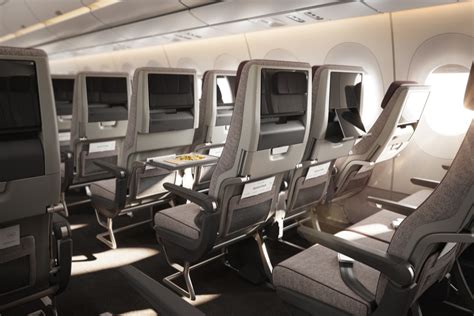
At its core, Relax Row is deceptively simple. Instead of installing expensive lie-flat seats or redesigning cabins, United repurposes what already exists: three adjacent economy seats. Add a mattress pad, pillow, blanket, and eye mask, and suddenly a standard row becomes something entirely different—a makeshift bed at 35,000 feet. The brilliance lies not in engineering, but in economics and timing.
Routes such as Newark Liberty International Airport to London Heathrow Airport or ultra-long-haul journeys from San Francisco International Airport to Singapore Changi Airport are where this concept becomes powerful. These are flights where sleep is not optional—it is survival.
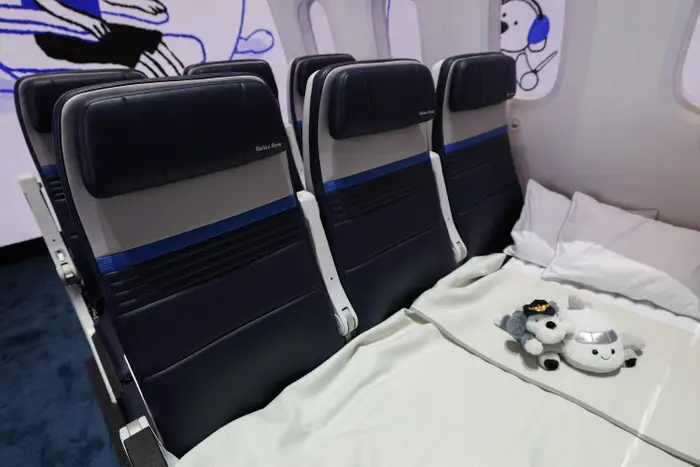
By turning unsold inventory into a monetized sleep product, United is effectively creating a new category: sleep-as-a-service in economy class.
How Relax Row Transforms Economy Seating Into a Sleep Product
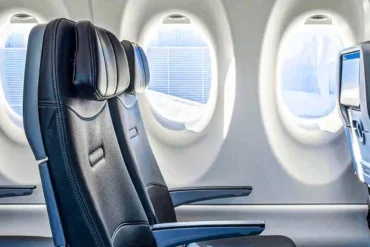
Relax Row is not about luxury. It is about space utilization. Traditional economy seating forces passengers into a fixed posture—slightly reclined, constrained, and often restless. Relax Row breaks that limitation by giving a single traveler control over an entire row.
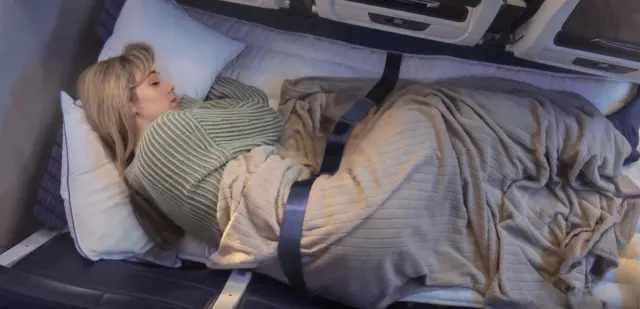
This transforms the geometry of the experience. Instead of vertical discomfort, passengers gain horizontal flexibility. Legs can stretch fully. The torso can lie flat across cushions. The psychological difference alone is substantial—sleep becomes plausible rather than aspirational.
Unlike purpose-built solutions, this approach avoids structural changes to aircraft cabins. No new seat certifications, no reduced seat density, no long installation cycles. It is a modular concept that can be deployed dynamically, depending on load factors.
This is where Relax Row becomes strategically significant. Airlines frequently depart with empty seats, particularly during off-peak seasons or on certain long-haul routes. Traditionally, those seats generate zero revenue. With Relax Row, they become premium micro-inventory.
The result is a rare alignment of incentives:
Passengers gain rest. Airlines gain revenue. No one sacrifices capacity.
What Relax Row Actually Costs in Real Terms
Pricing is where Relax Row becomes truly disruptive. Early fare tracking and industry analysis suggest that upgrades will typically land in the low hundreds of dollars above economy fares. This positions the product in a pricing zone that feels accessible, especially when contrasted with premium cabins.
To understand the impact, consider typical fare structures on long-haul routes:
- Economy tickets: often between $400 and $800
- Relax Row upgrade: approximately $200 to $600 extra
- Premium economy (Premium Plus): frequently $1,000 to $3,000 roundtrip
- Business class (Polaris): often several thousand dollars
The gap is not incremental—it is exponential.
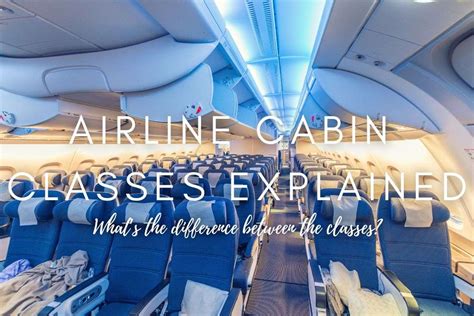
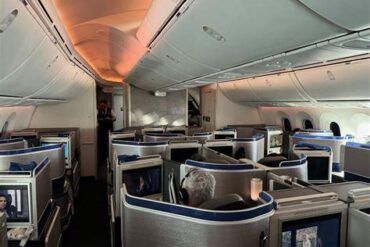
Where Premium Plus delivers a broader package—wider seats, better meals, priority services—Relax Row isolates a single variable: sleep quality. For a significant segment of travelers, that is the only variable that truly matters.
This pricing model also introduces a psychological shift. Instead of committing to a higher fare class during booking, passengers can decide closer to departure. That flexibility changes how travelers approach upgrades, making comfort a real-time decision rather than a pre-planned expense.
Premium Economy vs Relax Row: A Battle of Priorities
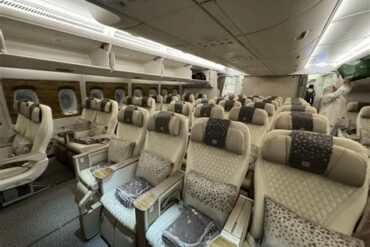
Premium economy, branded as Premium Plus by United Airlines, has long been positioned as the rational upgrade. It offers measurable improvements: wider seats, deeper recline, upgraded catering, and additional baggage allowances.
But it still shares one critical limitation: you remain seated.
Relax Row challenges that paradigm directly. It does not attempt to compete on service, dining, or ground experience. Instead, it asks a sharper question: Would you trade all of that for the ability to lie down?
For many long-haul travelers, the answer is increasingly yes.
Consider a 14-hour transpacific flight. Premium economy might provide a more comfortable seat, but it cannot eliminate the fundamental constraint of upright sleeping. Relax Row, while less refined, offers something closer to a natural sleep posture.
That distinction becomes even more pronounced on routes exceeding 10 hours. On shorter overnight flights, the difference may feel marginal. On ultra-long-haul sectors, it becomes decisive.
This creates a divergence in passenger psychology:
- Those who value service, amenities, and status perks gravitate toward premium economy
- Those who prioritize sleep above all else lean toward Relax Row
It is not a hierarchy. It is a fork in the decision tree.
Why Relax Row Echoes Air New Zealand’s Skycouch Strategy
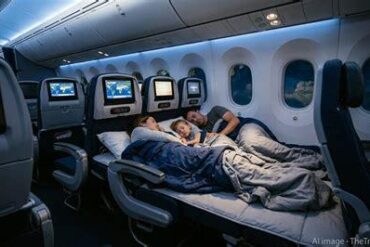
The closest conceptual parallel to Relax Row is the Skycouch offered by Air New Zealand. Introduced years earlier, Skycouch reimagined economy seating by converting rows into couch-like surfaces through adjustable leg rests.
The similarities are obvious: both products transform economy rows into rest-oriented spaces without fundamentally altering cabin layouts. Both target travelers priced out of business class but unwilling to endure standard economy discomfort.
However, the execution differs in meaningful ways.
Skycouch is a hardware-driven solution. It requires specialized seat design and is built into the aircraft configuration. Relax Row, by contrast, is software-driven in spirit—a flexible offering layered on top of existing infrastructure.
This distinction gives United a key advantage: scalability. Relax Row can be deployed selectively, adjusted dynamically, and withdrawn without operational disruption.
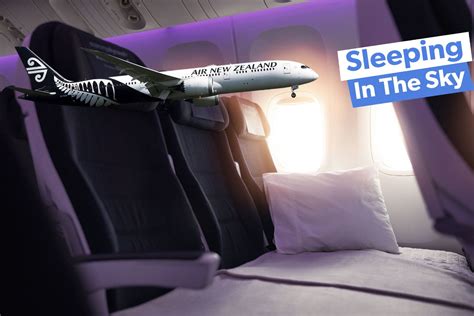
There is also a demographic nuance. Skycouch has historically appealed to couples and families, functioning as a shared space. Relax Row is optimized for solo travelers seeking uninterrupted rest.
Both products reflect a broader industry realization: sleep is the ultimate premium feature, and it does not always require a business-class seat to deliver it.
Route Length Changes Everything About Value
The true value of Relax Row cannot be measured in isolation. It depends heavily on flight duration and timing.
On a 7-hour overnight crossing, such as transatlantic routes between the United States and Europe, the benefit is real but limited. Sleep windows are short, and the incremental comfort may not justify even a few hundred dollars for some travelers.
On ultra-long-haul routes—think 12 to 16 hours—the equation changes dramatically.
Flights between San Francisco International Airport and Singapore Changi Airport are not just long; they are physically demanding. Fatigue accumulates. Circadian rhythms collapse. The ability to lie flat—even imperfectly—can transform arrival conditions.
Passengers heading directly into business meetings, tight connections, or multi-leg itineraries often place a premium on functional rest rather than luxury. Relax Row caters precisely to that mindset.
It effectively decouples sleep from the traditional hierarchy of cabin classes. Instead of paying for an entire premium experience, passengers pay for one critical outcome: rest.
The Hidden Strategy: Monetizing Empty Seats
Behind the passenger experience lies a more strategic story. Relax Row is not just a product—it is a revenue optimization tool.
Airlines operate on thin margins, and empty seats represent lost income. Traditionally, the only way to reduce this inefficiency was through pricing adjustments or overbooking strategies. Relax Row introduces a third option: repackaging unsold capacity.
This aligns with a broader shift toward ancillary revenue. Modern airlines no longer rely solely on ticket sales. They monetize every aspect of the journey—seat selection, baggage, onboard services, connectivity, and now, sleep itself.
Relax Row fits seamlessly into this ecosystem. It is:
- Low-cost to implement
- Flexible in pricing
- Scalable across routes
- Highly targeted in appeal
This makes it an ideal product for dynamic pricing models, where cost fluctuates based on demand, availability, and timing.
The implication is profound. Cabin classes, once rigid and clearly defined, are becoming fluid layers of purchasable experiences.
Could Relax Row Redefine Economy-Class Expectations?
For decades, the idea of lying down on an airplane was synonymous with business or first class. Relax Row challenges that assumption, not by replicating luxury, but by democratizing access to rest.
If successful, it could reshape passenger expectations. Travelers may begin to view sleep as a baseline requirement rather than a premium privilege. This, in turn, could pressure other airlines to develop similar offerings—whether through modular seating, convertible rows, or entirely new cabin concepts.
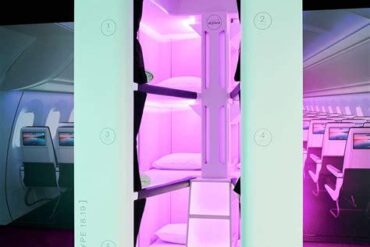
The competitive landscape is already shifting. Airlines are experimenting with sleep pods, hybrid seating, and flexible cabin configurations. Relax Row is part of a larger movement toward customizable inflight experiences.
Its success will ultimately depend on pricing consistency and availability. If passengers can reliably secure it at a reasonable premium, it becomes a compelling alternative. If pricing drifts too close to premium economy, its value proposition weakens.
But the direction is clear. The future of long-haul travel is not just about where you sit. It is about how you rest.
Final Analysis: A Smarter Way to Buy Sleep at 35,000 Feet
Relax Row is not a replacement for premium economy or business class. It is something more precise—a surgical upgrade designed for a specific need.
It strips away everything non-essential and focuses on one outcome: better sleep on long flights.
For travelers who prioritize rest over refinement, it may represent the most rational upgrade in modern aviation. For airlines, it is a blueprint for monetizing space without sacrificing flexibility.
And for the industry as a whole, it signals a subtle but powerful shift. The next frontier of inflight innovation is not just about adding more luxury. It is about redefining value in the space passengers already occupy.