The question sounds like an engineering rumour, but it points to a real and consequential change in how Airbus builds the A350. On the New Production Standard (NPS) aircraft, the manufacturer did not shave material off the sidewalls in the crude sense of making the cabin thinner and hoping passengers would not notice. Instead, Airbus re-engineered the interior lining, the sidewall panels that sit between the structural frame and the passenger, so that the same fuselage cross-section would yield measurably more usable floor width at seat height. The shift added roughly four inches (10.2 centimetres) of interior width, and Airbus now advertises that this gain is enough to support a 10-abreast economy layout with 17-inch (43.2-centimetre) seats. That single sentence reframed the A350-1000 as a credible 777-300ER replacement in the densest cabins, and it is the technical fact at the heart of every debate about whether the airliner can finally match Boeing’s ten-abreast economics without ruining the passenger experience.
The stakes are easy to underestimate. The A350-1000 is a superb aircraft by almost any measure: it is quieter than the 777-300ER, dramatically more fuel-efficient, and capable of carrying a heavy payload on ultra-long-haul routes that would tax older widebodies. Yet for most of its service life it has flown in a nine-abreast economy layout, while the 777-300ER it was designed to replace typically carries ten seats per row. On paper that one missing seat per row compounds across dozens of rows, and airlines evaluating fleet replacement compare the resulting trip costs and revenue per departure with brutal arithmetic. Airbus did not need a better aeroplane; it needed a cabin that could hold its own in a spreadsheet.
What The A350 New Production Standard Actually Changed
On 29 September 2022, Airbus delivered the first NPS A350, an A350-900, to Iberia. The package was broader than a cosmetic cabin tweak. Airbus increased the aircraft’s maximum take-off weight, reduced empty weight, improved field performance, and repositioned the bulkheads to create more usable floor space on both the A350-900 and the larger A350-1000. Alongside those structural and systems changes came the redesigned sidewall architecture that produced the extra interior width. Because the sidewalls curve inward toward the floor, the panel geometry determines where the outboard seat cushion and armrest can actually sit; reshaping that surface effectively recovers space that would otherwise be lost to the fuselage’s natural taper.
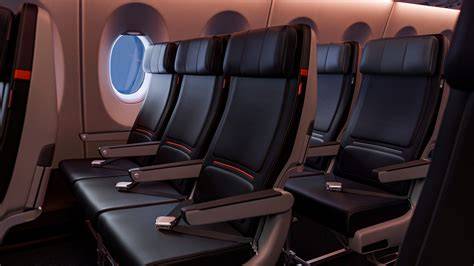
This is why the phrase “trimmed sidewall panels” is only half right. The panels were thinned and reprofiled, not simply deleted, and the change allowed seats to be pushed closer to the skin of the aircraft. Airbus’s wider application of the same philosophy to the cabin gave carriers a pathway to densify without abandoning the A350’s structural efficiency. The catch, as with all geometry-based densification, is that the recovered millimetres must come from somewhere. When you add a seat to a fixed-width tube, the space has to be taken from the seat itself, the armrests, or the aisle.
Why Ten Abreast Matters For The A350-1000 Specifically
The A350-900 has already proven itself as Airbus’s most successful widebody, and its nine-abreast layout is so well liked that densification matters far less for that variant. The A350-1000 is a different story. It competes directly against the 777-300ER, most of which are configured with ten economy seats per row, and against the forthcoming 777-9, which is longer and also ten abreast. For airlines seeking to grow capacity while retiring older jets, a nine-abreast A350-1000 can look like a step backwards in seats per departure even as it delivers enormous efficiency gains. That mismatch is precisely the gap the NPS sidewall was designed to close.
Previously, only the French Caribbean carrier Air Caraïbes and the French long-haul low-cost operator French bee had installed ten-abreast A350 cabins, and their seats measured about 16.5 inches (41.9 centimetres) across, a figure full-service carriers considered too punitive for premium long-haul markets. The NPS specification changed the arithmetic by promising seats closer to the width found on the 777 and 787. Airbus’s argument was straightforward: if a ten-abreast A350 can match Boeing’s seat width while retaining the A350’s fuel burn, operating economics improve without a visible sacrifice.
Philippine Airlines And The Reality Of A Ten-Abreast A350
That argument received its first serious test when Philippine Airlines took delivery of its first A350-1000 in December 2025, becoming the third operator to fly the type ten abreast. The layout is dense but carefully tiered: 42 business class seats, 24 premium economy seats and 316 economy seats, for a total of 382 passengers. For an aircraft of this size, that is a substantial capacity, and because the A350-1000 retains excellent freight capability, the revenue potential per departure is genuinely attractive.
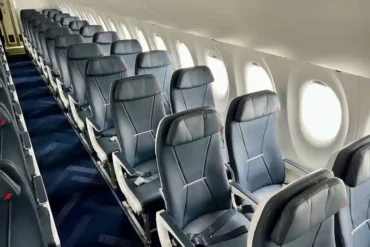
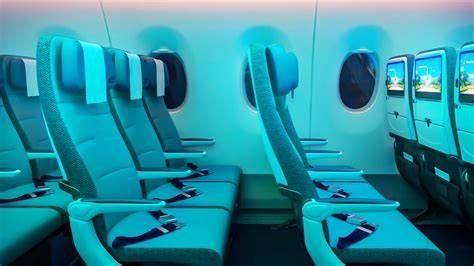
The comfort story is more complicated. Although the published seat width is comparable to a 777 or 787, Philippine Airlines had to trim the armrests, push the seats closer to the sidewall and narrow the aisles to make the numbers work. Reports from the cabin suggest the economy experience feels noticeably tighter than on Boeing widebodies, and that impression matters because the A350’s appeal to full-service carriers has always rested on its spacious, quiet, well-proportioned cabin. Since Philippine Airlines committed, no other airline has publicly chosen a ten-abreast A350, which is itself a signal that carriers remain cautious about trading the aircraft’s reputation for a marginal capacity gain.
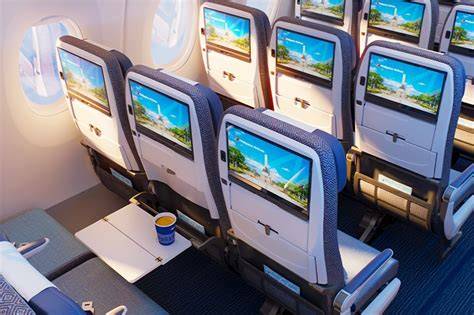
Boeing faced the same geometry problem and solved it differently. The 777X uses thinned sidewalls as well, but because the 777 cross-section is wider to begin with, the result is enough room for wider armrests or more generous aisles than older 777s. In practice, a ten-abreast 777X should feel more comfortable than a ten-abreast A350, even though both claim similar seat widths, while a nine-abreast A350 remains the most comfortable of the three. The A350-1000 in its standard economy layout is still an exceptional aircraft, and the added width gives carriers a density option they lacked before, but the evidence so far suggests the ten-abreast variant has not moved the needle in the order book.
The A350-1000 Versus The 777-9 In A Crowded Market
The sales picture is often reduced to a single comparison: the 777-9 has outsold the A350-1000, with more than 500 orders against roughly 373 for the Airbus. The order book tells a subtler story. Of the twelve customers that have ordered the 777-9, nine are also A350 customers, and two of those, Emirates and Singapore Airlines, have ordered the A350-900 but not the A350-1000. All Nippon Airways is the only 777-9 buyer that has ordered neither A350 variant. Rather than choosing one aircraft over the other, the market increasingly treats them as complementary tools.
The reason comes down to floor space and premium demand. The A350-1000 has a lower trip cost and remains a large aircraft, but airlines that want expansive premium cabins, including first class, can find its overall capacity falling uncomfortably low compared with the 777-300ER. The 777-9’s advantage is sheer cabin area, which becomes decisive as premium demand rises. Most airlines have selected the 777-9 as a premium flagship with a first class cabin, while their A350-1000s typically carry fewer business class seats and no first class at all. Emirates alone holds 235 orders for the 777-9 and Qatar Airways holds 90, and while 325 orders are 325 orders regardless of how many airlines placed them, the concentration shows how much of the 777-9’s lead rests on two Gulf mega-carriers rather than a broad rejection of the A350-1000.
Why The A350-1000 Arrived At An Awkward Moment
The A350-1000’s modest sales are less a verdict on the aircraft than a matter of timing. Many 777-300ERs remain relatively young, and a large share of airlines had already replaced their 747s with the type, so the replacement wave that should drive A350-1000 demand has simply not started in earnest. The type arrived just as the market was still digesting a previous generation of large widebodies.
That cycle is now turning. As the earliest 777-300ERs age, the A350-1000 has gained traction as a successor. Japan Airlines selected it to replace its 777-300ERs, Virgin Atlantic chose it as a replacement for its 747-400s, and Qantas has positioned it as part of its post-A380 long-haul strategy. The customer list now spans Air Canada, Cathay Pacific, Riyadh Air, China Airlines, Korean Air, STARLUX Airlines, Air France, Delta Air Lines, Lufthansa, Turkish Airlines, Air India, Etihad Airways, Ethiopian Airlines, British Airways, EVA Air, Qatar Airways, Philippine Airlines and leasing giant Air Lease Corporation, a breadth that reflects genuine confidence in the aircraft’s economics and range rather than any enthusiasm for density.
The Stretch Question That Overshadows The Sidewall Debate
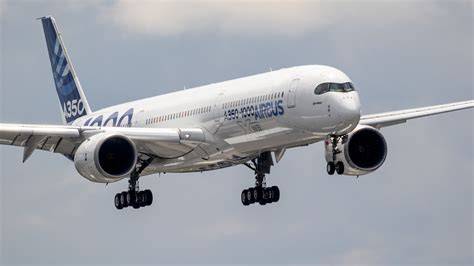
Airbus is reportedly studying a stretch of the A350-1000 that would bring capacity closer to the 777-9, with a programme decision expected before 2030, the same timeline the manufacturer has given for a potential A220 stretch. Several design questions remain. The most consequential is whether to re-engine the aircraft to preserve range, since the A350-1000’s engines are widely regarded as maxed out, or to retain the current engines and gross rating while accepting a range penalty. The answer will shape both development cost and the aircraft’s appeal.
There is also a competitive dimension. If Airbus launches a stretched A350, Boeing could respond with a stretched 777-10, a study it is actively pursuing with Emirates, potentially fragmenting the large widebody market still further. Crucially, both studies appear to be driven by customer requests rather than a bet on an empty market, which means the deciding question for Airbus is not whether a stretch would be impressive but whether developing one would earn more money than simply selling the current lineup. For now, the A350-1000 remains an outstanding people-mover, an exceptional ultra-long-haul machine and a strong replacement for ageing large widebodies, and the sidewall redesign has given Airbus a density option it did not previously offer. Whether airlines take that option in meaningful numbers, or keep the cabin nine abreast and wait for a stretch, is the question that will define the type’s next decade.