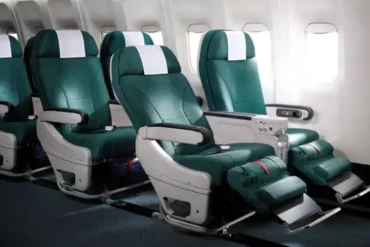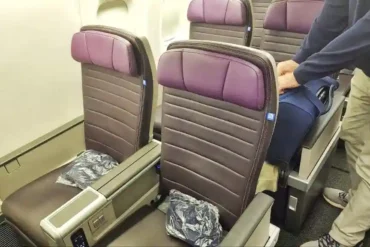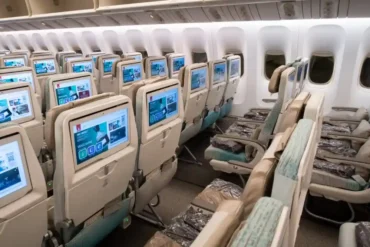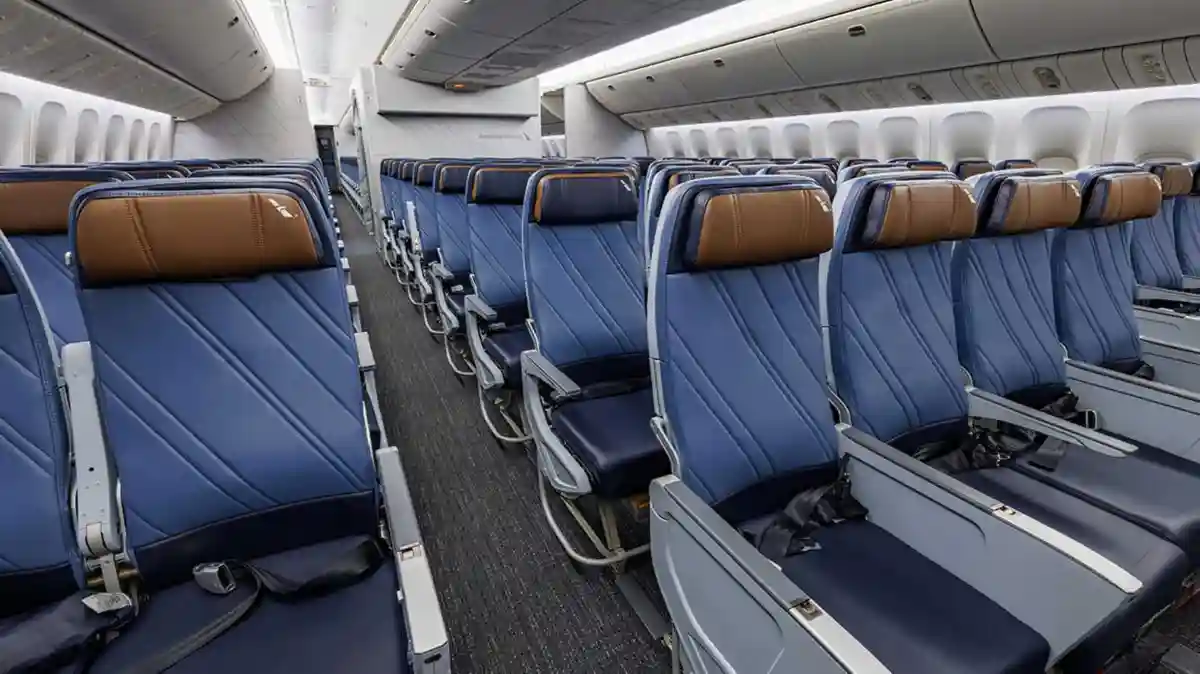
The 34-inch economy seat pitch was never a luxury specification; it was the quiet baseline of long-haul travel for decades, the measure that let a passenger cross an ocean without negotiating with the seat in front for every inch of knee room. Any traveler who flew international routes in the 1990s or 2000s will remember that geometry, even if they never knew its number: a row deep enough to slide a small bag beneath the seat ahead, enough clearance to straighten a leg mid-flight, and a recline that did not immediately collide with a laptop screen behind. That baseline has largely vanished. Across standard economy cabins on long-haul aircraft, 30 to 32 inches has become the working norm, with 30 and 31 inches now routine on many dense configurations flown by major carriers on routes where every seat must justify its square footage. The four inches surrendered between the old standard and today’s reality are not a rounding error; they are the physical difference between a seat that accommodates a body and one that merely contains it, and they have been repackaged, remarketed, and resold as the very thing premium economy exists to provide.
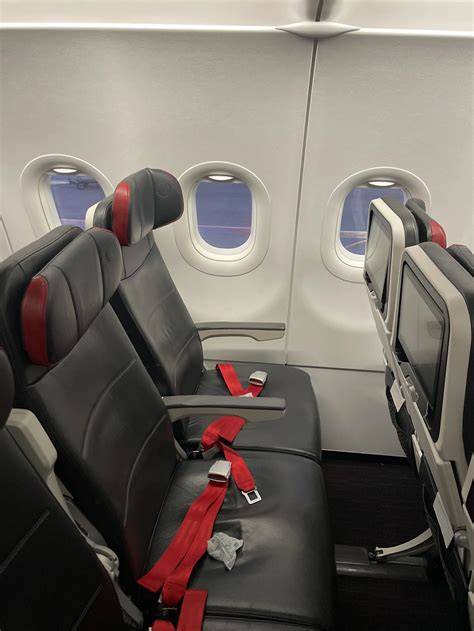
What 34 Inches of Pitch Actually Meant in the Standard Economy Era
Seat pitch is a technical measure, defined as the distance between a corresponding point on one seat and the same point on the seat in the row ahead or behind, and it is not identical to the unobstructed space a passenger’s knees actually receive. Seatback thickness, tray table housings, literature pockets, and under-seat entertainment boxes all consume part of that advertised figure, which is why two cabins quoting the same pitch can feel meaningfully different. Even accounting for that caveat, 34 inches of pitch functioned as a genuine comfort threshold. It allowed taller passengers to sit with their knees clear of the seatback for hours, gave shorter passengers room to shift weight and cross legs, and made the difference between sleeping in fragments and sleeping at all on an overnight sector. It was also a competitive signal: airlines advertised pitch in seat maps and brochures because travelers had learned to compare it, and carriers that trimmed it risked being called out in reviews and frequent-flyer forums.
The erosion happened gradually and then all at once. Aircraft reconfigurations introduced during fleet renewals, densification programs, and the pursuit of lower unit costs moved row spacing from the mid-thirties into the low thirties, and eventually to 30 and 31 inches on many long-haul narrowbody and widebody layouts. The change was rarely announced as a reduction in comfort. It was presented as part of a cabin refresh, a new seat generation with thinner backrests, or a schedule improvement, and because pitch figures are not regulated and are inconsistently published, many passengers discovered the change only after boarding. The result is a standard economy cabin in which the old baseline survives mainly as a memory, and in which the space that once came with an ordinary ticket is now the central selling proposition of a separate, more expensive fare class.
How Revenue per Square Foot Redesigned the Cabin Around Premium Economy
The explanation for the disappearing 34-inch row is not malice toward economy passengers; it is revenue per square foot, the metric that increasingly governs how airlines allocate the finite interior volume of an aircraft. Every inch of cabin space carries an opportunity cost, because a row that is made deeper is a row that cannot be sold, and a cabin that is configured generously is a cabin generating less revenue per departure than a denser alternative flying the same schedule. Airlines therefore model cabin layouts against operating costs, aircraft utilization, demand by fare class, and the willingness of different passenger segments to pay for specific attributes, and even small adjustments to row spacing and seat width ripple through the revenue equation for every flight in an aircraft’s rotation.
Business class makes the incentive unmistakable. A lie-flat seat can occupy two to four times the floor area of an economy seat while commanding a fare several times higher, and industry estimates place business class revenue at roughly four to five times that of economy on a per-square-foot basis. Premium economy occupies the middle of that curve, generating an estimated 1.8 to 2.4 times economy’s revenue for approximately 1.5 times the footprint. Those ratios explain why airlines increasingly optimize the mix of cabins rather than the raw count of passengers: selling fewer seats at substantially higher prices can outperform maximum capacity on routes where corporate travelers and affluent leisure passengers demonstrate strong willingness to pay for space, privacy, and schedule flexibility.
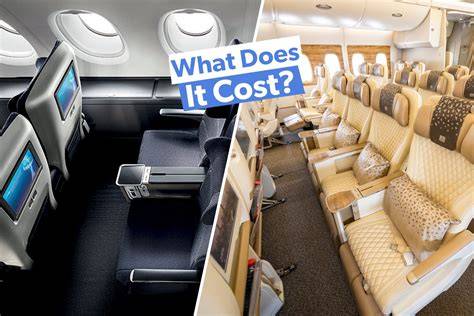
Why the Aircraft Interior Became a Barbell Instead of a Ladder
The commercial logic produces what analysts describe as a barbell-shaped cabin, with high-yield premium products clustered at one end and a densely configured economy cabin at the other, and a thinner middle where the traditional comfortable economy seat once lived. Business class captures passengers paying for privacy, lie-flat beds, lounge access, and priority service. Standard economy retains fare-sensitive travelers who compare total trip cost and accept the resulting geometry. Premium economy is positioned between them to capture the traveler willing to spend more than an economy fare but unwilling to pay for a flat bed, and it is precisely this middle tier that has absorbed the comfort that used to be standard. The pitch, width, and recline that define premium economy today are not novel inventions; they are approximations of what a conventional economy seat offered when 34 inches was ordinary.
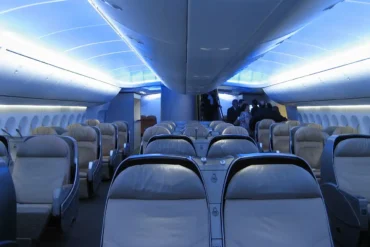
Aircraft geometry reinforces the trend. On a Boeing 787 Dreamliner, most carriers including American Airlines and United Airlines operate a 3-3-3 economy layout, while the wider Boeing 777 frequently accommodates an additional seat per row in a 3-4-3 arrangement, compressing width even where pitch is held constant. Thinner seat cushions and redesigned backrests claw back a fraction of the legroom that reduced pitch removes, but they cannot restore the sense of lateral and longitudinal space a passenger experiences, and they are not advertised as compensation. The physical result is a cabin that looks modern in photographs and feels tighter in practice, with the shortfall measured not in a single dramatic change but in four accumulated inches spread across every row.
Premium Economy as Yesterday’s Standard Economy, Sold at Today’s Premium Price
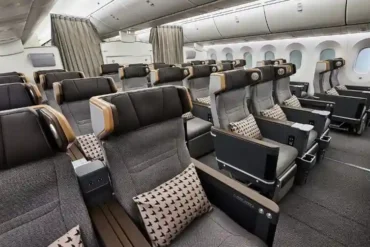
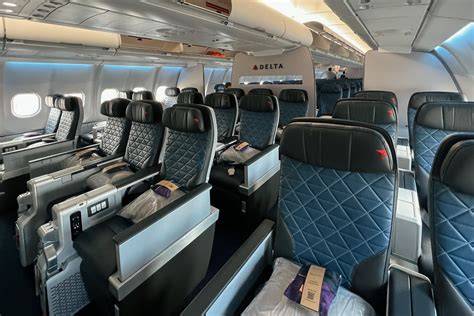
Premium economy began as a modest intermediate product: a wider seat, additional legroom, greater recline, earlier boarding, improved catering, and a quieter cabin, priced well below business class and well above the cheapest economy fare. Over time it hardened into a distinct revenue category rather than a collection of slightly better seats near the front of the cabin. On long-haul aircraft such as the Airbus A350, the product can include dedicated cabin sections, enhanced dining service, larger entertainment screens, priority baggage handling, and amenity kits, and the exact bundle varies considerably between carriers. The irony at the center of the category is that its headline benefit, a pitch in the mid-to-upper 30-inch range, places it close to the traditional expectations of ordinary economy seating rather than far beyond them.
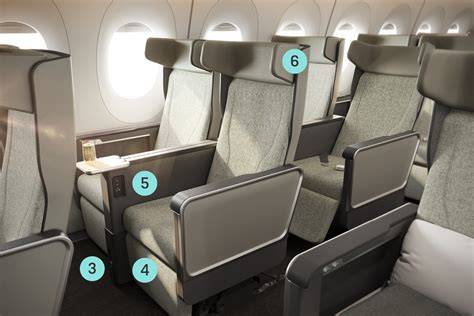
For airlines, the arrangement is elegant. Comfort can be monetized without raising the base fare for every passenger, because travelers who prioritize legroom purchase an upgrade while price-sensitive travelers remain in standard economy or choose a restricted entry fare. The same aircraft then serves multiple willingness-to-pay profiles on a single departure, and the cabin divider becomes a pricing instrument as much as a physical barrier. The cost of that elegance is borne by the passenger who books the default economy fare expecting the default economy experience and discovers that the experience they remember now requires selecting a different fare category at checkout.
The Financial Evidence That Premium Cabins Now Drive the Business
The financial scale of premium demand is no longer marginal. Delta Air Lines reported premium ticket revenue of approximately $6.82 billion in the third quarter of 2026, narrowly exceeding the $6.80 billion generated by its main cabin, a milestone that illustrates how central premium products have become to a major network carrier’s economics. A single quarterly result does not prove that every airline or route has crossed the same threshold, but it does demonstrate the direction of travel, and it explains why American Airlines and United Airlines continue to expand and differentiate premium-cabin offerings across their long-haul fleets. Capacity data reinforces the point: US premium seat capacity has grown 33% since 2020, compared with 16% growth for economy, meaning the fastest expansion in the cabin is occurring precisely where revenue per square foot is highest.
That asymmetry has a direct consequence for standard economy. When an airline adds premium rows, it removes economy rows from the same fuselage, and when it densifies the remaining economy cabin to preserve seat count, it reduces the pitch available to the passengers least able to pay for an upgrade. The two trends compound: fewer economy seats competing for the same demand, each with less space, while the comfort formerly included in the fare is relocated behind a premium label. Premium growth is therefore not simply adjacent to the shrinking economy seat; it is structurally connected to it.
Basic Economy Completes the Squeeze at the Bottom of the Fare Ladder
At the other end of the barbell, basic economy allows airlines to advertise aggressively low entry fares while stripping out benefits that a conventional economy ticket once included as standard. Depending on the carrier and itinerary, restrictions can cover advance seat selection, ticket changes and refunds, boarding priority, and carry-on or checked baggage allowances, turning the cheapest fare into a deliberately limited product with a clear upsell path. The strategy lets network carriers compete with low-cost rivals on advertised price without discounting every seat in the cabin, because travelers focused on cost can select the restricted fare while others pay more for flexibility, baggage, and the ability to choose where they sit.
Together, basic economy and premium economy create a steeper hierarchy inside a single aircraft. The stripped-down entry product sits at one end, the spacious premium product at the other, and standard economy occupies the middle with a less certain identity than it once had. Its traditional role as the reasonably comfortable default has been diluted by differentiated seating, variable legroom, and fare rules that determine what the ticket actually includes. This does not mean every carrier is uniformly reducing pitch on every aircraft, nor that all economy cabins are equally restrictive, but it does mean that cabin design and pricing segmentation have become inseparable, and that passengers now purchase a specific seat product rather than a general class of service.
What Passengers Should Verify Before Booking an Economy Seat
Comparing economy fares requires looking past the advertised price to the specific seat pitch, seat width, and fare restrictions attached to the itinerary. The cheapest fare can lose its advantage once seat selection fees, baggage charges, and change penalties are added, and a 30-inch pitch can feel materially more restrictive on an overnight flight than a 31- or 32-inch configuration on a daytime sector of similar length. Travelers who need legroom should check the published seat map for the aircraft actually assigned to the flight, because configurations vary within the same airline, the same aircraft family, and even the same route on different days.
Premium economy warrants equally close scrutiny. The label does not guarantee a consistent product: some cabins offer genuinely wider seats, deeper recline, dedicated service, and a quieter section, while others deliver a limited upgrade centered on extra legroom and a few amenities. Premium economy pricing can also function as a decoy, appearing attractive beside an expensive flexible economy fare while sitting surprisingly close to a discounted business class ticket that includes a lie-flat seat. Comparing all three cabins on pitch, width, baggage allowance, change flexibility, and total cost reveals whether the upgrade reflects genuine additional value or simply another carefully positioned price point in an increasingly segmented market. The seat that once came with an ordinary ticket has not disappeared; it has been renamed, relocated to a separate fare class, and priced accordingly, and the only reliable defense is to read the numbers before the cabin door closes.