Landing a commercial aircraft is rarely routine. Even under ideal conditions, a landing requires precise coordination between pilots, aircraft systems, terrain awareness, weather interpretation, and air traffic control. Yet some airports push these demands far beyond the ordinary. Around the world, a handful of runways have earned a reputation among aviators as places where skill, discipline, and nerve are tested on every approach.
What makes an airport truly difficult is rarely just one factor. In most cases, it’s a convergence of hazards: short runways, steep approaches, unpredictable winds, mountainous terrain, or highly congested airspace. Sometimes the runway itself is challenging. Other times, the complexity lies in the approach procedures required to reach it.
For pilots, these destinations represent some of the most technically demanding operations in aviation. Each successful landing is the result of meticulous preparation and training, often involving specialized certification before a crew is even allowed to attempt the approach.
High-Traffic Airspace: When Congestion Becomes the Challenge
Many of the world’s most demanding airports are not remote mountain strips but rather major international hubs surrounded by dense traffic corridors. In these environments, the challenge lies less in terrain and more in the complexity of airspace management.
A prime example is the cluster of airports around New York City. Within a relatively small area sit several of the busiest airfields in North America, including LaGuardia Airport, John F. Kennedy International Airport, Newark Liberty International Airport, and Teterboro Airport.
Aircraft arriving at these airports must follow narrow approach corridors that weave through layers of traffic, often requiring precise timing and constant communication with controllers. Deviations are limited, and pilots must maintain strict spacing while navigating complex arrival patterns.
One of the most famous procedures in this region is the Park Visual approach to Runway 31 at LaGuardia. Instead of relying purely on instruments, pilots follow visual landmarks along the East River before turning sharply toward the runway. While experienced aviators often enjoy the unique challenge, the maneuver demands heightened vigilance, particularly during heavy traffic periods.
Other airports around the United States employ similar visual approaches, such as the Potomac River approach into Ronald Reagan Washington National Airport or the stadium visual approach into Newark. These procedures illustrate that difficulty in aviation is not always about geography—sometimes it is about choreography in the sky.
Mountain Operations: Aspen’s Demanding High-Altitude Runway
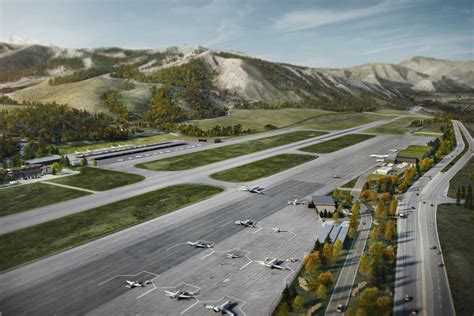
Deep in the Rocky Mountains lies one of the most famous challenging airports in North America: Aspen–Pitkin County Airport.
Serving the elite ski resort town of Aspen, this airport sits 7,820 feet above sea level, placing it among the highest commercial airports in the United States. High elevation dramatically affects aircraft performance. Thin air reduces engine power and wing lift, forcing pilots to operate with carefully calculated weight limits and performance margins.
The geography around Aspen complicates matters even further. The airport is nestled within a steep mountain valley, and surrounding peaks limit approach paths. Aircraft typically land on Runway 15 and depart from Runway 33, following carefully designed procedures that keep aircraft clear of nearby terrain.
Because of these constraints, the Federal Aviation Administration requires special pilot certification to operate flights into Aspen. Not every airline crew can simply schedule a flight there; they must undergo additional training that focuses on steep descent profiles, precise navigation, and strict go-around procedures.
Only a limited set of regional aircraft types are approved for operations at Aspen, including the Bombardier CRJ-700 and Embraer E175. Larger aircraft would struggle with the combination of altitude, runway length, and terrain constraints.
For pilots, Aspen represents a fascinating blend of mountain flying and commercial operations, where every landing requires exact planning and flawless execution.
Madeira’s Infamous Turn: Cristiano Ronaldo International Airport
Few airports combine dramatic scenery with demanding flight procedures as spectacularly as Cristiano Ronaldo International Airport in Portugal.
Located on the island of Madeira in the Atlantic Ocean, this airport sits between towering mountains and open sea, a geographic arrangement that creates powerful and unpredictable wind conditions. The single runway—05/23—features one of the most unusual approaches in commercial aviation.
While Runway 23 allows for a relatively standard instrument landing system approach, Runway 05 requires something entirely different. Due to surrounding terrain, aircraft cannot simply line up with the runway from miles away. Instead, pilots must fly past the airport and perform a tight 180-degree visual turn before aligning with the runway for final descent.
The maneuver occurs at relatively low altitude and often in gusty crosswinds. Timing, speed control, and precise positioning are critical. A small misjudgment can force a go-around, sending the aircraft climbing back out over the ocean before attempting the approach again.

These conditions once gave Madeira an intimidating reputation among pilots. Over the years, runway extensions and improved procedures have enhanced safety, but the airport still demands special training certification before crews are allowed to land there.
For those who master the approach, however, the experience is unforgettable. Pilots frequently describe the arrival into Madeira as one of the most visually stunning landings anywhere in Europe.
St. Barts: A Short Runway With Almost No Margin for Error
Few runways in the world look as dramatic—or intimidating—as the one at Gustaf III Airport, commonly known as St. Barts Airport.
The runway measures only 2,119 feet (646 meters) in length, far shorter than what most commercial aircraft require. Even regional jets would struggle to operate safely here. Instead, the airport is limited to smaller turboprop aircraft, with the De Havilland DHC-7 being one of the largest planes capable of using the runway.
What makes the approach especially unusual is the terrain immediately before the runway. Aircraft descending toward Runway 10 must pass just above a steep hilltop, often only a few dozen feet overhead, before dropping sharply onto the runway.
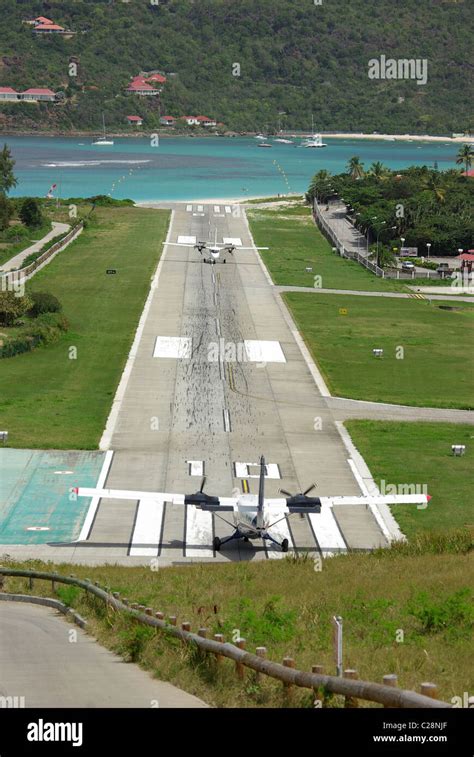
Beyond the runway lies a beach and the open Caribbean Sea, leaving almost no room for error during landing. The lack of an instrument landing system means pilots must rely entirely on visual approaches supported by PAPI lights, which help guide the correct descent angle.
Because of the steep descent profile and short landing distance, pilots undergo specialized training and certification before flying into St. Barts. The reward is one of the most breathtaking arrivals in aviation—an approach that feels almost cinematic as aircraft skim low above tropical hills before touching down.
Paro International Airport: Bhutan’s Legendary Valley Approach
In the Himalayan kingdom of Bhutan lies another airport known for its extreme landing challenges: Paro International Airport.
Situated 7,332 feet above sea level in a deep valley surrounded by Himalayan peaks exceeding 18,000 feet, Paro is widely considered one of the most demanding commercial airports in the world.
Unlike most major airports, Paro lacks an instrument landing system. Instead, pilots must navigate visually through a winding valley using a series of geographic checkpoints. During the approach, aircraft pass between steep mountains, follow the contours of the valley, and execute a sharp turning maneuver just before final alignment with the runway.
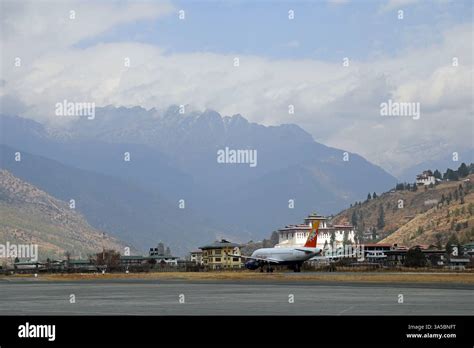
Weather conditions further complicate the approach. Strong valley winds can develop rapidly, and visibility may change quickly due to shifting cloud layers in the mountains. As a result, flights into Paro operate only during daylight hours under visual meteorological conditions.
Only a handful of pilots worldwide are certified to land here. The primary airlines serving Paro—Drukair and Bhutan Airlines—require extensive training and supervised practice before allowing captains to conduct independent operations.
For travelers, the approach offers an extraordinary aerial tour of Bhutan’s dramatic landscape. For pilots, it remains a true test of precision flying.
Lukla Airport: The Runway Beneath Mount Everest
Among aviation enthusiasts, few airports are as legendary—or as intimidating—as Tenzing–Hillary Airport, often referred to simply as Lukla Airport.
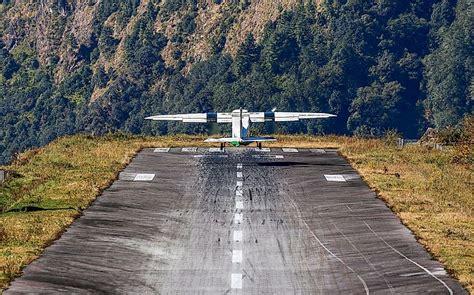
Located near the gateway to Mount Everest, this small airstrip sits at 9,337 feet above sea level. The runway measures just 1,729 feet (527 meters) and features a striking 12 percent uphill gradient.
This steep slope actually helps aircraft slow down after landing, but it introduces another complication: there is no possibility of a go-around once the landing is committed. High terrain rises directly beyond the runway’s far end, leaving pilots with only one realistic option—land successfully.
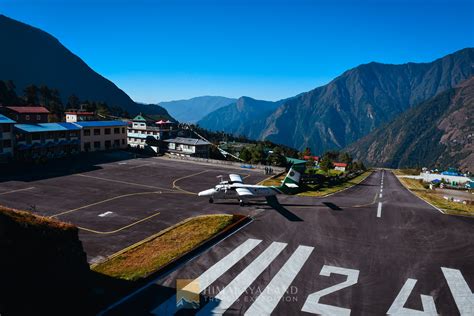
Approaches must be flown into Runway 06, while departures occur from Runway 24. Weather in the region is notoriously unpredictable, with clouds, fog, and shifting winds frequently disrupting operations.
Pilots flying into Lukla must have extensive experience in short takeoff and landing techniques, as well as specialized training specific to the airport. Even with these qualifications, flights are sometimes delayed for hours—or days—waiting for safe conditions.
Despite the difficulty, Lukla remains a vital lifeline for trekkers and mountaineers heading toward Everest Base Camp.
Why These Airports Continue to Challenge the World’s Best Pilots
The airports highlighted here illustrate the diverse reasons an airfield can be difficult. Some are surrounded by mountains that force aircraft through narrow valleys. Others feature short runways that leave little margin for error. Still others sit inside crowded airspace where dozens of aircraft must move with perfect coordination.
What they all share is a requirement for extraordinary preparation and discipline. Pilots must study specialized procedures, practice complex approaches in simulators, and remain constantly aware of terrain, weather, and aircraft performance.
Yet these airports also showcase the remarkable capabilities of modern aviation. Every successful landing demonstrates the effectiveness of training, aircraft design, navigation systems, and global safety standards.
For passengers, the experience might simply feel like a scenic descent or a dramatic landing. For the pilots in the cockpit, however, each arrival represents a carefully calculated ballet of precision and professionalism—the kind that keeps aviation safe even in the most demanding corners of the world.