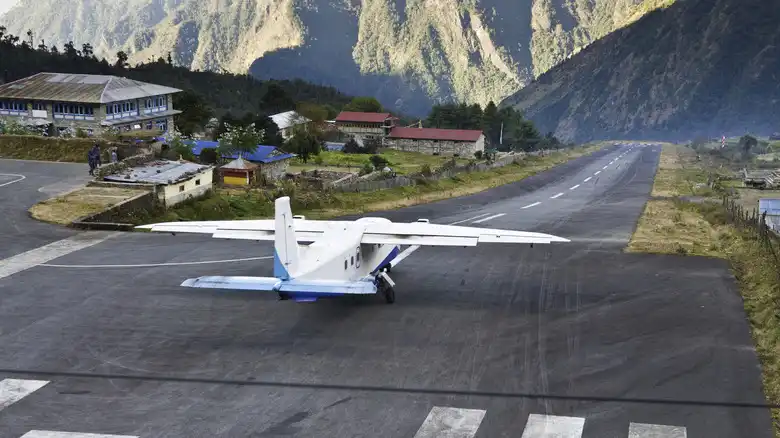
Perched precariously among the Himalayan peaks, Tenzing-Hillary Airport, better known as Lukla Airport, has earned its reputation as the world’s most dangerous airport. At 9,334 feet above sea level, this gateway to Mount Everest demands precision, courage, and very specific aircraft capabilities. Unlike international hubs designed for large jets, Lukla can only accommodate a small class of STOL (Short Take-Off and Landing) aircraft, whose performance is tailored to extreme conditions. The reason is not only the altitude but also the geography and weather that combine to make this runway one of aviation’s ultimate tests.
The Unique Challenges of Lukla Airport
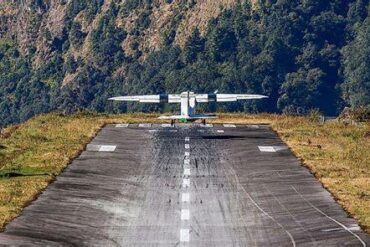
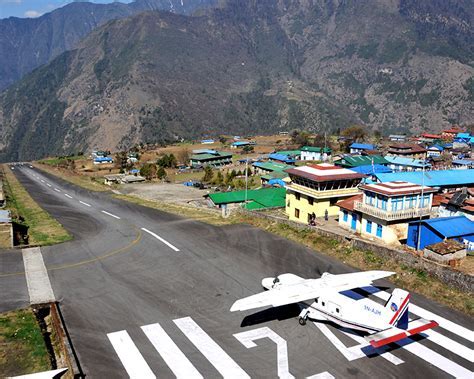
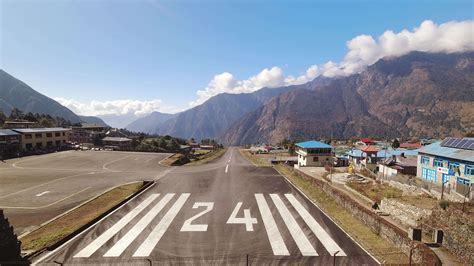
What makes Lukla so formidable is a convergence of factors. The airport is literally carved into the mountainside, with the runway sloping upward at a 12% incline to help slow planes upon landing. Yet this design also creates immense difficulty for takeoffs, as aircraft must gain speed quickly while ascending. To one side of the runway lies a sheer drop into the valley, while the other end abruptly meets a solid rock wall. There is no room for error, no chance of a go-around. Pilots must commit fully to every landing attempt, knowing that hesitation could end in disaster.
Complicating matters further is the thin air at high altitude. The reduced oxygen impacts both engine performance and aerodynamic lift, forcing planes to operate with less thrust and lift than they would enjoy at sea level. Meanwhile, unpredictable Himalayan weather frequently cloaks the region in fog, sudden storms, or turbulent winds, often grounding flights for hours or even days. Together, these elements make Lukla one of the most technically demanding destinations in global aviation.
Why Commercial Jets Cannot Operate at Lukla
Most passengers are accustomed to commercial runways stretching between 8,000 and 13,000 feet, with some mega-airports like Denver International or Shigatse Peace Airport exceeding 16,000 feet. In stark contrast, Lukla’s strip measures only 1,729 feet—a fraction of what is required for large commercial jets such as the Boeing 737 or Airbus A320. The short runway alone disqualifies these aircraft, as they cannot safely stop or accelerate within that distance, especially under high-altitude conditions.
Beyond length, the geographic constraints of Lukla render it unsuitable for modern jets. Wide-body or even narrow-body commercial aircraft require clear approach paths and wide maneuvering areas, yet Lukla’s runway is hemmed in by towering Himalayan ridges. The surrounding peaks effectively block the kind of descent and climb gradients required by heavier planes. Safety regulations also prohibit these aircraft from attempting such landings, as the risks far outweigh the logistical benefits.
The Aircraft That Can Land at Lukla
Because of these restrictions, only a select group of STOL aircraft are cleared to use Lukla. These planes are lightweight, highly maneuverable, and engineered for extreme short-field performance. They rely primarily on manual piloting rather than complex autopilot systems, giving pilots direct control in the most challenging scenarios.
The most common aircraft at Lukla include:
- De Havilland Canada DHC-6 Twin Otter – A rugged, twin-engine turboprop renowned for its reliability in remote conditions. Its ability to take off and land on incredibly short strips has made it the backbone of Nepalese mountain aviation.
- Dornier Do 228 – A German-built twin-turboprop designed for tough regional routes, capable of handling steep approaches and short runways with surprising agility.
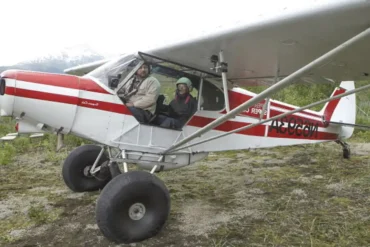
- Pilatus PC-6 Porter – Though less common, this single-engine utility aircraft is known for its exceptional STOL capabilities, often used in high-altitude airstrips worldwide.
- Let L-410 Turbolet – A Czech-built twin-engine STOL commuter aircraft, which has occasionally served the Lukla route under Nepalese operators.
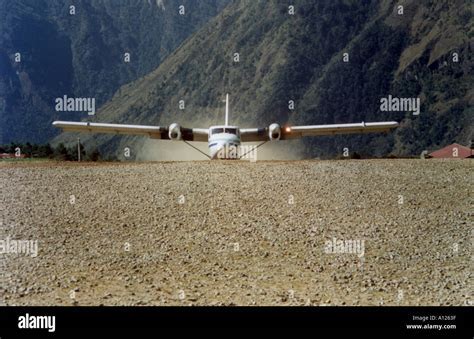
These aircraft typically carry between 15 and 20 passengers, a stark contrast to the hundreds aboard larger jets. Flights from Kathmandu to Lukla take about 30 minutes, but for many passengers, this short hop is the most memorable—and terrifying—leg of their entire Everest journey.
The Role of Pilots: Skill and Nerve
If the aircraft themselves are specialized, the pilots flying them are even more so. A standard commercial airline captain cannot simply transfer into Lukla operations. Nepalese aviation authorities require pilots to undergo extensive training before being certified to land at the airport. This includes numerous supervised flights, repeated simulator training under adverse conditions, and demonstration of flawless technique in both takeoff and landing procedures.
Pilots must memorize the exact approach corridor, as the surrounding mountains leave only one possible path in and out. Unlike conventional airports where a missed approach is standard safety practice, Lukla does not allow for second chances. The pilot must commit fully or abort the attempt entirely, diverting back to Kathmandu. This reality explains why flights are frequently canceled or delayed if conditions are not perfect.
Weather as the Final Arbiter
Despite the technical prowess of both planes and pilots, weather ultimately dictates flight schedules. Lukla lies in a region where meteorological conditions can shift within minutes. Morning skies may appear clear, only to be swallowed by clouds by midday. Winds rushing down narrow valleys can create violent turbulence, while sudden fog banks reduce visibility to near zero. Even minor weather shifts can make landings unsafe, forcing pilots to turn back.
For trekkers headed toward Everest Base Camp, this unpredictability is part of the adventure. Many expeditions build buffer days into their itineraries precisely because flights to and from Lukla are never guaranteed. Delays of a few hours are routine; cancellations of several days are not uncommon. This further underscores the reality that Lukla is not just an airport but a test of patience, endurance, and adaptability.
Accidents and Safety Measures
The dangers of Lukla are not theoretical. The airport has witnessed multiple fatal accidents over the decades, often linked to weather or misjudged approaches. The combination of a short runway, sheer drop-offs, and shifting winds leaves almost no margin for error. However, increased safety protocols in recent years, along with stricter pilot certification, have improved outcomes. Today, only the most experienced pilots are entrusted with Lukla flights, and operations are tightly regulated by Nepalese authorities.
Runway surface upgrades, stricter flight windows, and ongoing pilot assessments all contribute to keeping operations as safe as possible under inherently risky conditions. Still, Lukla remains one of the few airports in the world where flying is never routine.
Lukla’s Role in Himalayan Aviation
For all its challenges, Lukla is indispensable. As the primary gateway to Everest Base Camp, it supports not only trekkers but also local communities, medical evacuations, and cargo deliveries. Without air access, the journey from Kathmandu would require several days of rugged overland travel through mountainous terrain. For many residents of the Khumbu region, Lukla is not just an airport—it is a lifeline.
The airport’s official name, Tenzing-Hillary Airport, honors the first climbers to summit Everest in 1953. Its symbolic status underscores its role in modern mountaineering, tourism, and regional survival. Despite the risks, it continues to function daily, bridging the gap between Nepal’s capital and the remote Himalayan world.
Conclusion: A Runway Like No Other
Only a small family of STOL aircraft—backed by pilots of extraordinary skill—can land at what is universally regarded as the world’s most dangerous airport. The combination of thin air, unpredictable weather, a runway shorter than a football field, and sheer cliffs on either end make Lukla a place where aviation is pushed to its limits. It is a reminder that even in the modern age of wide-body jets and global air travel, there remain airports where raw piloting skill and specialized aircraft define survival.
For those who fly in, the journey is equal parts exhilarating and terrifying, a dramatic prelude to the Himalayas themselves. For the aviation world, Lukla stands as the ultimate symbol of how geography, weather, and human determination collide in the skies.