New York City has always understood the power of arrival. For more than a century, ships, trains, and aircraft have delivered ambition to its shores. Today, travelers think of JFK International Airport, LaGuardia Airport, and Newark Liberty International Airport as the region’s aviation triumvirate. Yet long before these names defined the skyline’s invisible highways, another airfield claimed the mantle of the city’s primary gateway. That airfield was Floyd Bennett Field, and its story reads like a parable of American progress—bold, improvised, and constantly reinvented.
In the early 1930s, when aviation still felt like a dare rather than a routine commute, Floyd Bennett Field stood at the edge of Brooklyn as a declaration of modernity. It was New York’s first municipal airport, purpose-built, paved in concrete, and bristling with steel hangars that gleamed against the marshy margins of Jamaica Bay. The city had decided it would no longer rely on scattered private airstrips or distant fields on Long Island. If New York was to lead the world in finance, culture, and industry, it would also lead in the sky.
That ambition was not abstract. It was fueled by spectacle. Charles Lindbergh’s 1927 transatlantic flight from Roosevelt Field electrified the public imagination and exposed a civic embarrassment: New York lacked a proper airport within its own limits. The message was unmistakable. Aviation was no longer a carnival trick; it was infrastructure. And so, in 1928, city officials approved the construction of a municipal airfield that would embody durability, technical confidence, and metropolitan pride.
The Birth of Floyd Bennett Field: A Municipal Airport Built for the Future
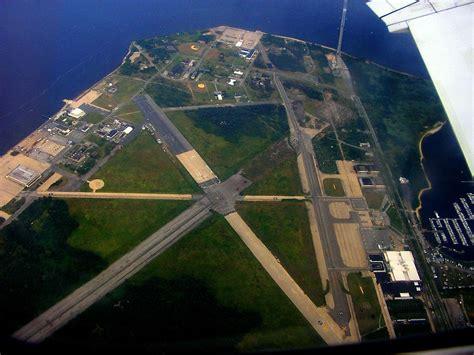
Construction began on a windswept, marshy island along the southeastern edge of Brooklyn in the Marine Park neighborhood. Engineers reshaped the landscape with landfill, dredge spoil, and rubble, transforming tidal flats into a geometric grid of concrete runways. Unlike the grassy strips common in the era, Floyd Bennett Field featured paved runways, a deliberate statement that New York intended to compete with Europe’s rapidly modernizing aviation hubs.
The airport officially opened in 1931 and was named after naval aviator Floyd Bennett, who had flown with Admiral Richard Byrd on pioneering polar expeditions. The name carried symbolic weight. Aviation was exploration, science, and national prestige all wrapped into one. To land at Floyd Bennett Field was to participate in that forward thrust.
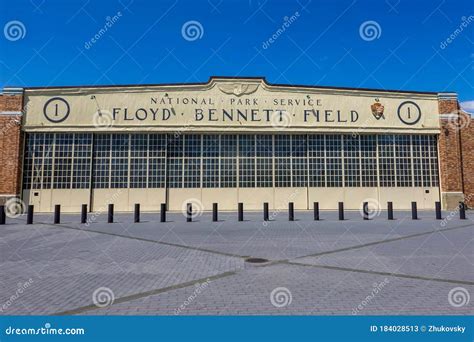
The design reflected this seriousness of purpose. Large steel hangars lined the field, capable of housing the era’s largest aircraft. A formal terminal building anchored the complex, giving passengers a sense of ceremony. Even in its infancy, the airfield was engineered not as an afterthought but as a cornerstone of urban identity.
A Brief Moment of Dominance in New York Aviation
In its first years, Floyd Bennett Field pulsed with activity. During just the latter half of 1931, it recorded more than 25,000 landings by commercial and military aircraft combined. By 1933, it surpassed Newark Airport in total arrivals and departures, briefly claiming the distinction of being one of the busiest airports in the United States by flight volume.
The airfield quickly gained a reputation as a prime departure point for long-distance and transatlantic attempts. In 1932, the city’s Department of Docks described it as “the most desirable American field as an ocean hop terminal.” Between 1931 and 1939, twenty-six around-the-world or transatlantic flights either began or ended at Floyd Bennett Field. Record-breaking aviators, endurance pilots, and headline-chasing adventurers gravitated toward its concrete runways.
The 1930s were an era when aviation records were cultural events. Pilots were celebrities, and their aircraft were mechanical protagonists in a global drama of speed and distance. Floyd Bennett Field became a stage for that drama. The roar of radial engines over Jamaica Bay signaled more than takeoffs; it announced technological audacity.
Yet dominance in flight volume did not translate into commercial prosperity. Here the story pivots, and the pivot reveals a fundamental truth about infrastructure: access matters as much as ambition.
Why Floyd Bennett Field Never Became a Commercial Powerhouse
Geography proved both a blessing and a constraint. The airfield’s location on Brooklyn’s southeastern fringe placed it far from Manhattan’s commercial core. In an era before expressways and rapid transit links to remote airports, the journey to Floyd Bennett Field was cumbersome. Airlines, already operating on thin margins, were reluctant to commit to regular passenger service without reliable ground connections and lucrative airmail contracts.
Airmail revenue was the lifeblood of early commercial aviation. Without it, scheduled passenger routes struggled to survive. Floyd Bennett Field failed to secure a significant airmail contract, and that omission reverberated through its commercial prospects. By the end of 1934, the airport had served only fifty-two airline passengers. For a city of millions, that number was more symbolic than substantial.
American Airlines briefly operated a shuttle to Boston. Seaplane services attempted to bridge the gap to Manhattan. Neither effort gained lasting traction. Most commercial and mail aircraft that used the field likely did so only when Newark was unavailable. The city, pragmatic and restless, shifted its focus toward a new airport in Queens. That project would become LaGuardia Airport, and later, the expansion of Idlewild—renamed John F. Kennedy International Airport—would permanently reconfigure New York’s aviation hierarchy.
Floyd Bennett Field had demonstrated technical prowess and hosted aviation history, but it had not secured the commercial ecosystem required for sustained dominance. Airports, like organisms, thrive when logistics, location, and policy align. Here, they did not.
A Golden Age for General Aviation and Record-Breaking Flights
If commercial airlines hesitated, aviators did not. Throughout the 1930s, Floyd Bennett Field flourished as a center for general aviation—a term that encompasses private flying, record attempts, and non-scheduled operations. Its modern infrastructure and unobstructed approaches made it ideal for ambitious departures.
The field hosted numerous aviation “firsts,” endurance flights, and speed records. Competitive events such as the Bendix Cup featured prominently, turning the airfield into a proving ground for aircraft performance and pilot stamina. Civilians could even take flying lessons, weaving the romance of flight into the city’s social fabric.
The proximity to the Atlantic Ocean added practical allure. Long-distance flyers preparing for transoceanic journeys valued the immediate access to open water routes. The airport became a crucible for experimentation, a place where risk and aspiration intersected on concrete.
But history rarely allows a single role to endure unchanged. As global tensions escalated in the late 1930s, the strategic value of airfields along the East Coast became unmistakable.
Naval Air Station New York: Military Transformation During World War II
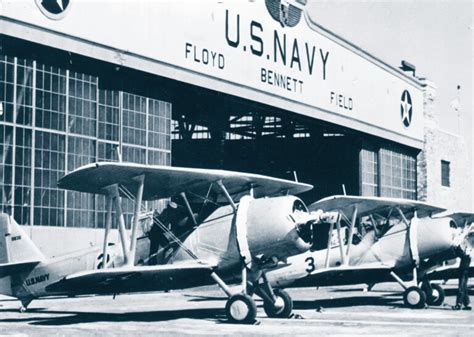
In 1941, as the United States edged toward entry into World War II, the Navy formally assumed control of Floyd Bennett Field, converting it into Naval Air Station New York. The shift was decisive. What had been a municipal gateway became a military asset.
The base supported Navy and Marine aviation units, training flights, patrol missions, and reserve operations. Aircraft that once carried record-chasing civilians now served national defense. Hangars echoed with the disciplined routines of wartime aviation rather than the improvisational energy of pioneering flights.
After the war, the installation was redesignated as a Naval Air Reserve Training Station in 1946 before returning to full Naval Air Station status as Cold War tensions intensified. For decades, military aircraft continued to operate from the field. The site’s strategic coastal location and existing infrastructure made it a durable component of the nation’s defense network.
This period lasted until 1971, when the Navy decommissioned the facility. The departure marked the end of nearly four decades of sustained military aviation at the site. For the first time since 1931, Floyd Bennett Field faced an identity vacuum.
From Airfield to Gateway National Recreation Area
Post-military uncertainty invites creativity—and conflict. Proposals surfaced to convert Floyd Bennett Field back into a civilian airport. The idea was ultimately dismissed. The surrounding airspace had grown crowded, dominated by operations at JFK Airport, making fixed-wing commercial revival impractical.
In 1972, a different vision prevailed. Floyd Bennett Field was incorporated into the newly established Gateway National Recreation Area, a sweeping initiative by the National Park Service to preserve and repurpose significant waterfront lands around New York Harbor. The site reopened to the public as parkland in 1974.
The transformation was not an erasure but an adaptation. Many original buildings, including hangars and the terminal, were preserved and later designated as part of a historic district on the National Register of Historic Places. Visitors could walk through structures once animated by propellers and pilots, now recontextualized as architectural artifacts.
Today, the field remains active in selective ways. The New York City Police Department maintains a helicopter base on-site. Portions of the runway system are used by hobbyists flying model aircraft. In 2023, a temporary shelter for migrants and asylum-seekers was established at the field, underscoring how infrastructure continues to serve evolving civic needs.
Airports are designed for transit, for motion. As a national park, Floyd Bennett Field has become a space for pause.
Grasslands, Birdwatching, and Urban Ecology at Floyd Bennett Field
Perhaps the most unexpected chapter in Floyd Bennett Field’s story is ecological. The airport was constructed atop reclaimed marshland near the mouth of Jamaica Bay. During its operational years, large grass areas between runways were maintained through regular mowing. When aviation ceased in 1971, maintenance stopped. Nature, patient and opportunistic, began reclaiming the terrain.
In 1985, the National Park Service partnered with the NYC Bird Alliance to restore approximately 130 acres of grassland habitat. Trees were selectively removed, and mowing resumed—not for aircraft safety, but to preserve ecological conditions favorable to grassland birds. What had once been buffer zones for runways became rare urban habitat.
Species such as the Savannah Sparrow now nest there. Seasonal visitors include Grasshopper Sparrows, Bobolinks, and American Woodcocks. In winter, hawks roost in nearby pine groves, and Snowy Owls have been spotted perched along runway fence lines. Across Jamaica Bay, nesting ospreys and egrets complete a tableau that would have astonished the airport’s original engineers.
The North Forty section, near the model airplane area, leads to Return-A-Gift Pond, where warblers and herons can be observed along quiet trails. The juxtaposition is striking: concrete runways stretching toward the horizon, framed by reeds and birdcalls. The geometry of human ambition now hosts ecological resilience.
A New Vision: Innovation and Coastal Resilience
The story is not finished. In partnership with the National Park Service and the Science and Resilience Institute at Jamaica Bay, the Jamaica Bay-Rockaway Parks Conservancy has unveiled plans to transform portions of the site into a center for environmental innovation. Historic Hangars 3 and 4 are being revitalized to house a Center for Innovation in Nature-Based Solutions and Restoration.
Spanning approximately 50,000 square feet of interior space, the facility aims to address coastal resilience challenges—flooding, biodiversity loss, and rising urban heat—through applied ecological science. The language of the future here is not takeoff clearance but restoration metrics, scalable methods, and measurable impact.
There is a poetic symmetry in this evolution. An airfield born of technological optimism now hosts research designed to protect the fragile margins of a changing climate. The site’s vast open space, once essential for safe landings, now offers room for environmental experimentation and public engagement.
Floyd Bennett Field no longer dominates New York’s skies. Instead, it anchors a different kind of leadership: a model for adaptive reuse. The arc from municipal airport to naval air station to national park illustrates how infrastructure can be repurposed without being forgotten. Concrete and grass coexist. Hangars become laboratories. Runways frame bird habitats.
In a city defined by relentless reinvention, Floyd Bennett Field stands as a reminder that dominance is temporary, but transformation can be enduring. The airport that once symbolized New York’s aviation ambition now embodies its capacity for renewal—a national park where history, ecology, and innovation share the same horizon.