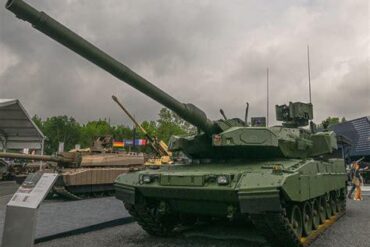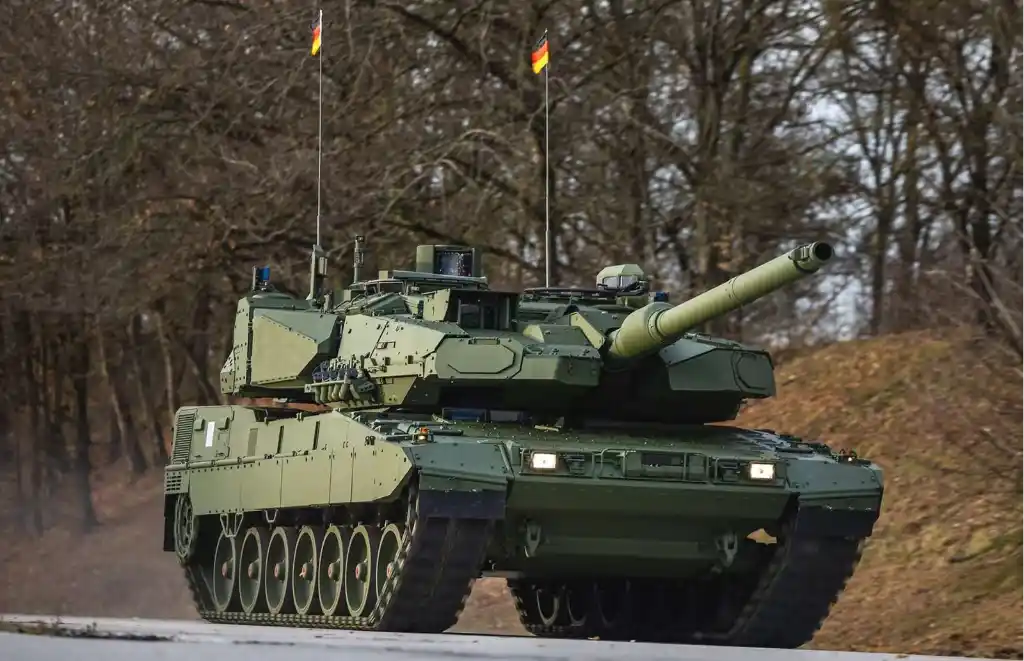
Germany has officially unveiled the Leopard 2A8, a next-generation main battle tank (MBT) that symbolizes a monumental leap in armored warfare capability for both the Bundeswehr and NATO allies. With a focus on advanced survivability, digitization, and lethality, the Leopard 2A8 emerges as the most modern iteration in the storied Leopard family. As Europe confronts a new era of geopolitical tension, this tank is not merely a piece of military hardware—it is a strategic statement.
A Historic Return to Full-Scale Tank Production
On 19 November 2025, Germany rolled out its first newly built Leopard 2A8 from the KNDS plant in Munich. This event marked Germany’s first full-production tank built for its own forces since 1992, reinforcing Berlin’s commitment to revitalize its land forces under the strategic doctrine of Zeitenwende—a turning point in defense policy.
The initial order includes 123 Leopard 2A8s, with deliveries scheduled between 2027 and 2030. The first recipient will be Panzerbrigade 45, Germany’s permanently deployed brigade in Lithuania, located at NATO’s eastern frontier. Additionally, German Defense Minister Boris Pistorius has signaled the procurement of 75 more units, projecting a total Leopard 2A8 fleet of at least 430 main battle tanks by the end of the decade. This decision aligns with NATO’s collective objective of strengthening interoperability and heavy armor readiness in Eastern Europe.
Evolution of a Legend: From Leopard 2 to 2A8
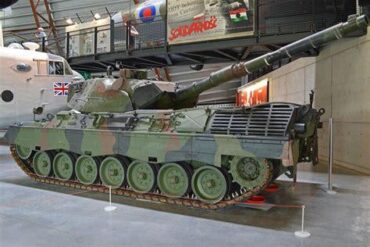
The Leopard 2 has undergone a remarkable evolution since its introduction in the late 1970s. From early models like the 2A1 with analog systems to the urban-optimized 2A7V, each variant has brought significant upgrades in fire control, armor, and battlefield adaptability.
The Leopard 2A8, however, is a defining leap—it retains the classic four-man crew and chassis but introduces a fully digital architecture, advanced active protection systems (APS), and next-generation network integration, placing it squarely in the top tier of “Gen 3+” MBTs globally.
Firepower: Precision and Overmatch
At its core, the Leopard 2A8 is equipped with the Rheinmetall 120 mm Rh-120 L55A1 smoothbore gun, capable of firing the latest DM73 kinetic energy penetrators and DM11 programmable HE rounds. These munitions allow engagements at distances up to five kilometers, providing substantial overmatch against legacy tanks and hardened fortifications.
Supporting armament includes:
- Coaxial 7.62 mm machine gun
- Roof-mounted 7.62 mm secondary MG
- Multi-barrel smoke grenade launchers for obscuration and soft-kill defense
These integrated systems enable the 2A8 to dominate across open terrain and urban settings, delivering lethal firepower with extreme precision.
Unparalleled Protection: Passive and Active Defense
One of the most significant upgrades in the 2A8 is its comprehensive survivability suite, designed with insights from recent conflicts such as the war in Ukraine. The tank features:
- Modular composite armor on hull and turret
- Strengthened roof plating against top-attack munitions
- Enhanced underbody protection for mine resistance
- Integrated Trophy APS, the first wide-scale deployment in Bundeswehr service
The Trophy system, developed by Rafael, includes four radar arrays and dual interceptor launchers that create a hemispheric shield around the tank, neutralizing incoming ATGMs (Anti-Tank Guided Missiles) and drone-launched munitions before impact.
Additional defensive layers include laser warning receivers, NBC (nuclear, biological, chemical) overpressure protection, and internal spall liners, ensuring the crew remains protected under a spectrum of battlefield threats.
Digitization: A Network-Centric Battlefield Asset
What truly distinguishes the Leopard 2A8 is its transition into a digitally-native MBT. Every subsystem—from power distribution to fire control—is now part of a unified digital backbone. This includes:
- Digital Fire Control System (FCS) with fused day/night thermal imagery
- 360-degree situational awareness through optical and infrared feeds
- Commander’s panoramic periscope with integrated laser rangefinder
- Simplified gunner controls and centralized displays
This digital ecosystem enhances crew efficiency, enabling faster threat detection, engagement, and coordination. The system supports live-fire data recording for post-mission review, significantly improving unit-level training and tactical refinement.
Mobility and Endurance: Power for the Future
The Leopard 2A8 remains powered by the proven MTU MB 873 Ka-501 diesel engine, delivering 1,500 hp through a Renk HSWL 354 transmission. While retaining a top speed of 60 km/h and a range of 400 km, the A8 grows in combat weight to approximately 69.5 tons, reflecting its enhanced armor and equipment.
New power management systems include:
- 20 kW Auxiliary Power Unit (APU) for silent watch operations
- Ultracapacitor stabilization for electrical surge resilience
- Dedicated 10 kW cooling unit for crew comfort in hot environments
These upgrades ensure the tank can function effectively in extended deployments and maintain full combat readiness without reliance on the main engine.
Dimensions and Crew Configuration
Despite its upgrades, the Leopard 2A8 maintains its recognizable form:
- Hull length: 8.05 m (11.17 m with gun)
- Width: 3.8 m
- Height: 2.72 m (turret roof)
- Ground clearance: 50 cm
The crew configuration continues to follow the traditional four-man setup: commander, gunner, loader, and driver—a deliberate choice to preserve training continuity and enable seamless integration with older Leopard variants across allied forces.
Strategic Implications and NATO Alignment
Beyond technical specifications, the Leopard 2A8 represents a critical strategic asset for NATO. Its deployment to Panzerbrigade 45 in Lithuania reinforces NATO’s eastern flank and signals Germany’s revived leadership role in collective defense.
Combined procurement from NATO allies underscores this further:
- Germany: 123 confirmed, 75 pending
- Lithuania, Netherlands, Czechia: 134 combined
- Norway and Croatia: also adopting the standard
With at least 257 Leopard 2A8s committed across Europe, the tank is quickly becoming the standard heavy armor platform for NATO’s future battlefield.
Comparative Edge Among Peer MBTs
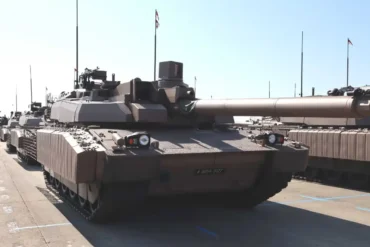
The Leopard 2A8 comfortably leads the “Gen 3+” MBT class. While competitors such as the M1A2 SEP v3, Leclerc XLR, and Challenger 3 offer comparable enhancements, the A8 stands out for its diesel efficiency, digital-native architecture, and APS integration.
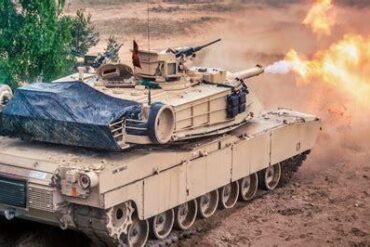
- M1A2 SEP v3: Equipped with Trophy APS but burdened by gas turbine fuel demands
- Leclerc XLR: Lighter, three-man crew, but limited by older base chassis
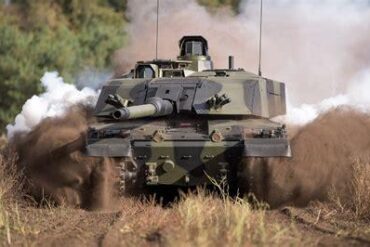
- Challenger 3: Shares L55A1 gun but relies on deep retrofits of legacy platforms
The Leopard 2A8, by contrast, is a from-scratch production vehicle, built with modularity and long-term adaptability in mind.
Bridging to the Future: Leopard 2AX and MGCS
Germany’s unveiling of the Leopard 2A8 is not the end of the line. It serves as a bridge platform to the forthcoming Leopard 2AX/”Leopard 3″ and the joint Main Ground Combat System (MGCS) project with France. These next-gen platforms will likely incorporate new weapon systems, hybrid propulsion, and advanced AI-enabled battle networks.
Yet for the next two decades, the Leopard 2A8 will anchor Germany’s heavy armor doctrine. Its robust mechanics, modern sensors, and digital combat systems ensure it can counter emerging threats, whether from drone swarms, ATGMs, or electronic warfare.
Conclusion: A Defining Milestone in Modern Warfare
The Leopard 2A8 is more than a tank; it is a symbol of Germany’s rearmament, a pillar for NATO interoperability, and a formidable battlefield asset capable of shaping 21st-century conflict dynamics. By marrying proven engineering with cutting-edge protection and digital warfare capabilities, Germany has not only modernized its armored corps but also redefined the gold standard in European main battle tanks.
As the geopolitical climate continues to evolve, the Leopard 2A8 stands ready to lead.